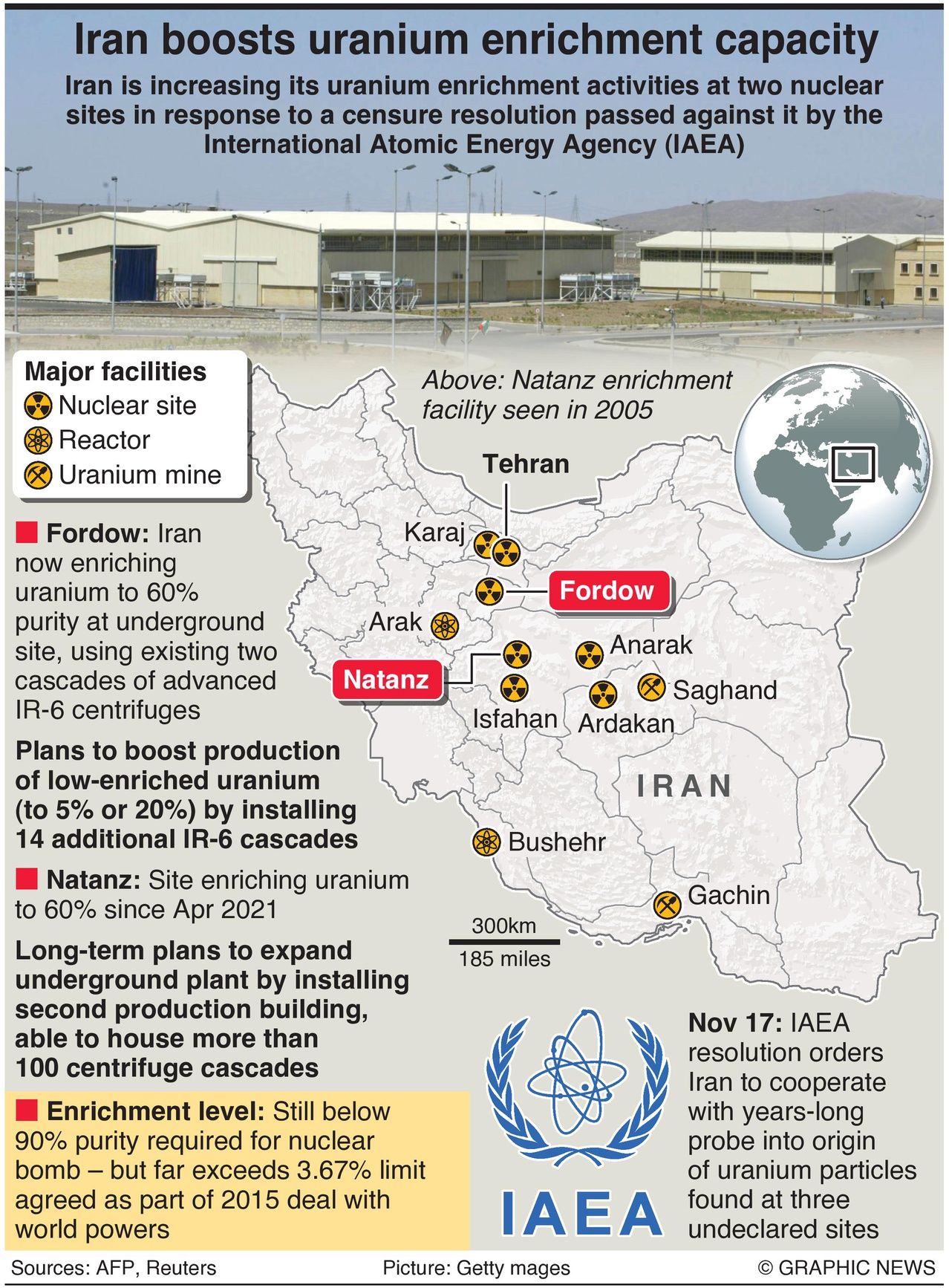
Just a week ago, under Secretary of Defense for Policy, Colin Kahl said that the U.S. now believes that Iran can produce “one bomb’s worth of fissile material” in “about 12 days.” That is the shortest “breakout time” assessment ever put forward by the U.S. administration on Iran’s nuclear capabilities.
The assessment comes after a confidential report by the International Atomic Energy Agency confirmed that uranium particles enriched to 83.7% had been found in Iran’s Fordow Fuel Enrichment Plant, an underground nuclear facility. Uranium enriched to 90% is considered weapons grade. The report also states that Iran’s hoard of 60% enriched uranium is now estimated to be 87.5 kilograms. That is an increase of 25.2 kg from the agency’s last quarterly report.
While these reports raised the alarm and drew condemnation, a diplomatic overture may be turning the tide, though it is early days yet.
The International Atomic Energy Agency (IAEA) Director-General, Rafael Grossi, said that his two-day visit to Tehran had brought forth “concrete” commitments from the Iranian regime. He said that Tehran had agreed to more inspections and to reconnect surveillance cameras at several nuclear sites in the country.
The IEAE chief returned to Vienna after high-level meetings with senior officials, including Iran President Ebrahim Raisi, Minister of Foreign Affairs Hossein Amir-Abdollahian, and Vice-President and President of the Atomic Energy Organization of Iran (AEOI) Mohammad Eslami.
Even as many expressed reservations on whether President Raisi’s government will follow through on the assurances given, Grossi asserted that beyond mere “promises,” he had secured “certain agreements which are concrete.”
After Washington unilaterally withdrew from the JCPOA and instituted a policy of “maximum pressure,” the international agency was denied access to Iran’s nuclear facilities to “monitor activities in relation to the production and inventory of centrifuges, rotors and bellows, heavy water and uranium ore concentrate (UOC).”
Grossi told the media, “Also in January at the Fordow fuel enrichment plant, we found particles of high enriched uranium with enrichment levels well beyond the enrichment level declared by Iran. The Agency and Iran have initiated technical discussions to fully clarify this issue.” Iran is said to have agreed to inspections at the Fordo underground plant, where uranium particles enriched to near weapons grade were found.
The latest “concrete” assurances save Iran from another resolution criticizing the country’s nuclear program at the Board of Governors meeting of the Vienna-based IAEA. Tehran’s willingness to cooperate with the international body and reinstate safeguards on its nuclear programs may also help to revive the Joint Comprehensive Plan of Action (JCPOA), also known as the Iran Nuclear Deal. Should Tehran follow through and international monitoring resume, the world will have a clearer picture of what Iran has achieved since the nuclear deal breakdown.
But the assessment that Tehran is mere days away from a nuclear weapon has rattled one of the nation’s foes – Israel, a country it does not share geographical borders with. Prime Minister Benjamin Netanyahu has made no secret that Iran’s nuclear power ambitions are unacceptable and considers a nuclear-powered Iran an “existential threat.”
Israel has a history of conducting preemptive strikes on nuclear facilities in countries it perceives as threatening its national security. In 1981, Israeli warplanes destroyed the Osirak nuclear reactor in Iraq. Tel Aviv, a nuclear power in its own right, has been accused of carrying out similar strikes in other countries, including Iran and Syria. In 2007, Israeli warplanes allegedly bombed a nuclear reactor in Syria that was being constructed with North Korean assistance. More recently, Israel has been accused of several attacks on Iranian nuclear facilities, including a 2021 attack on the Natanz nuclear facility.
Israel’s actions have drawn international criticism, even as Prime Minister Netanyahu maintains that it is well within his country’s right to pre-empt an attack. But, Israel’s history of cross-border strikes prompted Grossi to caution, “International law from the Geneva Protocols in 1949 and thereafter and several resolutions of the general conference of the IAEA: attacks on nuclear facilities are illegal, are a violation of the UN Charter.”
The covert hostilities between Iran and Israel go back decades. Many fear that matters may come to a head if Iran achieves nuclear weapon capability. With the U.S. embroiled in saving Ukraine from Russia, it is unlikely that Israel would get much support from the Biden administration for an open war. Plus, the dynamics in the region are too fragile and dependent on multiple factors to predict how events may shape up.
Israel-Arab world relations are complicated. Tel Aviv has normalized diplomatic relations with some Arab countries, including the United Arab Emirates, Bahrain, Sudan, and Chad. But, some Arab countries still do not recognize Israel’s right to exist. Support for Palestine is strong among Muslim nations.
Iran, too, has complicated relations in the region. While many Arab nations condemn Iran’s nuclear pursuits, some have accused it of meddling in their domestic affairs and inciting factional fighting. Despite the tensions, Tehran does enjoy historical ties with the Arab world. Another Tehran ally, Russia, has grown closer after Iran refused to condemn Moscow’s war against Ukraine. Iran has provided the Russian army with kamikaze drones that explode on impact in the Ukraine war theatre. There are reports that Russia may supply arms to Iran and help Tehran pursue its nuclear ambitions.
Grossi commented that he is always committed to finding diplomatic solutions over military ones is heartening. The world cannot afford another war, especially not one with nuclear weapons in the fray. For the sake of peace, let us hope Grossi’s endeavors bear fruit.
Related:
TIPP Picks
 Daily Caller News Foundation

TIPP Staff
Daily Caller News Foundation
TIPP Staff
TIPP Takes
Geopolitics And Geoeconomics
#1. Ukraine’s President Volodymyr Zelenskyy Vows Not To Retreat From Bakhmut – A.P.
In his nightly video address, the president reported that his advisers unanimously agreed to press on with the fight, “not to retreat,” and to bolster Ukrainian defenses.

His top adviser, Mykhailo Podolyak, said Ukrainian forces around Bakhmut have been grinding down enemy forces, reinforcing their positions, and training tens of thousands of Ukrainian military personnel for a possible counteroffensive.
Intense Russian shelling has targeted the city and nearby villages over the past week as Moscow wages a three-sided assault to try to finish off Bakhmut’s resistance.
#2. Ukraine Demands Investigation After Video Appears To Show Russians Killing POW – RFE/RL
“The shooting of a captured Ukrainian serviceman is a violation of the Geneva Conventions,” Dmytro Lubinets, the Ukrainian parliament’s human rights commissioner, wrote on Telegram.

The video shows an unidentified, detained Ukrainian soldier standing in a trench being shot dead with automatic weapons after saying, “Glory to Ukraine.”
#3. Xi Jinping Aide Who Oversaw 2-Month Lockdown To Be China’s Next Premier – Reuters
Four years before Li Qiang gained notoriety as the force behind the two-month Covid lockdown of Shanghai, the man set to become China’s next premier worked quietly behind the scenes to drive a bold revamp of the megacity’s sclerotic stock market.

Previously the Communist Party chief in Shanghai, Li is poised to be confirmed as premier on Saturday during the ongoing National People’s Congress, charged with managing the world’s second-largest economy.
He would replace the retiring Li Keqiang, widely perceived to have been increasingly sidelined as Xi tightened his grip on the management of the economy.
#4. U.S.-China Relations Have Seriously Deviated, New Foreign Minister Qin Gang Says – BBC
China’s foreign minister says U.S.-China relations have “seriously deviated” while warning of potential conflict.

“Containment and suppression will not make America great. It will not stop the rejuvenation of China,” said Qin Gang.
Mr. Qin, China’s former ambassador to the U.S., held his first press conference as foreign minister on Tuesday.
#5. China Blames Ukraine Crisis On ‘Invisible Hand’ – Al Jazeera
The “invisible hand” is “using the Ukraine crisis to serve certain geopolitical agendas,” China’s FM Qin Gang said.

He spoke at a press conference on the sidelines of the country’s annual parliamentary meeting in Beijing, without specifying whom he was referring to.
He called for dialogue to begin as soon as possible.
China’s position on the Ukraine war has come under renewed scrutiny in recent weeks amid its deepening relationship with Moscow and concern in Western capitals that it cannot be an honest broker in any potential peace talks when it has refused to name Russia as the aggressor in the conflict.
#6. Canada To Probe Alleged Chinese Election Interference – D.W.
Canadian Prime Minister Justin Trudeau announced the appointment of an independent special investigator to investigate the alleged Chinese interference in Canadian elections.

Trudeau’s announcement came after Canadian media, citing unidentified intelligence sources, reported on Beijing’s alleged attempts to meddle in the 2019 and 2021 federal elections.
Canadian media had reported that China preferred to see Justin Trudeau’s Liberal Party retain power leading Beijing to work against the Conservative Party in federal elections.
#7. Taiwan: Tsai-McCarthy Meet Switched To U.S. From Taiwan, Reports Say – RFA
A highly anticipated but also sensitive meeting between the U.S. House Speaker Kevin McCarthy and Taiwan’s President Tsai Ing-wen is reportedly to take place in California instead of Taiwan.

The change comes after Tsai “convinced” the U.S. side of China’s possible angry response.
McCarthy’s predecessor Nancy Pelosi made a historic visit to Taiwan in August 2022, the first by a Speaker of the U.S. House of Representatives in 25 years. China responded by staging a week-long multi-branch military exercise around the island.
According to the latest reports, President Tsai will visit the Americas in early April.
#8. Israeli Attack Puts Syria’s Aleppo Airport Out Of Service: Report – Al Jazeera
According to Syrian state media, Israel launched an air raid on Syria’s Aleppo airport, damaging its runway and taking it out of service.

The SANA news agency said the missile attacks occurred early on Tuesday morning. There was no comment from Israeli officials.
Israel has carried out hundreds of air attacks for almost a decade against suspected Iranian-sponsored weapons transfers and personnel deployments in neighboring Syria. Still, it rarely acknowledges or discusses the operations.
#9. Iran’s Khamenei Calls Girls’ Poisoning ‘Unforgivable’ After Public Anger – Reuters
Iran’s supreme leader said that the poisoning schoolgirls is an “unforgivable” crime that should be punished by death if deliberate, amid public anger over a wave of suspected attacks in schools.

Authorities have accused the Islamic Republic’s “enemies” of using the attacks to undermine the clerical establishment. But suspicions have fallen on hardline groups operating as self-declared guardians of their interpretation of Islam.
In Washington, President Joe Biden’s press secretary called the poisonings shameful.
#10. North Korea Warns U.S. Against Shooting Down Its Missile Tests – Al Jazeera
North Korea has said that any move to intercept and shoot down its test missiles would be considered “a declaration of war.”

The statement by Kim Yo Jong, the powerful sister of North Korean leader Kim Jong Un, cited a South Korean media report that said the United States planned to shoot down Pyongyang’s intercontinental ballistic missiles (ICBMs) if the weapons were test-launched toward the Pacific Ocean.
The U.S. and its allies have never shot down North Korean ballistic missiles — typically launched at steep angles to avoid neighboring countries — but the question has drawn new scrutiny since Pyongyang suggested it would fire more missiles over Japan.
#11. Japan’s New Flagship H3 Rocket Launch Fails, Ordered To Self-Destruct – Kyodo News
The launch failed after several delays, including one last month in which a launch attempt was aborted moments before blastoff at the Tanegashima Space Center.

The latest setback may also lead to calls for an overhaul of Japan’s space strategy under which the H3, the first revamp of its main launch vehicle in around 20 years, was expected to give the country a foothold in the increasingly competitive satellite launching business.
#12. Saudi Arabia Deposits $5 Bln In Turkey’s Central Bank: Statement – Reuters
Saudi Arabia has signed an agreement with Turkey to deposit $5 billion in the country’s central bank through the Saudi Fund for Development (SFD), the fund said.

While Turkey’s net foreign exchange reserves rebounded from just over $6 billion last summer, when it was at its lowest in at least 20 years, they have lost some $8.5 billion since a massive earthquake hit the country’s southern region early in February that killed more than 45,000 people and left millions homeless.
The Saudi deposit follows joint efforts by Ankara and Riyadh to mend ties.
#13. Iraq’s ‘Theft Of The Century’: Investigators Say Kadhimi’s Office At Heart Of Plot – Middle East Eye
The investigative committee probing the theft of $2.5bn from an Iraqi state bank account has concluded the office of former prime minister Mustafa al-Kadhimi was instrumental in the conspiracy, a report seen exclusively by Middle East Eye reveals.

The Parliamentary Fact-Finding Committee was formed in late October after the crime, dubbed by Iraqi media the “theft of the century,” became public.
The committee’s final report was submitted over the weekend and found that several former prime minister’s team members had “facilitated the theft” while in office and helped smuggle the stolen money out of the country.
#15. ‘Patriarchy Is Fighting Back…So Are We’: Gender Equality Is Still 300 Years Away, Says UN – WION
Global progress on women’s rights is “won over decades (is) vanishing before our eyes,” said United Nations chief Antonio Guterres.

He warned that gender equality remains a distant goal. Speaking during a speech ahead of International Women’s Day on March 8, he said, “Gender equality is growing more distant. On the current track, UN Women puts it 300 years away.”
Ticking off a litany of abuses that women face, such as maternal mortality, child marriage, girls being denied education, and more, he said that “women’s rights are being abused, threatened, and violated around the world.”
Republished with permission from TIPP Insights