President Joe Biden’s economic policies have recently found strong support within his own Democratic Party and among the big media. Yet, despite the push by Biden’s most ardent supporters, a majority of average voters disagree that the president’s policies are turning the economy around, according to the latest I&I/TIPP Poll.
The president in recent weeks has maintained that his economic policies are “turning things around” and “delivering for the American people,” and has made other comments intended to boost support for Bidenomics.
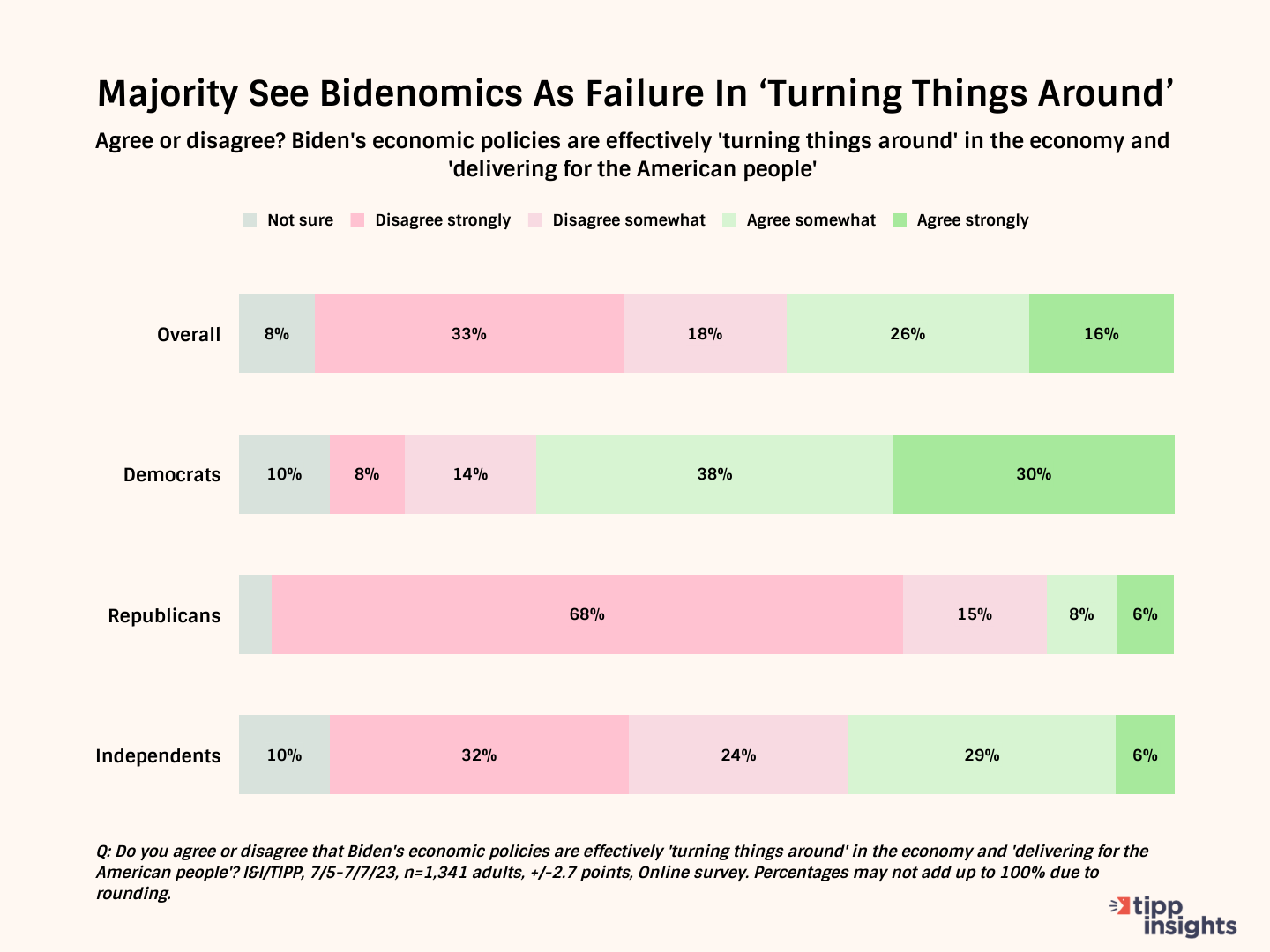
But by 51% to 42%, Americans disagree with those assessments, based on the online I&I/TIPP Poll, taken July 5-7 from 1,341 adults. The poll has a margin of error of +/-2.7 percentage points.
Among the majority, 33% said they disagreed “strongly,” while just 18% said they disagreed “somewhat.” Results were weaker for the minority opinion, with just 16% saying they agreed “strongly” that Biden’s policies were turning things around, while 26% said they only “somewhat” agreed.
Once again, the political chasm is wide. For Republicans, 83% disagreed that Biden’s policies were working, while just 14% agreed. Independents came in with 56% disagreeing, 35% agreeing. Only Democrats were enthused about Biden’s stewardship, with 68% agreeing that his policies were working while 22% disagreed.
But politics wasn’t the only dividing line. Blacks and Hispanics, by 56% to 37%, agreed Biden’s economic plans were working. For white Americans, responses were a near mirror image to that: Just 34% agreed, 58% disagreed.
Another interesting split emerged by age, with younger Americans far more likely than older ones to see Bidenomics as a nascent success.
For example, those 18-24 split, as 51% agreed and 37% disagreed. And among those 25-44, the numbers were fairly similar: 50% agree to 42% disagree. But those 45-64 (33% agree, 59% disagree), and 65 and over (35% to 58%) viewed Biden’s policies as a failure.
How can it be that different age groups see the economy so differently?
Well, for one, they are at different places in the economic lifecycle, which provides a different perspective depending on where one is on the continuum. Those who are younger still have an entire work and earning career ahead of them.
For older Americans, many living on fixed incomes, recent bouts of inflation have been devastating, cutting into their standards of living. As TIPP Insights recently noted, since Biden entered office, overall inflation has soared 16%, as measured by TIPP’s proprietary CPI data.
But prices for food and energy, which affect all consumers, have soared by 18.9% and 33.1%, respectively, since Biden took office, with real average weekly earnings declining for 26 of 29 months. On the brighter side, June was the first month since March 2021 that real average weekly earnings rose.
Nor is inflation a thing of the past. It’s still with us, and will be until we get a series of year-over-year readings close to the Fed’s long-term 2% inflation target.
“Demand for labor continues to outstrip supply, firms are still hiring and raising compensation while companies find relative ease in passing price increases to customers,” noted Alyce Anders of Bloomberg Markets.
Biden talks a lot about helping the beleaguered middle class, which as a group saw its standard of living upended in recent years.
“Yet it is precisely those people who’ve been hurt most: With wages rising slower than prices, the average American family, in effect, has lost $10,000 under Biden,” as the New York Post recently observed.
At the same time, the fiscal side of the economy has been devastated by two and a half years of runaway government spending, leaving a gaping $1 trillion annual hole in the nation’s budget that can be filled only in the future by massive spending cuts, enormous tax hikes, or more damaging inflation.
As Issues & Insights recently noted, citing a just-released Congressional Budget Office report:
The topline number is that the federal deficit so far this fiscal year has already topped $1.4 trillion, which is $875 billion higher than the same months last year and bigger than the deficit for all of fiscal year 2022.
The CBO finds that overall spending this year is running 10% higher than last year. At the same time, revenues are down 11% compared with last year, which defies claims by the administration that the economy is strong.
Meanwhile, the fiscal hole from entitlement spending and pandemic shutdowns only gets bigger, helping to swell government spending as a share of the entire economy by 40% over the next two decades, according to recent projections.
The Social Security program will run out of money to pay its promised benefits in 2033, while Medicare will run dry in 2031, new forecasts by the trustees for both programs show. That’s a year earlier than predicted just last year.
So, after nearly three years marked by disastrous inflation and a sharp economic contraction, there’s a reason why Americans are now questioning boldly optimistic economic prognostications emanating from the White House. And why the scandal-plagued president has now become the second-most unpopular president in modern history.
Or, as the Bill Clinton campaign used to say, “It’s the economy, stupid.”
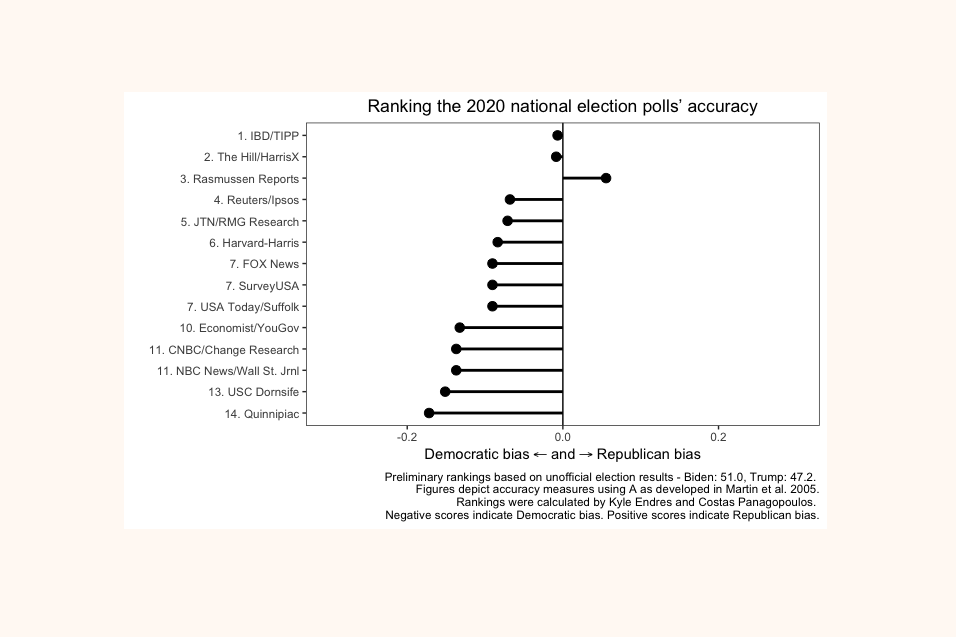
I&I/TIPP publishes timely, unique, and informative data each month on topics of public interest. TIPP’s reputation for polling excellence comes from being the most accurate pollster for the past five presidential elections.
Terry Jones is an editor of Issues & Insights. His four decades of journalism experience include serving as national issues editor, economics editor, and editorial page editor for Investor’s Business Daily.
Hey, want to dig deeper? Download data from our store for a small fee!
Our performance in 2020 for accuracy as rated by Washington Post:
Like our insights? Show your support by becoming a paid subscriber!
TIPP Picks
Must Watch/Read – Selected by tippinsights Editorial Board
1. IAEA Confirms Mines Near Zaporizhzhia Plant – D.W.
The International Atomic Energy Agency (IAEA) Director General, Rafael Grossi, said that the IAEA team had discovered “some mines located in a buffer zone between the site’s internal and external perimeter barriers” during an inspection.

“Our team has raised this specific finding with the plant, and they have been told that it is a military decision and in an area controlled by the military,” Grossi said.
2. UN Chief Urges Russia To Revive Grain Deal, Warning ‘The Most Vulnerable’ Will Suffer – Euronews
UN Secretary-General Antonio Guterres appealed during a speech in Rome at the opening of a three-day food summit.

He lamented that there are already negative effects on global wheat and corn prices. Wheat prices have risen more than 14% since Monday, when Russia pulled out of the grain deal, and corn prices are up more than 10%.
3. U.S. Condemns Ukraine’s Drone Attacks On Moscow – Reuters
The White House said it did not support attacks inside Russia after being asked about two drones from Ukraine that damaged buildings in Moscow early on Monday.

Russia vowed to take harsh retaliatory measures against Ukraine, calling the drone strikes, including one close to the Defence Ministry’s headquarters, a brazen act of terror.
4. U.S. Blacklists Officials Who Helped Wagner Group Enter Mali – UPI
The Biden administration has blacklisted three Malian military officials accused of ushering the Russian mercenary Wagner Group into the West African nation.

The private military has been accused of committing human rights abuses and war crimes, including killings and torture, in the African nations where its personnel operate.
5. Xi Orders Strengthening Party Control Of Armed Forces In Wake Of Russia’s Wagner Mutiny – Tibetan Review
In the aftermath of the recent short-lived mutiny in Russia by the Wagner Group, China has made a series of moves to further strengthen party control over the armed forces.

President Xi Jinping called a meeting of the country’s top brass to strengthen the Party building work in the armed forces and ordered them to renew their efforts to eliminate corruption.
He also called on them to reassert the Communist Party’s absolute leadership over the armed forces.
6. China’s Cambodia Base Nears Completion, Fearing U.S. Naval Power – Financial Times
According to satellite imagery, China has made significant progress in building the Ream Naval Base in Cambodia and is close to completing a pier that could berth an aircraft carrier.

Images taken by BlackSky, a U.S. commercial imagery company, show a nearly complete pier strikingly similar in size and design to a pier the Chinese military uses at its only overseas base in Djibouti.
7. China’s Youth Unemployment Crisis Spurs Trend Called ‘Full-Time Children’ – WION
It means that full-grown individuals get paid a salary by their parents to be their children “full-time.” They hang out with their parents, take them shopping, help around the house, etc.

In China, youth unemployment has become a serious challenge for the nation’s economy, battered by its stringent “zero-Covid” restrictions.
As per Lu Xi, an assistant professor at the Lee Kuan Yew School of Public Policy at the National University of Singapore, the wave of unemployment in China “may have just begun.”
8. North Korea Invites Chinese Delegation As 1st Known Foreign Guests Since Pandemic – Yonhap
North Korea said it had invited a Chinese party and government delegation as part of commemorations for the 70th anniversary of the armistice of the Korean War.

This is the first known case of North Korea inviting foreign guests to the country since it closed all borders in 2020 to contain the pandemic, though cargo transportation partially resumed between North Korea and China last year.
9. Israel Judicial Reform: Crowds Confront Police As Key Law Passed – BBC
Israeli police clashed with crowds of protesters at night after parliament adopted a highly controversial law to limit the Supreme Court’s powers.

The measure – part of a big reform package – will prevent the court from overruling unreasonable government actions.
Critics say the hard-right government’s reforms threaten Israeli democracy.
10. Marriage Of Convenience: Isolated Russia And Iran Bond Over Shared Animosity To West – Al Arabiya
Iran and Russia have been gradually strengthening their ties, forging a deeper strategic partnership that has implications for their bilateral relations, regional dynamics, and international geopolitics.

One significant factor is the shared interest in countering common adversaries and challenges. Consequently, they have found it beneficial to cooperate and support each other in the face of economic and political pressure from the West.
11. U.S. Sends Second Nuclear-Powered Submarine To South Korea – D.W.
A second U.S. submarine, the USS Annapolis, arrived in South Korea following the recent deployment of the first U.S. nuclear-armed submarine in the country in four decades.

The USS Kentucky had arrived at a port in Busan on the mainland about a week ago. The move is seen as a part of the two allies’ joint effort to counter North Korea’s nuclear threats.
12. North Korea Tests 2 Short-Range Ballistic Missiles – Kyodo News
North Korea launched two short-range ballistic missiles into the sea off its east coast late Monday, South Korea and Japan said, as tensions remain high over Pyongyang’s frequent weapons tests.

The latest launches came after the U.S. submarine Annapolis made a port call at Jeju Island, South Korea, as part of apparent efforts by Washington and Seoul to strengthen deterrence in the region.
13. U.N. Command, NKorea In Talks Over U.S. Soldier – AFP
The United Nations Command has started a conversation with Pyongyang over United States soldier Travis King, who ran across the border into North Korea last week, its deputy commander said.

The UN Command is a U.S.-led multinational force that oversees the Korean War truce. The two Koreas remain technically at war because the 1950–53 conflict ended in an armistice, not a peace treaty.
14. North Korea Says ‘No End’ To Bolstering Military Power Ahead Of Key Anniversary – Yonhap
“There can be no end to strengthening military power,” Rodong Sinmun, the country’s main newspaper, said in its editorial, stressing that such a goal should be carried out more swiftly and ceaselessly “at any cost.”

The statement is seen as an apparent attempt to justify the development of its nuclear and missile programs ahead of a key anniversary this week.
15. Taliban Visits Indonesia In Attempt To Gain Global Recognition – Nikkei Asia
A mid-level Taliban delegation visited Indonesia this month “to improve relations” between Afghanistan and the world’s most populous Muslim nation, a Taliban source said.

The visit, said analysts, was an attempt by the Taliban to gain support for international recognition and court foreign investment in Afghanistan to shore up its ailing economy, among the poorest in the world.
16. Europe, U.S. Heat Waves ‘Virtually Impossible’ Without Climate Change – AFP
In the new rapid analysis of the scorching temperatures, scientists from the World Weather Attribution group found that the heatwaves in parts of Europe and North America would have been almost impossible without climate change.

With tens of million people affected in the northern hemisphere and July on track to be the hottest month globally since records began, experts warn that worse is to come unless we reduce planet-heating emissions.
Please email [email protected]
Republished with permission from TIPP Insights