Beijing, or more accurately, the Chinese government seated in the historic city, does not deign it necessary to explain its actions to its citizens, let alone foreigners. Questions are not welcome; curiosity is not entertained in China.
Sacking the Foreign Minister, the face of the country on the world stage, without an explanation was bound to raise concern. But then, that’s of little concern to the Communist Party of China.
The former Foreign Minister Qin Gang remains in the State Council, adding to the puzzle. In China, state councilors outrank cabinet ministers. So, at least for now, Qin is within the Communist Party’s fold, though out of the foreign ministry. This fact raises even more questions about why the seasoned diplomat thought to enjoy the President’s backing “disappeared” after just 207 days in office.
The Chinese government is proficient at making high-profile persons “disappear”– from the public and digitally. Such instances are often preceded by public criticism or accusations of corruption. Those who go “missing” “come back” later without explanations or excuses. It is another of Beijing’s quirks that people are resigned to as the establishment is shrouded in secrecy.
Besides, China has staunchly stuck to a policy of “non-interference in domestic affairs” of others. Beijing has often reiterated that it expects the same courtesy. Beyond respect and consideration for other governments and their modus operandi, this principle of non-interference is used to ignore human rights violations, autocratic rule, and myriad other wrongdoings.
While this has helped Beijing forge alliances and advance its interests in lucrative fields, it also keeps one of President Xi’s cherished dreams out of his reach – becoming a global power with clout at par or more than that of the U.S.
The Chinese leader fails to understand that opacity and arbitrariness are not characteristics that build trust. Explaining does not always make one weaker. Predictability in governance and actions are necessary to forge relations on the global stage. Manufacturing prowess, gigantic trade volumes, and economic potential are not substitutes for leadership qualities.
The initial disappearance and unexpected ouster of Qin Gang has given rise to rampant speculation. His absence from public forums was initially attributed to “ill health.” His sacking, it is rumored, is because of an alleged affair with a journalist. Since coming to power, President Xi has purged corrupt officials and others who have tarnished the image of the Party.
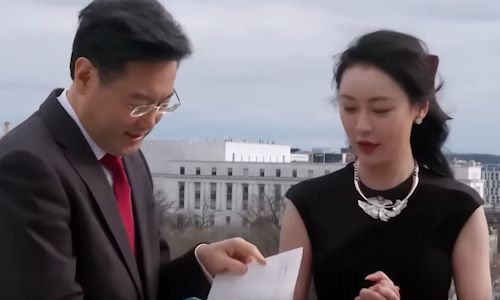
If the firing resulted from personal misconduct, as rumors suggest, the “ill health” ruse could have served better than utter silence. The lack of transparency has left those who interacted with him in an official capacity wondering whether the new Foreign Minister also signals a shift in policy. Though the government is bigger than one minister, there may be doubts regarding the business that Qin Gang conducted.
Flashing the “health reasons” card or any other plausible reason would have dialed down speculation and curiosity. The lack of transparency only adds to the perception that Beijing is unpredictable and indifferent – not desirable traits in an aspiring world leader.
Like our insights? Show your support by becoming a paid subscriber!
TIPP Takes
Geopolitics And Geoeconomics
1. Russia Plans To Double 2023 Defense Spending, Costs Of War Rocket – Reuters
Russia has doubled its 2023 defense spending target to more than $100 billion – a third of all public expenditure – a government document reviewed by Reuters showed.

Rising war costs support Russia’s modest economic recovery this year with higher industrial production but have already pushed budget finances to a deficit of around $28 billion, a figure compounded by falling export revenues.
2. Ukraine, U.S. Begin Discussions On Security Guarantees: Official – WION
Ukraine began talks with the U.S. on security guarantees for the country as a follow-up to pledges by G7 countries at last month’s NATO summit.

Ukraine viewed these talks as an interim phase before it acceded to the North Atlantic Treaty Organization (NATO).
3. Kremlin Doesn’t Believe U.S. Promise Over Grain Deal: RIA – Reuters
Russia does not believe a U.S. promise that Washington will help ensure Moscow can freely export food if it returns to the Black Sea grain deal, state news agency RIA quoted the Kremlin as saying.

Secretary of State Antony Blinken said on Thursday: “In the event of a return to the agreement, of course, we’ll continue to do whatever is necessary to ensure that everyone can export their food and food products freely and safely, including Russia.”
4. North Korea Considering Providing Military Support To Russia: NSC – Yonhap
North Korea is considering providing additional military support to Russia, including munitions to be used in the latter’s ongoing war in Ukraine, a National Security Council (NSC) official said.

John Kirby, the NSC coordinator for strategic communications, said the U.S. would continue to expose and sanction efforts to assist Russia’s illegal war against Ukraine.
5. China To Ease Visa Regulations In An Attempt To Boost Economy – AFP
China will allow some foreigners to obtain visas on arrival and rural residents to settle more easily in cities as part of a series of measures to boost its flagging economy.

The relaxations aim to “promote the free movement” of “people, vehicles, information, and data,” an official from the Ministry of Public Security said.
6. Two U.S. Navy Sailors Arrested For Allegedly Giving China Military Secrets – Al Jazeera
The accused Navy service members were identified as Jinchao Wei, also known by the first name Patrick, and 26-year-old Wenheng Zhao, who goes by Thomas.

According to the Department of Justice, the two sailors were involved in separate information-gathering operations while in the employment of the U.S. Navy.
7. China’s 2023 Coal Approvals Grow Over 50 GW, Greenpeace Says – D.W.
China approved fifty gigawatts (GW) of new coal power in the first half of 2023, a study from Greenpeace shows.

China, the world’s top carbon polluter, focuses on energy security rather than cutting fossil fuel consumption. The repercussions of extreme weather have led China to build even more coal-fired plants as it attempts to counter the effects of drought on hydropower production and avoid power cuts.
8. Bank of England Raises Rates To 15-Year High – UPI
The Bank of England hiked its lending rates by a quarter to 5.25% and signaled that more may be necessary to bring inflation back to the 2% target rate.

Inflation in the British economy last year hit double-digits. Over the 12 months to June, inflation still stands at 7.9%, far higher than its peer economies.
The emphasis on restrictive monetary policy stands in contrast to the U.S. economy, for which policymakers at the Federal Reserve said they’d assess incoming data before making any decisions on future rate moves.
9. Canadian Province Alberta Cancels Bid For 2030 Commonwealth Games – BBC
The government of Alberta has pulled its support for a bid to host the 2030 Commonwealth Games due to rising costs.

Tourism and Sports Minister Joseph Schow said the bill was estimated at C$2.7bn ($2bn) – a burden “too high for the province to bear.”
Last month Australia pulled out of hosting the 2026 Games in Victoria due to budget blowouts.
10. Kuwaiti Foreign Minister Invited To Iran Amid Tensions Over Gas Field – Reuters
Kuwaiti Foreign Minister Sheikh Salem Abdullah Al-Jaber Al-Sabah was given the invitation when he received Iran’s new ambassador, Kuwait said in a statement.

Saudi Arabia and Kuwait claim exclusive joint rights to the field, while Iran also claims a stake and says a Saudi-Kuwaiti agreement to develop it, signed last year, is illegal.
11. Niger’s Ousted President Seeks Us’ Help, Points To Growing ‘Russian Influence’ – WION
In an opinion piece in the Washington Post, Niger’s ousted President Mohamed Bazoum sought help from the U.S. and the “entire world community” to help restore constitutional order in the country.

Bazoum also highlighted the military junta’s ties to the Russian mercenary group Wagner, which operates elsewhere in the region, and said it is exercising a malign influence in Niger.
12. ISIS Confirms Leader’s Death, Announces Replacement – AFP
The ISIS group announced the death of its leader Abu al-Hussein al-Husseini al-Qurashi, who it said “was killed after direct clashes” with extremist group Hayat Tahrir al-Sham in Idlib province in Syria.

The ISIS spokesman did not specify when he was killed. The spokesman announced the group’s new leader – its fifth – as Abi Hafsan al-Hashimi al-Qurashi.
13. Ocean Heat Record Broken, With Grim Implications For The Planet – BBC
According to the EU’s climate change service Copernicus, the average daily global sea surface temperature beat a 2016 record this week. It reached 20.96C. That’s far above the average for this time of year.

Scientists are also worried about the timing of this broken record. “March should be when the oceans globally are warmest, not August or September,” Dr. Samantha Burgess from the Copernicus Climate Change Service said.
Please email [email protected]
Republished with permission from TIPP Insights