You can’t make this up. Whoever coined the term “Bidenomics” is clearly out of touch. It’s disheartening to see the octogenarian President touring cities across the nation, taking credit for the success of the Bidenomics economy while many Americans are enduring profound hardships.
Americans are grappling with skyrocketing prices. Nowadays, you need $1,000 in earnings to purchase what $862 could buy when Biden assumed office. Alternatively, if you used to require $50,000 annually to cover household expenses before Biden’s presidency, you now need $58,000.
How do you address the shortfall?
Take on two jobs, reduce expenses, skip meals, use credit cards, or dip into retirement savings. There’s evidence that all these strategies are being employed in Biden’s America.
The dark shadow of Bidenomics is 16.2% inflation under Biden’s watch. It is a complete and utter failure that has led to stagflation in the United States. No amount of sugarcoating can hide the truth.
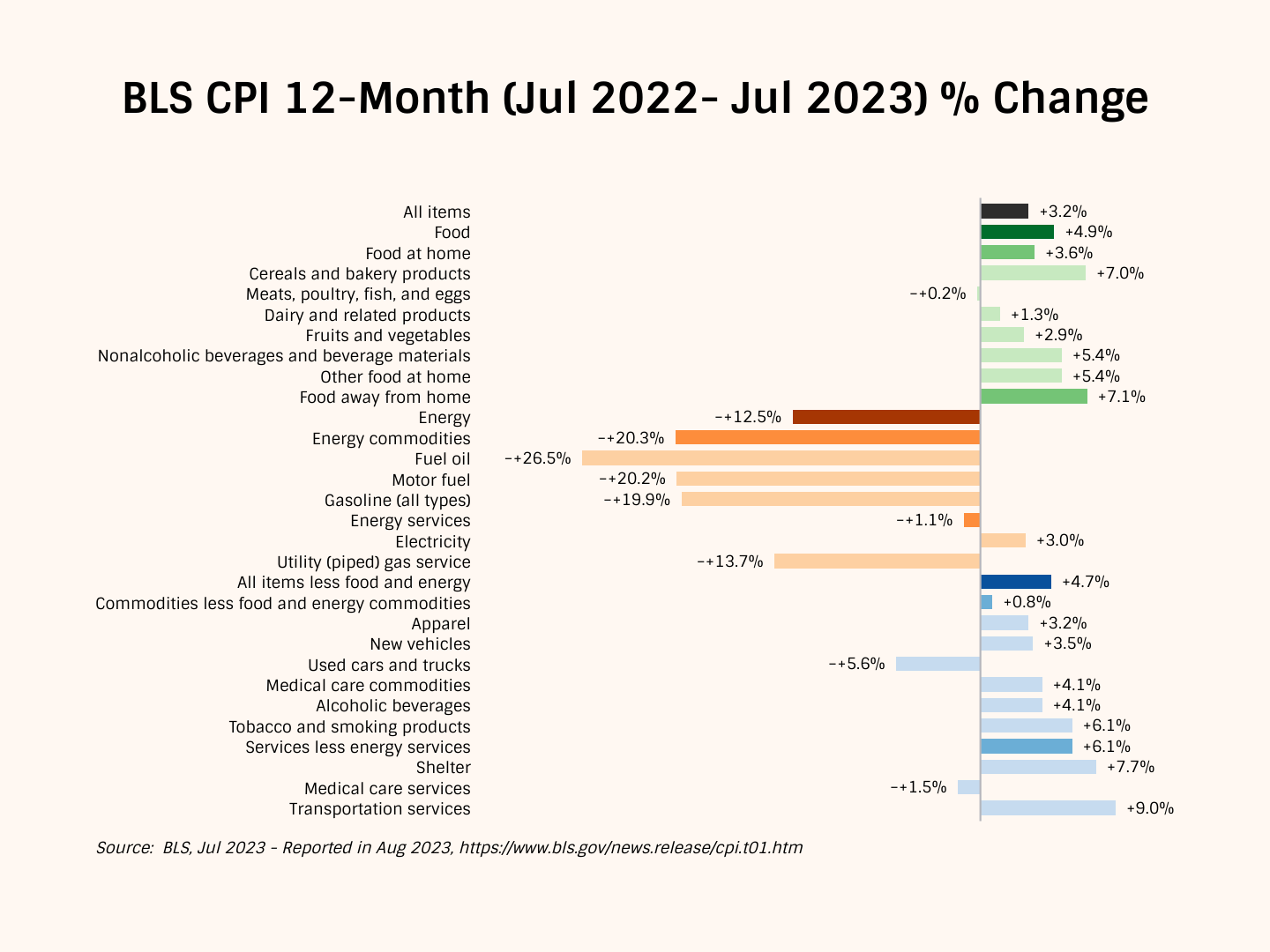
The Consumer Price Index (CPI) released by the government on Thursday showed a 3.2% year-over-year increase in prices from July 2022 to July 2023.
The CPI rate had declined steadily from a 40-year high of 9.1% in June 2022 to 3.0% in June 2023 for 12 consecutive months. The latest reading broke that run by increasing to 3.2% in July.
The CPI rose 0.2% between June 2023 and July 2023 after adjusting for seasonality and by the same amount of 0.2% on an unadjusted basis.
Last month, the White House press release stated: The June Consumer Price Index: Disinflation, Deflation, and Buying Power in the U.S. Economy.
In contrast, this month was more somber: Statement from President Joe Biden on July Consumer Price Inflation Report. Yet, it could not resist talking up Bidenomics:
We’re growing the economy from the middle out and bottom up, lowering costs for hardworking families, and making smart investments in America: that’s Bidenomics.
The Biden economy continues to be the worst-performing going back to President Carter. Since February 2021, the first full month of President Biden’s term, the prices of various commodities, including food, gasoline, used cars, and air tickets, have consistently increased. Although the rate of increase has slowed, prices are still rising monthly.
As we have noted numerous times, President Biden’s reckless spending has resulted in inflation levels not seen in 40 years. The U.S. economy will experience an extended period of stagflation characterized by a recession and inflation.
TIPP CPI
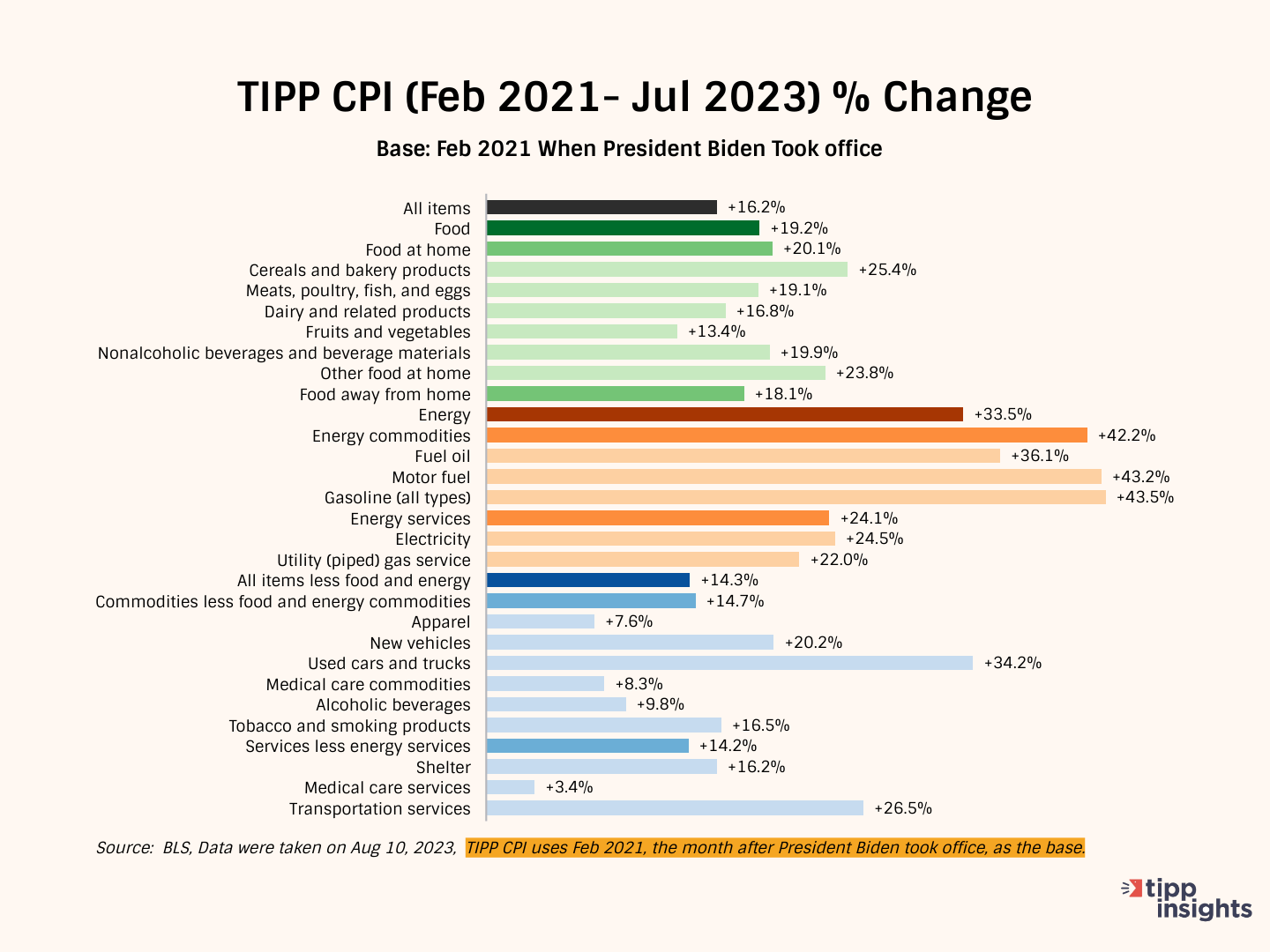
We developed the TIPP CPI, a metric that uses February 2021, the month after President Biden’s inauguration, as its base. All TIPP CPI measures are anchored to the base month of February 2021, making it exclusive to the economy under President Biden’s watch.
We use the relevant data from the Bureau of Labor Statistics (BLS) to calculate the TIPP CPI, but we adjust the period to Biden’s tenure. CPIs are like index numbers that show how prices affect people’s lives, similar to how the Dow Jones Industrial Average reflects the stock market.
When discussing the TIPP CPI and the BLS CPI, we convert the index numbers into percentage changes to better understand and compare them.
Bidenflation, measured by the TIPP CPI using the same underlying data, reached 16.2% in June. It was 16.0% in June, 15.9% in May, and 15.3% in April.
By the middle of 2022, significant inflation had already taken hold. In July 2022, CPI inflation stood at 8.5 percent. While the official BLS CPI year-over-year increases will compare prices to already inflated bases in the coming months, these statistics might mask the full impact.
TIPP CPI vs. BLS CPI
The following four charts present details about the new metric.
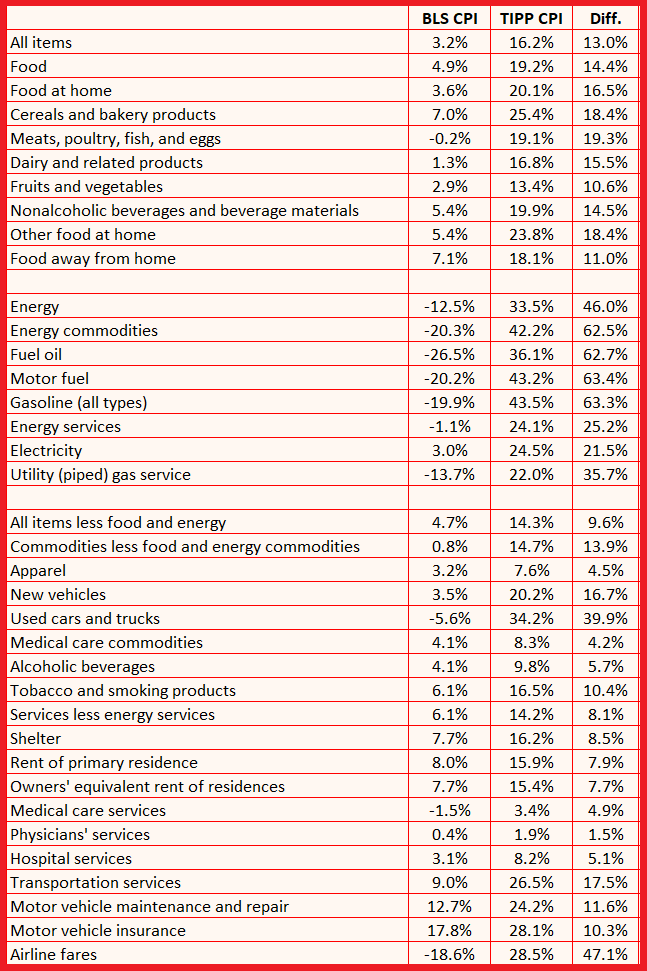
The annual CPI increase reported by BLS is 3.2% for July 2023. Compare this to the TIPP CPI of 16.2%, a 13.0-point difference. Prices have increased by 16.2% since President Biden took office. On an annualized basis, TIPP CPI is 6.4%.
Food prices increased by 19.2% under Biden compared to only 4.9% as per BLS CPI, a difference of 14.4 points.
TIPP CPI data show that Energy prices increased by 33.5%. But, according to the BLS CPI, energy prices declined by 12.5%. The difference between the two is a whopping 46.0 points.
The Core CPI is the price increase for all items, excluding food and energy. The Core TIPP CPI was 14.3% compared to 4.7% BLS CPI in the year-over-year measure, a 9.6-point difference.
Further, Gasoline prices have increased by 43.5% since President Biden took office, whereas the BLS CPI shows that gasoline price has improved by 19.9%, a difference of 63.3 points.
TIPP CPI finds that Used car prices have risen by 34.2% during President Biden’s term. The BLS CPI shows that the prices have dropped by 5.6%, a difference of 39.9 points.
Inflation for air tickets under President Biden is 28.5% compared to the BLS CPI’s finding of an improvement of 18.6%, a difference of 47.1 points.

Americans’ Concerns
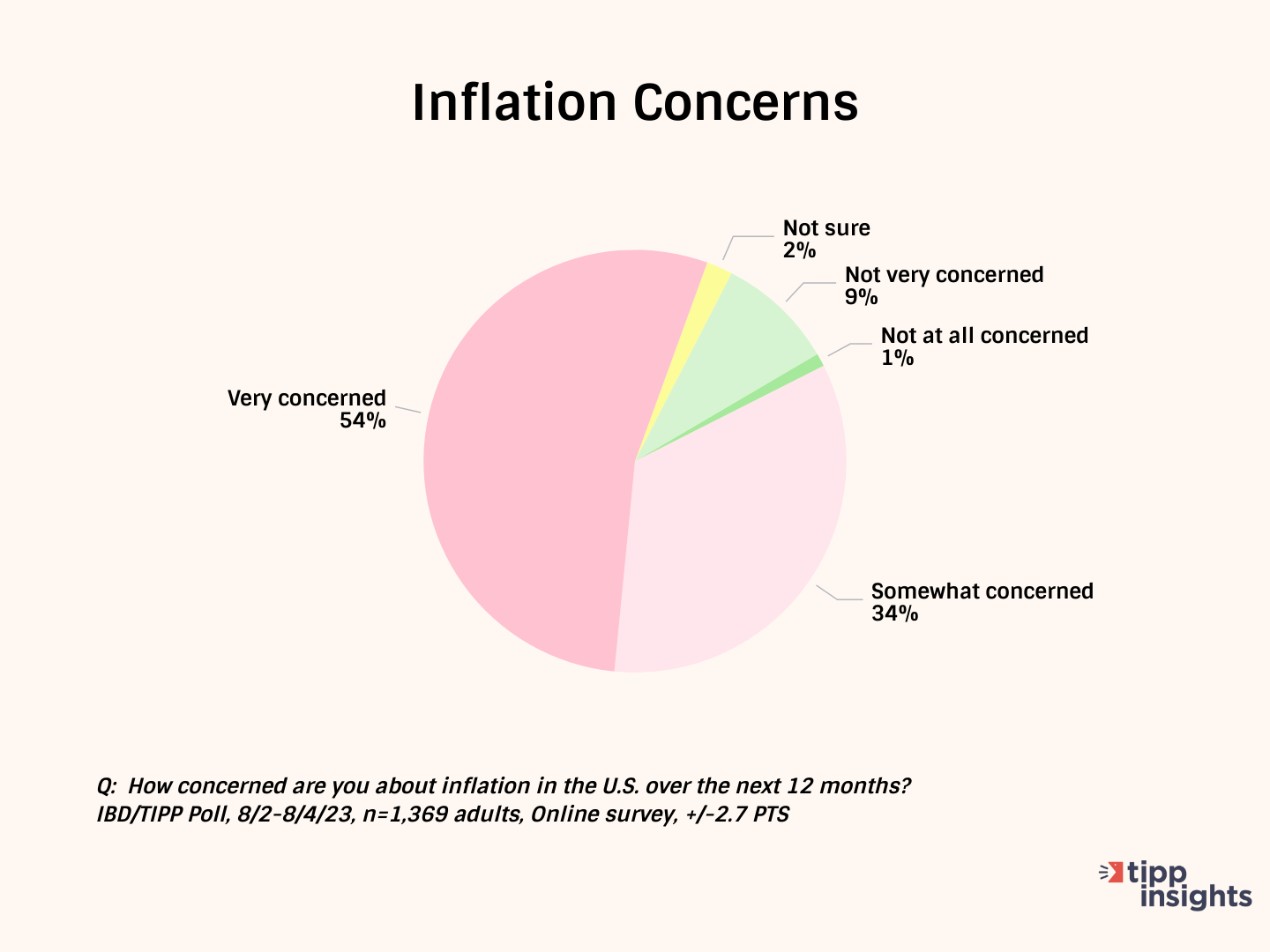
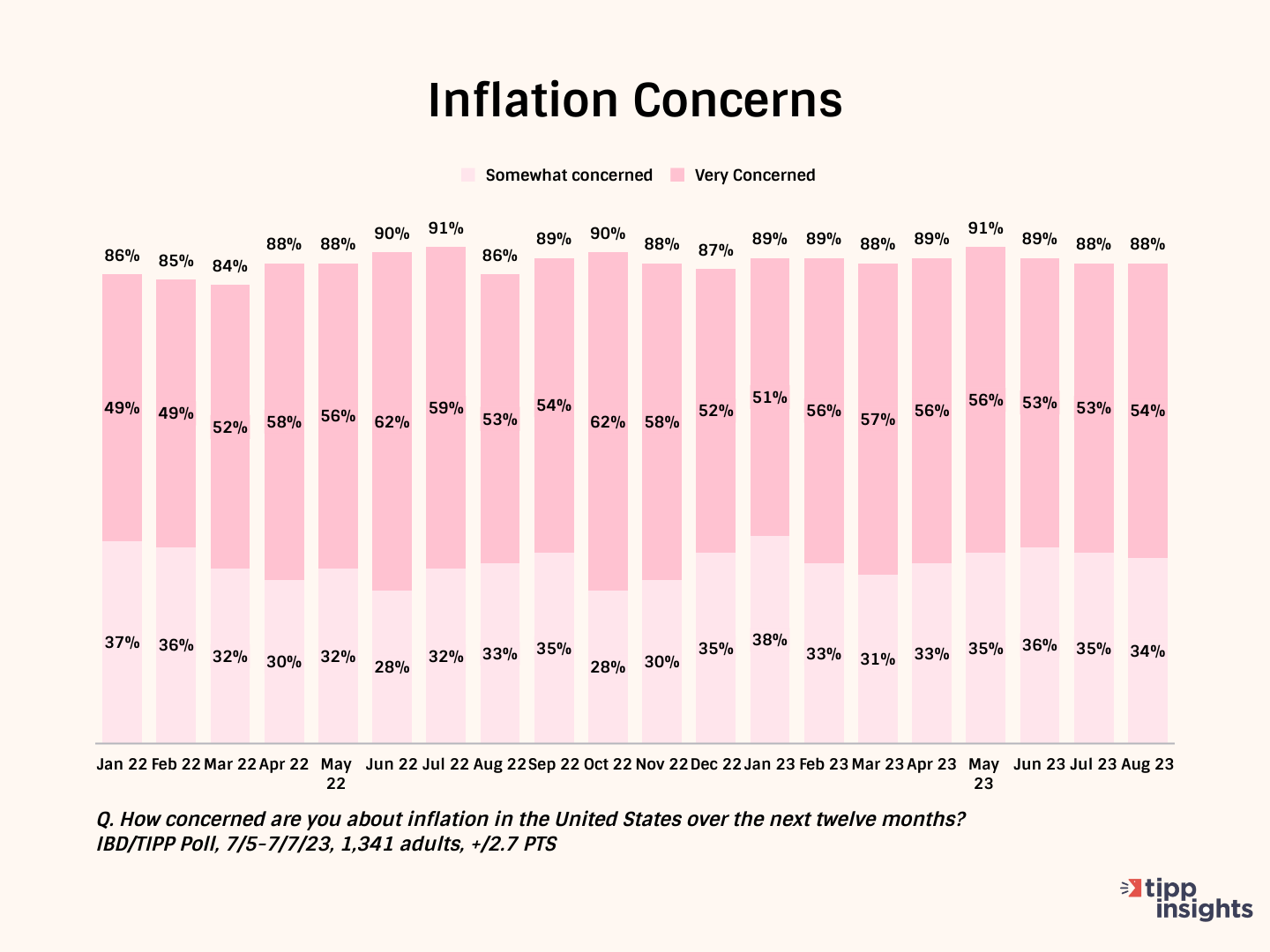
The latest Investor’s Business Daily/TIPP Poll, completed earlier this month, shows nine in ten (88% in August and July) survey respondents are concerned about inflation. Throughout the past year, inflation concerns have stayed above 85%. The “very concerned” share has been over 50% for eighteen months.
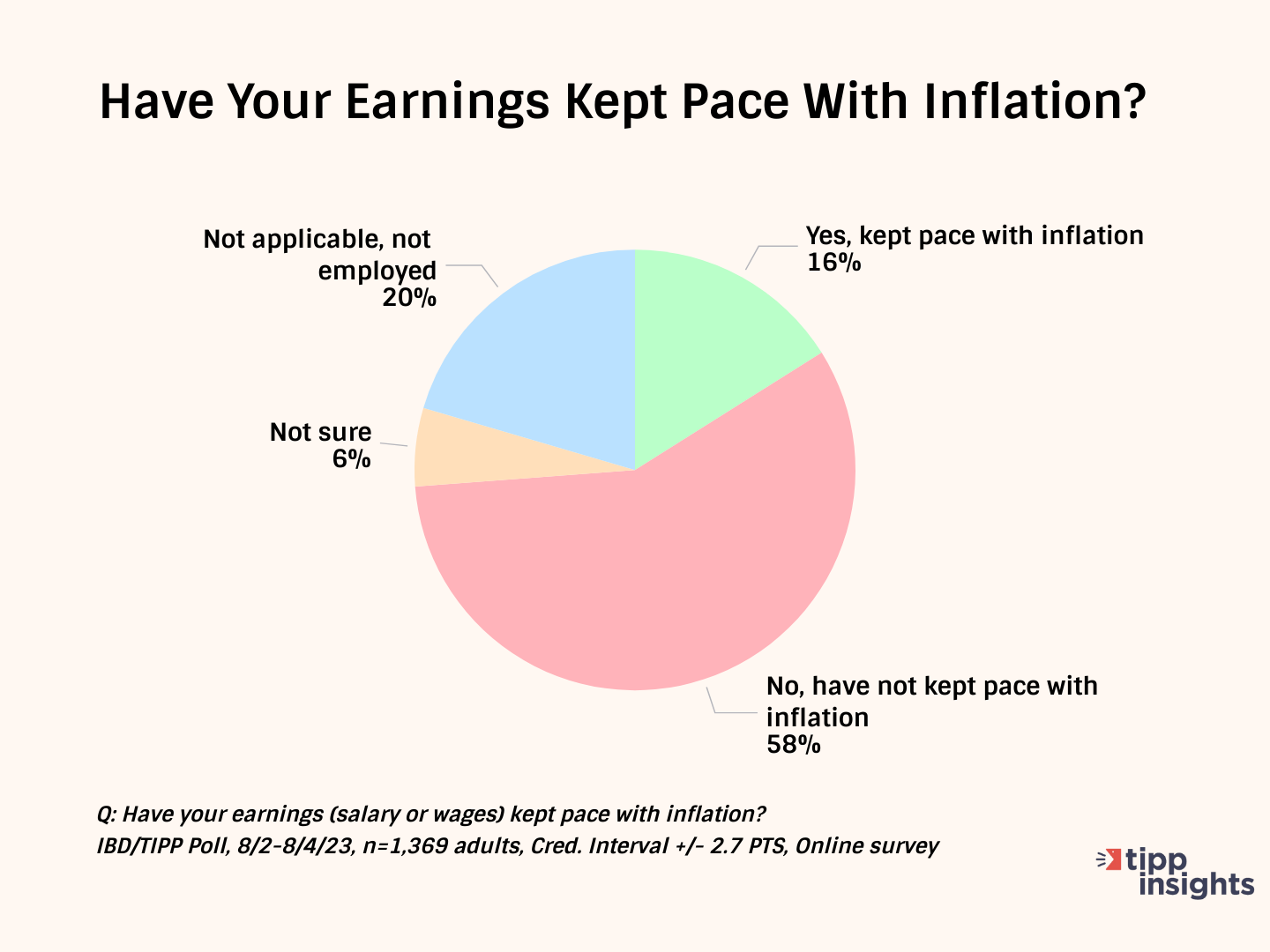
Over half (58%) say their wages have not kept up with inflation. Only 16% say their income has kept pace with inflation.
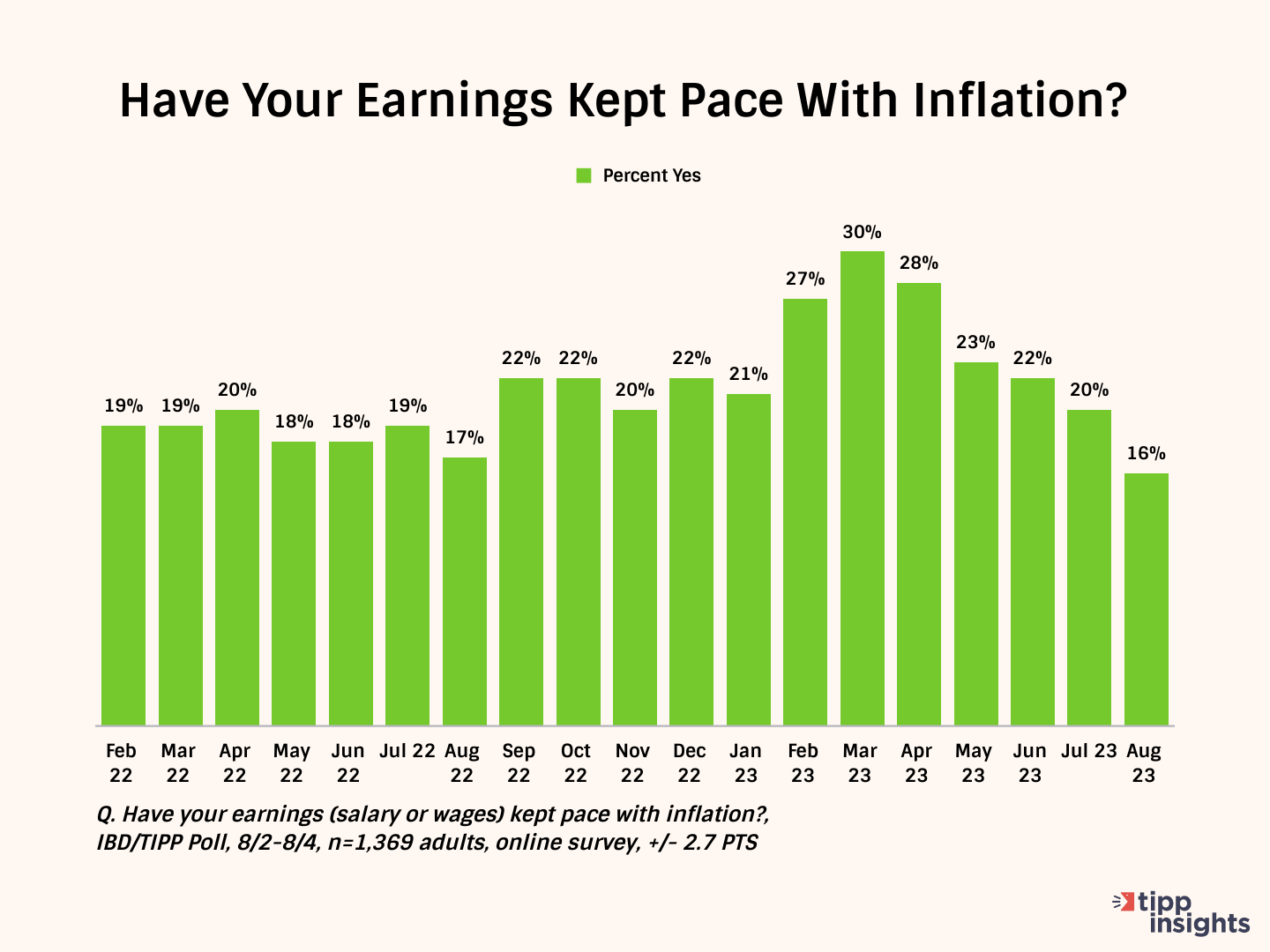
This statistic hovered in the low twenties for most of the last year. The positive change between January and March has petered. Notice the steady descent from March 2023.
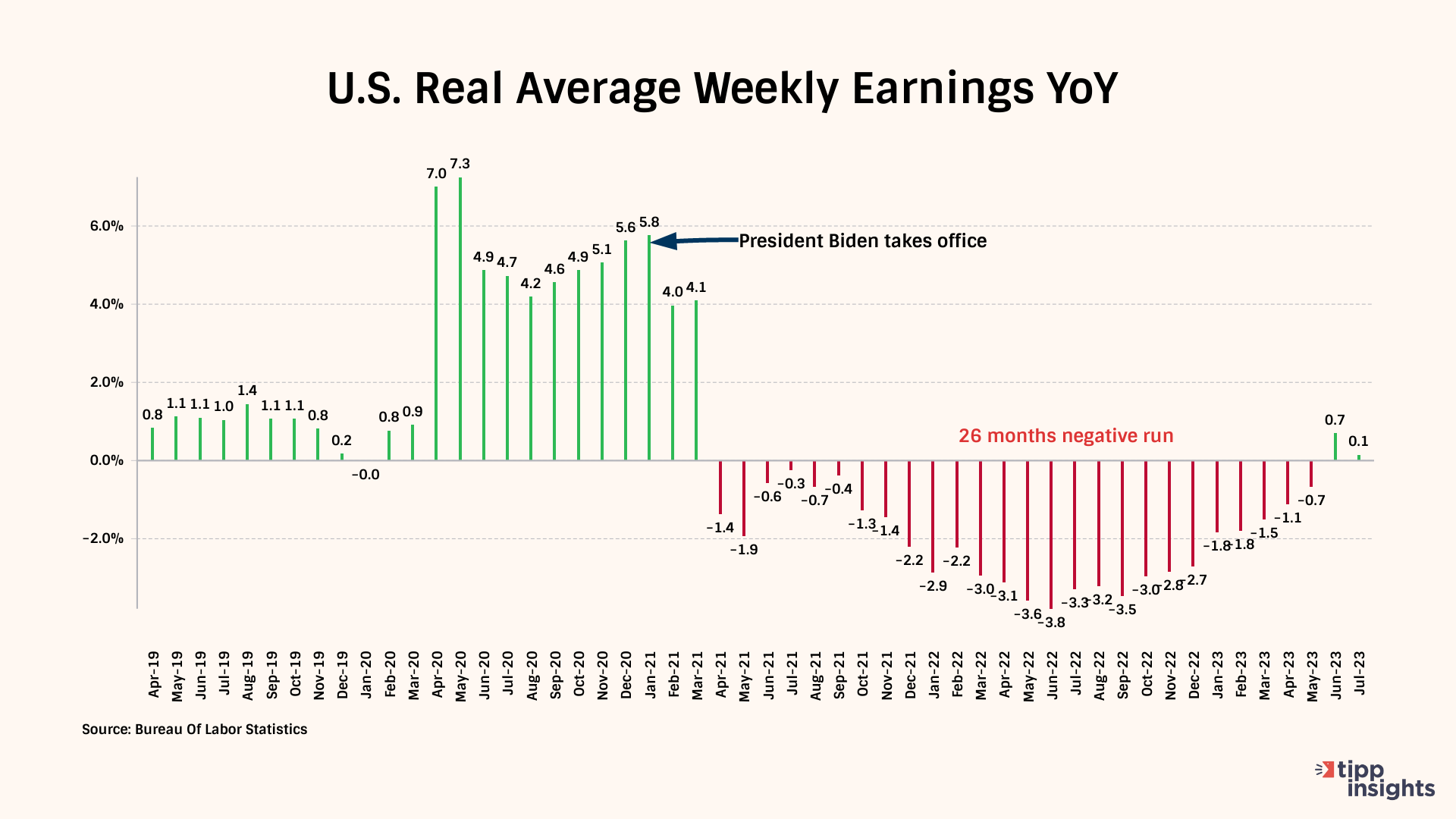
Nominal wages represent the amount of money one earns without considering changes in the cost of living. On the other hand, real wages consider inflation and measure the wages’ purchasing power. Real wages provide a more accurate reflection of what is affordable with the income earned by factoring in the changes in the cost of living.
Real weekly wages measured year-over-year have dropped for 26 of the 30 months of the Biden presidency. On a positive note, it broke a 26-month negative run in June.
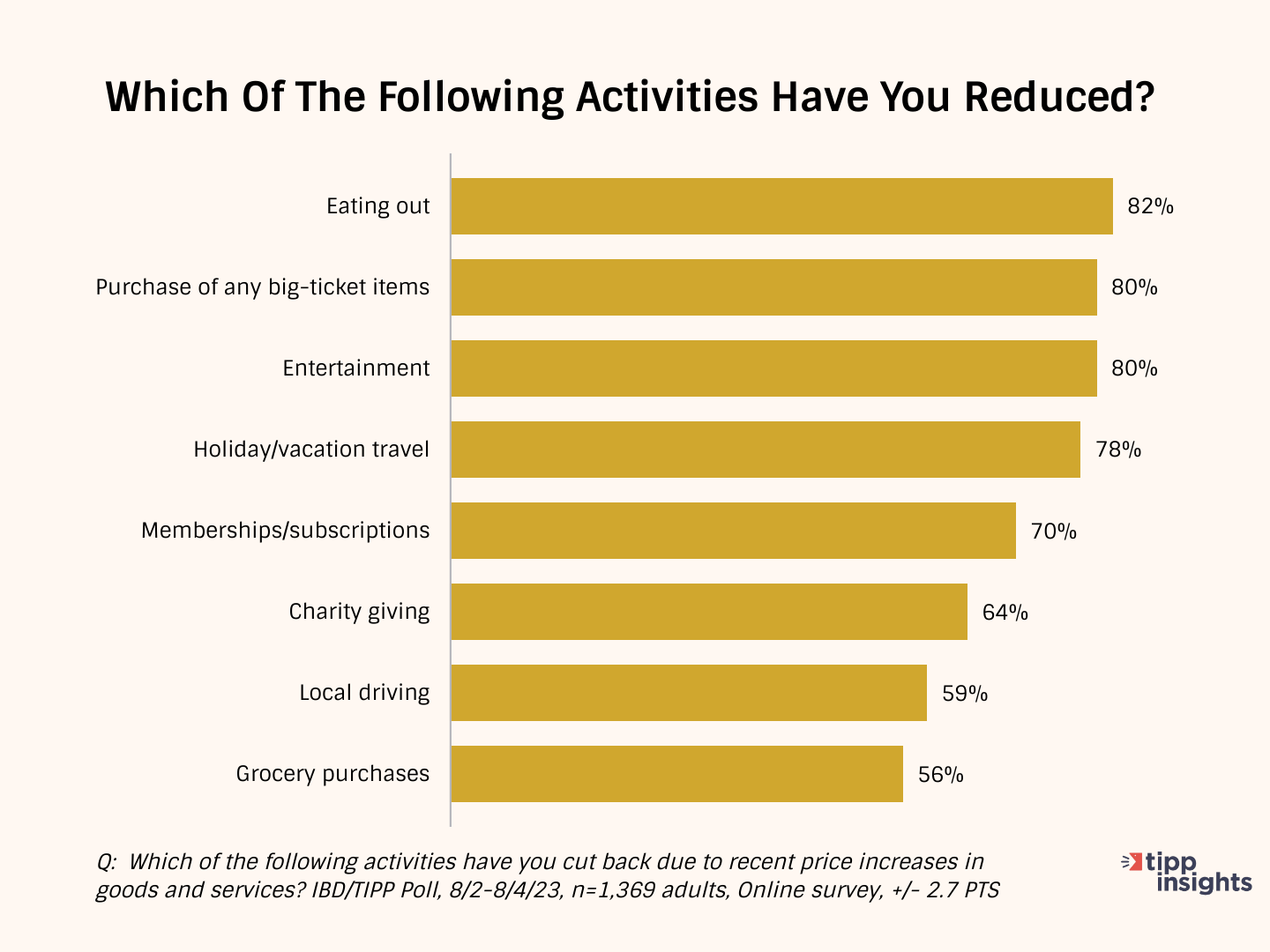
As a result of inflation, Americans are cutting back on household spending.
They are cutting back on eating out (82%), purchasing big-ticket items (80%), entertainment (80%), holiday/vacation travel (78%), and memberships/subscriptions (70%).
Many (64%) are cutting back on even good causes such as charity giving. Over one in two (56%) households spend less on groceries. The high gasoline prices forced 59% to cut back on local driving.
Inflation Direction
The chart below compares the 12-month average of monthly changes against the 6-month and the 3-month averages. We also show the reading for July 2023.
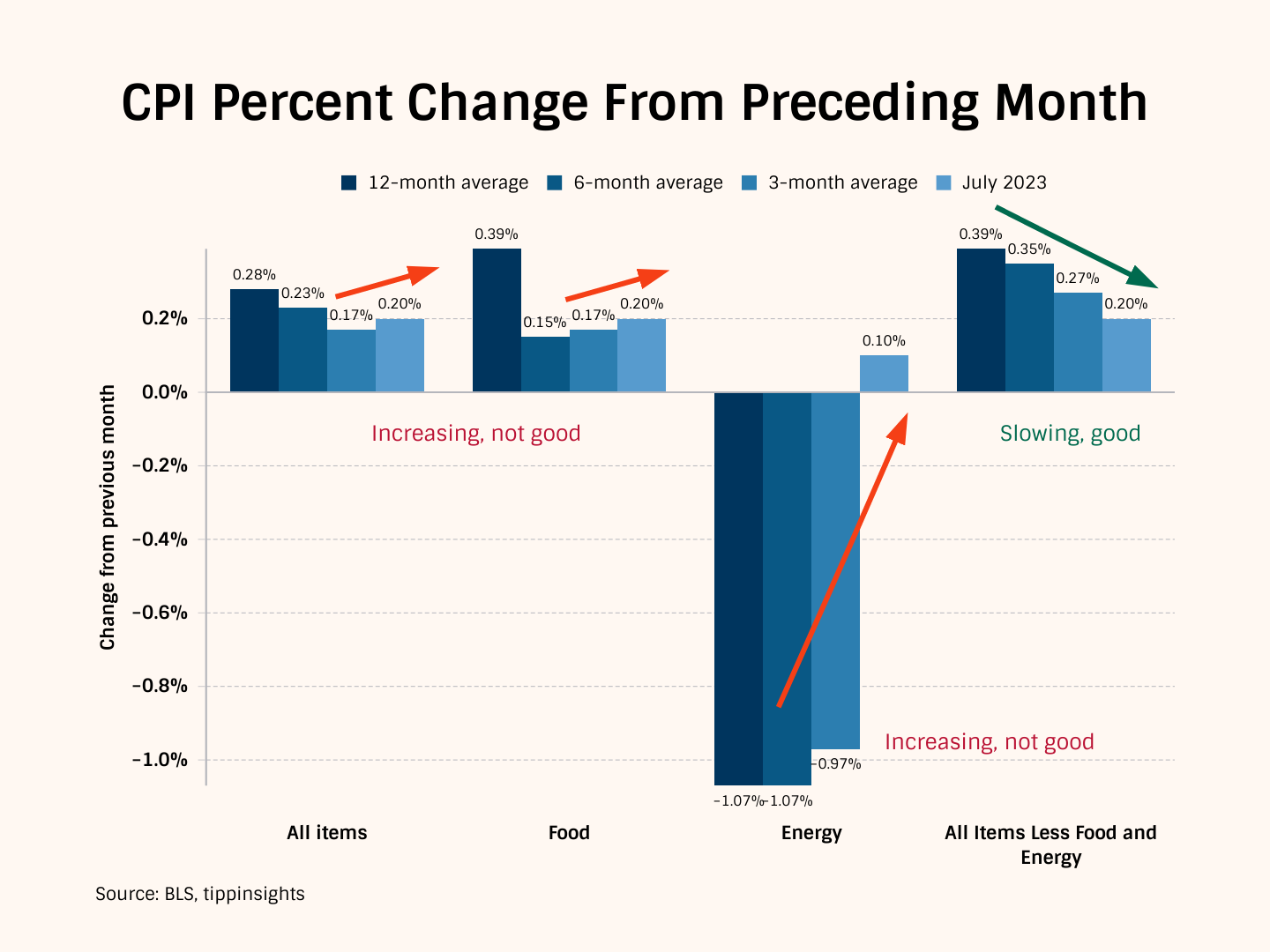
The 12-month average considers 12 data points and presents a long-term reference, while the six-month and three-month averages consider recent data points.
Typically, we compare the three-month average to the data from July 2023 to get a clearer picture. In July 2023, the price increase for ‘All items’ was 0.20%. However, the three-month average was lower at 0.17%. This means that the current reading is higher than the average of the past three months, indicating an acceleration in price increases.
The twelve-month long-term average of 0.28% is higher than the six-month average of 0.23%, which shows an improvement in the recent six months. Furthermore, the three-month average of 0.17% is lower than the six-month average of 0.23%.
In conclusion, this pattern suggests that while price increases have slowed down in the long term, there was a noticeable pickup in July.
In July, the price increase for Food was 0.20%, higher than the 3-month average of 0.17%. This indicates that food prices have increased. Further, when we compare the three-month average of 0.17% to the average of the past six months, which was 0.15%, we can see that the recent 3-month period had a slightly higher price increase.
The twelve-month average was 0.39%, much higher than the six-month (0.15%) and three-month (0.17%) averages. The data confirms the improvement relative to the past long-term 12-month average. However, the recent increase is worrisome.
The Energy situation sharply deteriorated last month, with a spike of 0.1%. This increase in July 2023 (0.10%) is worse than the three-month moving average of -0.97%, indicating deterioration.
“All items less food and energy” is called “core inflation,” i.e., after removing volatile food and energy components. The core inflation reading in July was 0.20%, lower than the three-month average of 0.27%. This indicates that there was improvement during that period.
Meanwhile, the three-month average of 0.27% is lower than the six-month average of 0.35%, suggesting a slowdown in inflation. Additionally, the six-month average of 0.35% is lower than the 12-month average of 0.39%.
The downward stair is the “perfect” pattern. These numbers indicate a positive situation where the core inflation rate has improved.
In summary, things look good directionally except for Food and Energy.
Inverted Yield Curve
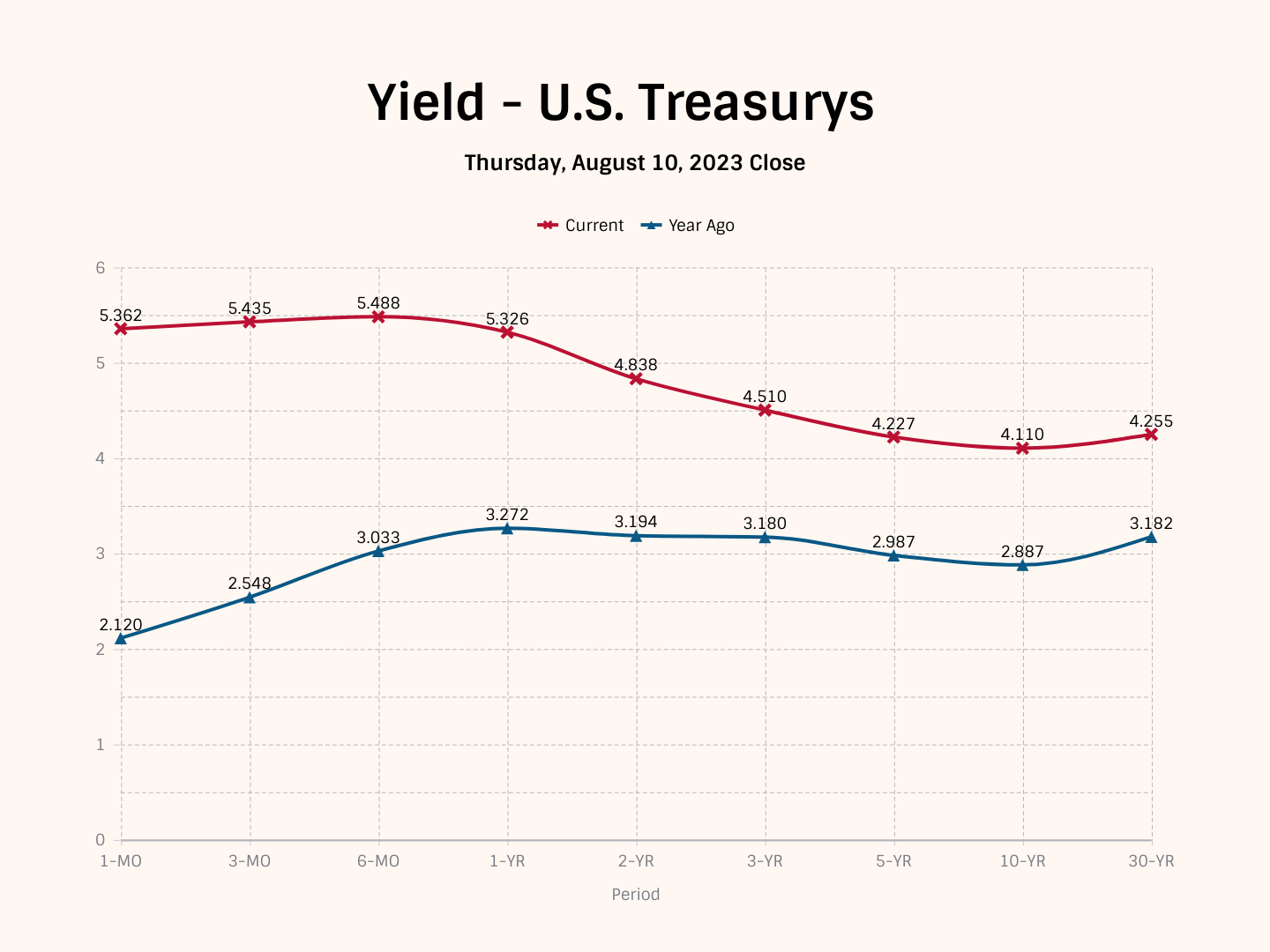
In normal circumstances, longer-term investments offer higher yields than shorter-term investments due to the higher risk associated with longer durations. However, an inverted yield curve can occur during periods of economic turbulence, such as the current times. This happens because investors expect higher yields in the short term to compensate for the potential short-term uncertainties in the economy. As a result, the yields on shorter-term bonds become higher than those on longer-term bonds of the same credit quality.
The presence of an inverted yield curve is an indication that investors anticipate economic instability or a possible economic downturn. The inverted yield curve is a leading indicator of lower inflation and recession. It has a strong track record of accurately predicting the last ten recessions since 1955, with only one incorrect signal in the mid-1960s.
The closing yields on Thursday were:
- 5.362% for the 1-month Treasury bill
- 5.435% for the 3-month Treasury bill
- 5.488% for the 6-month Treasury bill
- 5.326% for the 1-year Treasury bill
- 4.838% for the 2-year Treasury note
- 4.510% for the 3-year Treasury note
- 4.110% for the 10-year Treasury note
- 4.255% for the 30-year Treasury bond
Stagflation
Most Americans struggle, challenged by the high core inflation rate of 4.70%. Stagflation refers to a combination of stagnant economic growth and high inflation.
Since March 2022, the Fed has raised interest rates by 5.25 percentage points. High-interest rates are likely to slow down the economy further.
Each time the Federal Reserve increases interest rates to contain inflation, the U.S. government must pay higher interest rates to service its ballooning debt. A rising debt-to-GDP ratio limits the ability to fund essential government services.
The August IBD/TIPP Poll revealed that most Americans view the economy negatively. Nearly half (49%) believe we are in a recession, and six in ten (61%) feel that the economy is not improving.
Considering these factors and the numbers, we predict that the U.S. economy will face an extended period of stagflation characterized by a recession and inflation.
To access the TIPP CPI readings each month, you can visit tippinsights.com. We’ll publish the TIPP CPI and our analysis in the days following the Bureau of Labor Statistics (BLS) report. The upcoming release of TIPP CPI is on September 14, 2023. We’ll also post a spreadsheet in our store for download.
Hey, want to dig deeper? Download data from our store for a small fee!
Want to understand better? We recently wrote an explainer that sixth graders could understand. Everyone can benefit from it. Milton Friedman’s Priceless Lessons On Inflation
Like our insights? Show your support by becoming a paid subscriber!
TIPP Takes
Geopolitics And Geoeconomics
1. Ukraine To Open ‘Humanitarian Corridor’ For Ships Stuck In Black Sea Ports – Al Jazeera
Ukraine’s announcement of the corridor to release cargo ships trapped in its ports since the outbreak of war is a new test of Russia’s de facto blockade since Moscow abandoned the Black Sea grain deal.

At least initially, the corridor would apply to vessels such as container ships that have been stuck in Ukrainian ports since the February 2022 invasion by Russians and were not covered by the deal that opened the ports for grain shipments last year.
2. Russian Missiles Strike Hotel Used By UN – D.W.
A Russian missile struck a hotel in Zaporizhzhia, frequently used by UN staff. One person was killed, and 16 others were injured in the attack.

Local media reported that the damaged building is Reikartz Hotel in the city center, frequently used by staff from the UN and various non-governmental organizations.
3. Ukrainian Minister Warns Zaporizhzhya Nuclear Plant ‘One Step Away’ From Blackout – RFE/RL
Ukrainian Energy Minister Herman Halushchenko said on Ukrainian television that the nuclear plant is currently being supplied with power from a backup line.

“This is the only external power line left. And such a situation is one step away from the blackout of the Zaporizhzhya nuclear power plant – that is, the final loss of external power supply,” Halushchenko said.
In the event of a blackout, diesel generators would be connected to meet the station’s needs, but they may be damaged by Russian shelling, which would stop the station’s cooling and set off a nuclear meltdown, Halushchenko said.
4. Russia’s First Probe To The Moon Launched In Almost 50 Years – WION
The Luna-25 probe’s launch aims to give fresh impetus to the country’s space sector, which has been struggling for years and is now facing isolation because of the Russia-Ukraine conflict.

The spacecraft will spend around three to seven days choosing the right spot before the lunar probe lands in the south pole area.
5. Biden Calls China A “Ticking Time Bomb” Over Economic Troubles – Reuters
“They have got some problems. That’s not good because when bad folks have problems, they do bad things,” Biden said at a political fundraiser in Utah.

“China is in trouble,” Biden said.
Biden’s remarks were reminiscent of comments he made at another fundraiser in June when he referred to President Xi Jinping as a “dictator.” China called the remarks a provocation.
6. China Says CIA Spy Uncovered After Recruitment By U.S. In Italy – Al Jazeera
China has uncovered an alleged spy for the U.S. Central Intelligence Agency (CIA), a Chinese national.

A 52-year-old named Zeng worked for a military-industrial group and was offered money and immigration to the U.S. in exchange for sensitive military information, Beijing’s Ministry of State Security said.
China’s state broadcaster CCTV reported “compulsory measures” had been taken against Zeng but did not provide further details.
7. China Property Giant Country Garden Warns Of Up To $7.6bn Loss – BBC
Country Garden “is expected to record a net loss ranging from approximately RMB45 billion [$6.24bn] to RMB55 billion for the six months ended 30 June 2023,” the company said in an announcement to the Hong Kong Stock Exchange.

The expected loss compares to a $265m profit for the same time last year.
The announcement is the latest sign of the major issues faced by the world’s second-largest economy.
8. After Joe Biden’s China Tech Curbs, U.S. Investors Warn Of Retaliation – Reuters
While the market mostly shrugged off President Joe Biden’s move to prohibit some U.S. technology investments in China, U.S. investors said they were worried Beijing would retaliate or pull back from buying American technology.

U.S. investors were unfazed by the initial news, saying that the restrictions, at first blush, were more limited than feared. But several portfolio managers said the bigger worry was whether China would strike back, as it has in the past.
9. U.S. Confirms Release Of Five Americans Detained By Iran, Denies Sanctions Relief – Al Arabiya
The U.S. said that five Americans whom Iran unjustly detained had been released from prison and placed on house arrest.

Reports suggest that the U.S. will unfreeze $6 billion in Iranian funds held in South Korea and other jailed Iranians in the U.S. However, U.S. Secretary of State Antony Blinken said Iran would not receive any sanctions relief.
10. Niger Coup Leaders Threaten To Kill Ousted Prez Bazoum – WION
AP news agency citing two Western officials, reported that during a meeting with the U.S. Under Secretary of State Victoria Nuland, the Niger military leaders said they would kill Bazoum if the West African bloc ECOWAS used any military force.

The report comes hours after the 15-member Economic Community of West African States (ECOWAS) reiterated its earlier threat and ordered activating its standby force.
11. Colombian Nationals Arrested After Ecuadorian Presidential Candidate Assassinated – UPI
Ecuadorian presidential candidate Fernando Villavicencio was shot and killed Wednesday during a political rally in the country’s capital of Quito just days before the election.

Ecuador’s interior minister, Juan Zapata, announced that six suspects had been arrested in connection to the killing, saying all were Colombian nationals, according to the New York Times.
12. Egypt Hits Highest Inflation Level Amid Currency Crises – WION
Egypt inflation soared to an annual rate of 36.5 percent in July.

Egypt’s severe foreign currency shortage has further aggravated the situation, resulting from three devaluations of the Egyptian pound since early 2022, which was done to secure a $3 billion loan from the International Monetary Fund (IMF).
The country’s government debt will reach around 93 percent of GDP in 2023.
13. Owners Of Rainbow Swatch Watch In Malaysia To Be Jailed For 3 Years – WION
The Malaysian government said that the owners and sellers of Swatch rainbow-colored watches could face three years in prison. The ban said the brand’s “LGBTQ-related” products could “harm morals.”

Homosexuality is outlawed in the Muslim-majority country, and LGBTQ+ people face discrimination.
Please email [email protected]
Republished with permission from TIPP Insights