- Kevin McCarthy was ousted as Speaker of the House in a historic vote with a final count of 216-210, and the media attributed this to eight “right-wing” Republicans
- Democrats strategically voted with the eight Republicans to bring down McCarthy, as they aimed to showcase GOP incompetence and potentially win back the House in 2024
- McCarthy had removed funding for Ukraine from a government shutdown vote, and the Ukraine funding issue became central to the Speaker’s vote
- The vote may signal a shift in sentiment against the Ukraine war, and the Democrats inadvertently undermined their own president’s policy priority
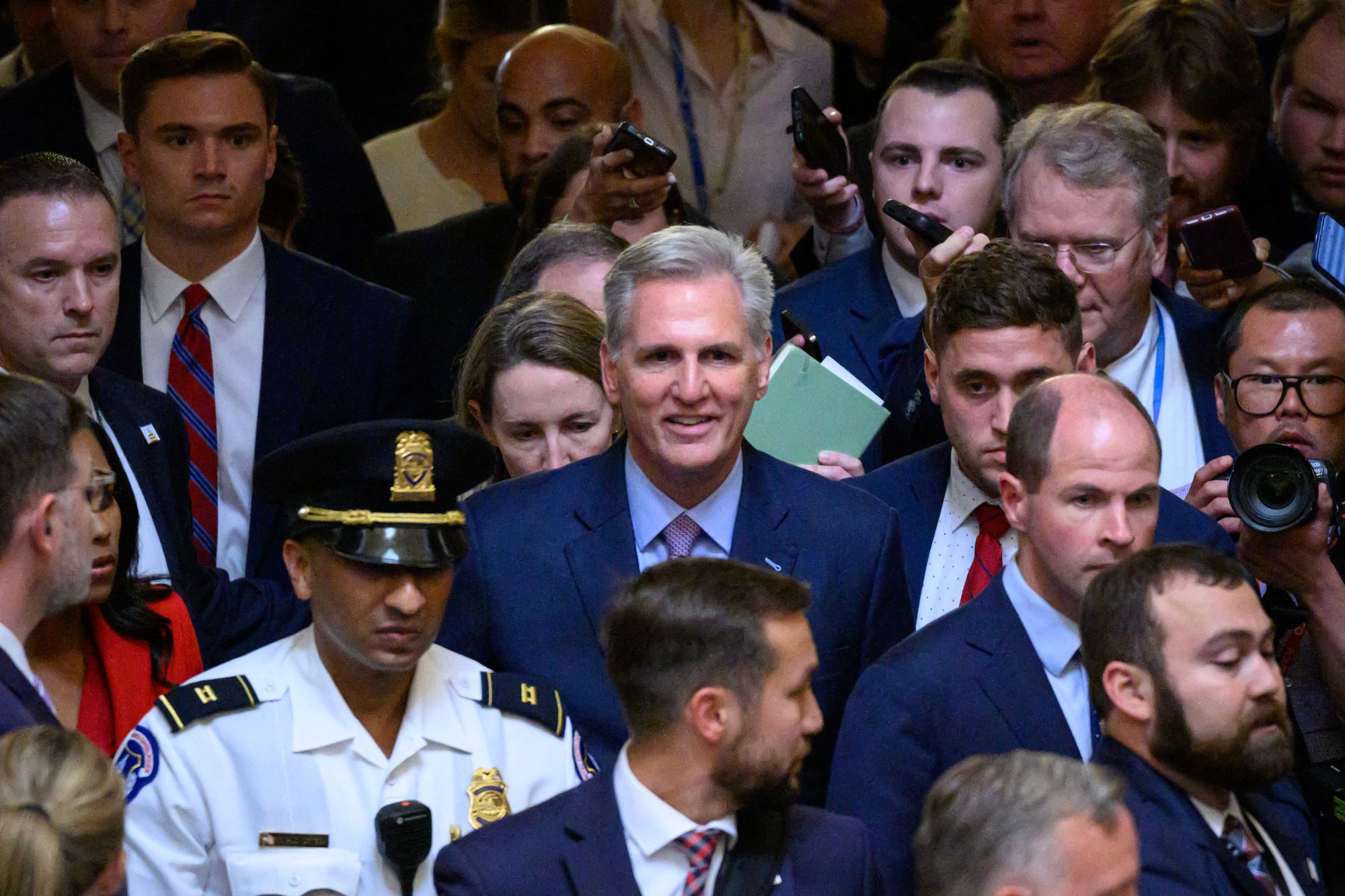
The media blamed the vote that ousted Kevin McCarthy as Speaker of the House, a historic outcome that has never happened before, on eight “right-wing,” “hardline,” MAGA Republicans. The final vote was 216-210.
Technically, the media narrative was true. When Kevin McCarthy was elected Speaker in January after fifteen grueling rounds of voting, he agreed to several concessions with his conservative flank. Chief among them was that any member could express displeasure with his leadership and bring a British-style “no confidence” vote in the entire House. He had gambled that such a vote would never come up. It did yesterday, and he lost when all Democrats voted unanimously against him.
We are reminded of how late British Prime Minister “Iron Lady” Margaret Thatcher, who convinced a wobbly George Bush 41 to liberate Kuwait from Saddam Hussain’s invasion during the first Gulf War, was ousted from Number 10 Downing Street in an internal party vote. Tucked into the rules of the British Parliament is one that empowers a group of MPs to bring a ‘vote of no confidence.’ Thatcher’s aides never saw this vote brewing. At the height of the short Gulf War that had consumed the British leader, the detractors held such a vote and shocked Thatcher. An obscure back-bencher, John Major, became Prime Minister and served for seven long years.
But, underneath the hood, what occurred on Tuesday was the risk of a prominent political gamble the Democrats took, something the media failed to cover. Intent on showing that the GOP can’t govern – a message that former Speaker Pelosi and Senate Majority Leader Chuck Schumer likes to rub in at every opportunity – and hoping for a chance to take back the House in 2024, the Democrats unilaterally voted with the eight Republicans to bring McCarthy down. In so doing, the Democrats placed President Biden’s Ukraine war funding priority and future funding requests at significant risk.
What led to yesterday’s vote. During last week’s vote to avoid a government shutdown, McCarthy engineered a miracle by removing not just Biden’s $24 billion emergency aid request for the Ukraine war but even the $6 billion that the Senate had overwhelmingly approved in its own version of the Continuing Resolution. There was not one dollar for Ukraine. Not one.
The Senate grudgingly passed the House version, and a government shutdown was averted. No senator wanted to be on record to let the U.S. government shut down only because Ukraine had won no money, although Ukraine was foremost on most senators’ minds, including several GOP senators.
In typical Beltway swamp style, Ukraine sympathizers let trial balloons float after that vote that the money would be found after all. Even President Zelenskyy, the clever politician he is, predicted that American support for Ukraine would never waver, indirectly continuing the pressure campaign he had unleashed when he visited Washington a few weeks ago. President Biden, speaking gibberish, let it slip that there even was a “deal” with McCarthy that would reinject all withheld war funding for Ukraine. In her typical style, White House Press Secretary KJP refused to take questions about the “deal,” asserting that Biden’s words stood on their own.
The media manipulation proved extraordinarily expensive to the Beltway Neocons as the revolt among McCarthy’s detractors intensified. What was just four potential GOP members who initially challenged his leadership increased to eight, with a sufficient margin to sink his speakership. Rep. Chip Roy (R., Texas), a conservative Republican, had made it clear before the vote he would support McCarthy but that all bets were off if Ukraine war funding was included. Roy actually voted to keep McCarthy as speaker because McCarthy had zeroed out all dollars for Ukraine, but there were a few who detested the trail balloon talk of a deal that voted against McCarthy.
The Ukraine funding issue became so integral to the debate that the NY Times reported that McCarthy said “unequivocally no” to the question about a secret side deal on Ukraine. He said he and the White House discussed only the “transferability” issue, presumably referring to whether the administration could still send weapons to Ukraine.
McCarthy could have saved his speakership if he had shown more leadership on the Ukraine war funding issue without taking a particular stand. Over six weeks ago, we suggested that he invite war critics to testify so that Americans could know the truth eighteen months into this prolonged war that has killed over 500,000 soldiers and displaced more than 11 million Ukrainians. We have noted dozens of times that the media reporting has been lopsided absent Congressional authorization to declare war, mainly repeating administration talking points. We have also criticized the administration’s moving the goalposts, first to say that funding is required to help Ukraine defend its sovereignty, and recently, as the counteroffensive is failing, to insist that weakening Russia’s military power is a strategic American priority. GOP presidential contenders Mike Pence, Nikki Haley, and Chris Christie have also been in lock-step with the administration.
In his defense, McCarthy was never desperate to fund the Ukraine war. Even before assuming the role that placed him third-in-line to the presidency, he had warned that he would not sign a blank check. But the Democrats were always desperate to fund Ukraine, and after the vote, they lost a lot more than McCarthy.
The House controls the purse strings of the United States, and a GOP House is here to stay until January 2025. Whoever becomes speaker next knows their position is safe only if they address numerous conservative priorities – such as passing individual appropriation bills, strengthening the Southern border, and addressing the debt. High on this list would be severely restricting or eliminating funding for the Ukraine war.
A new GOP speaker could always depend on Democratic support alone – sending money to Ukraine or surviving a future vote to oust them. But that would create so much chaos amongst House Republicans. Imagine a GOP speaker walking to the dictates of the Democrats and subservient to them for keeping them in power.
As the war grinds on, Ukraine is crippled without American funding. As we noted recently, Slovakia has already elected Robert Fico, the former Prime Minister and leader of the SMER party, who campaigned on withdrawing all support to Ukraine.
The significance of the vote on Tuesday is that the tide may be finally turning against the war. And it was the Democrats that helped doom their President’s most important policy priority.
Like our insights? Show your support by becoming a paid subscriber!
TIPP Takes
Geopolitics And Geoeconomics
1. Ukraine’s Frontline Attacks Have ‘Failed,’ Says Russia’s Defense Minister – AFP
“The enemy’s attempts to break through our defenses in the areas of Verbovoye and Rabotino on the Zaporizhzhia front have failed,” Defense Minister Sergei Shoigu told senior Russian military officials.

Kyiv launched the long-awaited counteroffensive in June but has acknowledged slow progress as its forces crash into sophisticated, kilometers-deep Russian defensive positions.
2. Ukraine Fatigue Growing, But Billions In U.S. Aid Expected To Be Approved By Year’s End – RFE/RL
The exclusion of aid for Ukraine in the temporary spending bill passed on September 30 pointed to waning support for Kyiv in the West as Russia’s invasion of Ukraine grinds on with no end in sight and the U.S., and Europe struggle with high inflation.

However, John Herbst, now an analyst at the Washington-based think tank Atlantic Council, is optimistic that a new bill providing aid to Ukraine will be adopted this year.
3. Russia Accuses U.S. And Coalition Of Committing Multiple Violations In Syrian Airspace – Al Arabiya
Moscow’s state news agency TASS cited Rear Admiral Vadim Kulit, deputy chief of the Russian Center for Reconciliation of the Opposing Parties in Syria, saying that the U.S. and Coalition aircraft carried out ten violations in the Syrian airspace.

He blamed the activities of the U.S. and Coalition for creating dangerous precedents in aviation incidents by aggravating the situation in the Syrian airspace.
4. U.S. Sanctions Chinese Firms In Crackdown On Fentanyl Supply Chain – BBC
The U.S. has announced sanctions on 25 China-based firms and individuals allegedly involved in producing chemicals used to make fentanyl.

In April, a spokesperson for the Chinese foreign ministry said there was “no such thing as illegal trafficking of fentanyl” between China and Mexico. This came after Mexican President Andrés Manuel López Obrador called on the Chinese government to help stop the alleged flow of fentanyl and its precursors into his country.
5. China Deletes Photo Of Embracing Runners Evoking ‘6/4’Tiananmen – RFA
China’s internet censors have deleted a photo of two embracing runners displaying the taboo combination of “6” and “4,” an accidental reference to the June 4, 1989, Tiananmen Square massacre that authorities have tried to cover up.

While the two women are patriotically draped in Chinese flags, the numbers on their shorts read “6’’ and “4,” a common discreet way of referring to Beijing’s Tiananmen massacre, in which dozens of Chinese students calling for greater democratic freedoms were killed in the square by People’s Liberation Army troops.
6. Big Chinese State-Owned Enterprises Setting Up Army-Linked Militias – RFA
According to official reports, major state-owned companies across China are setting up corporate militias under the direct management of local garrisons of the People’s Liberation Army.

After decades of relative invisibility throughout the post-Mao economic boom, the People’s Armed Forces departments are once more mobilizing to build militias in big state-owned companies and consolidate party leadership over local military operations.
7. Maldives’ New Leader To Expel Indian Troops – A.P.
The Maldives’ incoming leader said he would stick to his campaign promise to remove Indian military personnel stationed in the archipelago state, promising to begin fulfilling that.

“The people have told us that they don’t want foreign military here,” Muiz said.
The remarks are a serious blow to India’s geopolitical rivalry with China in the Indian Ocean region, where the Maldives’ presidential runoff election was seen as a virtual referendum between the regional powers.
8. TikTok: Social Media App Halts Online Shopping Service In Indonesia – BBC
Social media app TikTok is suspending its online shopping service in Indonesia to comply with new rules in Southeast Asia’s biggest economy.

Indonesia was the first country to pilot the app’s e-commerce service in 2021 and became one of the biggest markets for TikTok shops. Last week, Indonesia announced regulations that would force TikTok to split its shopping feature from the popular video-sharing service in the country.
9. EU Seeks To Protect Sensitive Technology From Chinese Buyers – RFI
The European Commission published a list of four of the most critical technologies it believes Europe must monitor more carefully because they can harm the bloc’s security when in the wrong hands.

They include advanced semiconductors, artificial intelligence, cloud computing, quantum technologies, biotechnologies, and genetic modification techniques.
It is a response to a dispute with China over trade restrictions imposed on EU member Lithuania after it strengthened ties with Taiwan.
10. Talks On Diplomats With India “In Private”: Canada Minister Amid Face-Off – NDTV
In a move towards defusing tension with India, Canadian Prime Minister Justin Trudeau has said Ottawa is not looking to “escalate.”

His government has indicated holding “private” talks to maintain a “strong diplomatic footprint” in India. Trudeau spoke to the media after the Financial Times reported that India wants 41 of the 62 Canadian diplomats out of the country.
11. Iranian Teenage Girl In Coma After Clash With Morality Police On Subway: Report – AFP
The Kurdish-focused rights group Hengaw said the teenager Armita Garawand had been badly injured in a run-in on the Tehran metro with female morality police officers.

The 16-year-old has been left in a coma and is being treated in hospital under heavy security, the rights group said. Iranian authorities remain on high alert for any upsurge of social tension just over a year after the death in custody of Mahsa Amini, who had been arrested for allegedly violating the strict dress rules for women.
12. Israel Blocked UK Foreign Secretary From Visiting Palestinian Village Terrorised By Settlers – Middle East Eye
British Foreign Secretary James Cleverly had planned to visit the West Bank village of Ein Samiya during his trip to Israel and the Palestinian territories in September, but Israel blocked the request.

Norwegian Foreign Minister Anniken Huitfeldt and Irish Foreign Minister Micheal Martin were also prevented from traveling to the stricken village. More than 170 Ein Samiya’s Palestinian residents fled following heightened settler attacks.
13. North Korea Slams U.S. Over Pentagon Document Calling Regime ‘Persistent’ Threat – Yonhap
North Korea rejected a Pentagon document labeling Pyongyang a “persistent” threat, saying the world’s biggest threat of weapons of mass destruction comes from none other than the United States.

The North said the “world’s biggest WMD threat just comes from the U.S.” and criticized the country for revealing its “dangerous intention for aggression” to threaten the North and seize “global military hegemony,” according to the KCNA.
14. France To Hold Emergency Meetings As Bedbug Cases Surge – AFP
Bedbugs have gone from being a subject of potential derision to a contentious political issue in France. Citizens report seeing them in locations including trains, the Paris metro, and cinemas.

The concerns have gained added weight with France in the throes of hosting the Rugby World Cup and Paris preparing to welcome athletes and fans from around the world for the 2024 Olympics.
15. Nobel Peace Prize Out On Friday: In “Dysfunctional” World, Here’s Who Could Win – AFP
With war in Ukraine, coups in Africa, and flaring geopolitical tensions, who in our “dysfunctional” global family, to use the words of the UN secretary general, could win this year’s Nobel Peace Prize?

The bleak state of world affairs has made it difficult to speculate on possible contenders this year.
16. Pope Francis Consults The World’s Catholics On the Future Of Church – RFI
Pope Francis opens a global gathering of bishops and laypeople at the Vatican to discuss the future of the Catholic Church, including some hot issues such as blessing same-sex unions.

Women and laypeople will be allowed to vote alongside bishops on specific proposals for the first time in the church’s history. This radical change is evidence of Pope Francis’s belief that the church is more about its flock than its shepherds.
Please email [email protected]
Republished with permission from TIPP Insights