The government narrowly avoided closing after Congress came to a last-minute, short-term political deal to keep it open for another 45 days. With soaring spending and exploding federal debt, the latest partisan dispute was inevitable. But Americans have a clear retort, according to the latest I&I/TIPP Poll: Regardless of party, they want cuts in federal spending, and blame our dangerously soaring debt on Congress’s failure to do so.
The national online poll of 1,378 Americans, taken from Sept. 27-29, asked respondents two questions related to the current budget impasse. The first: “The national debt has exceeded $33 trillion. What do you believe bears the primary responsibility for this situation?”
The message from the poll, which has a margin of error of +/-2.7 percentage points, was clear: Overall, 66% blamed surging debt on “excessive government spending,” followed by “insufficient taxation” (13%), “slow economic growth” (11%) and “unsure” (9%).
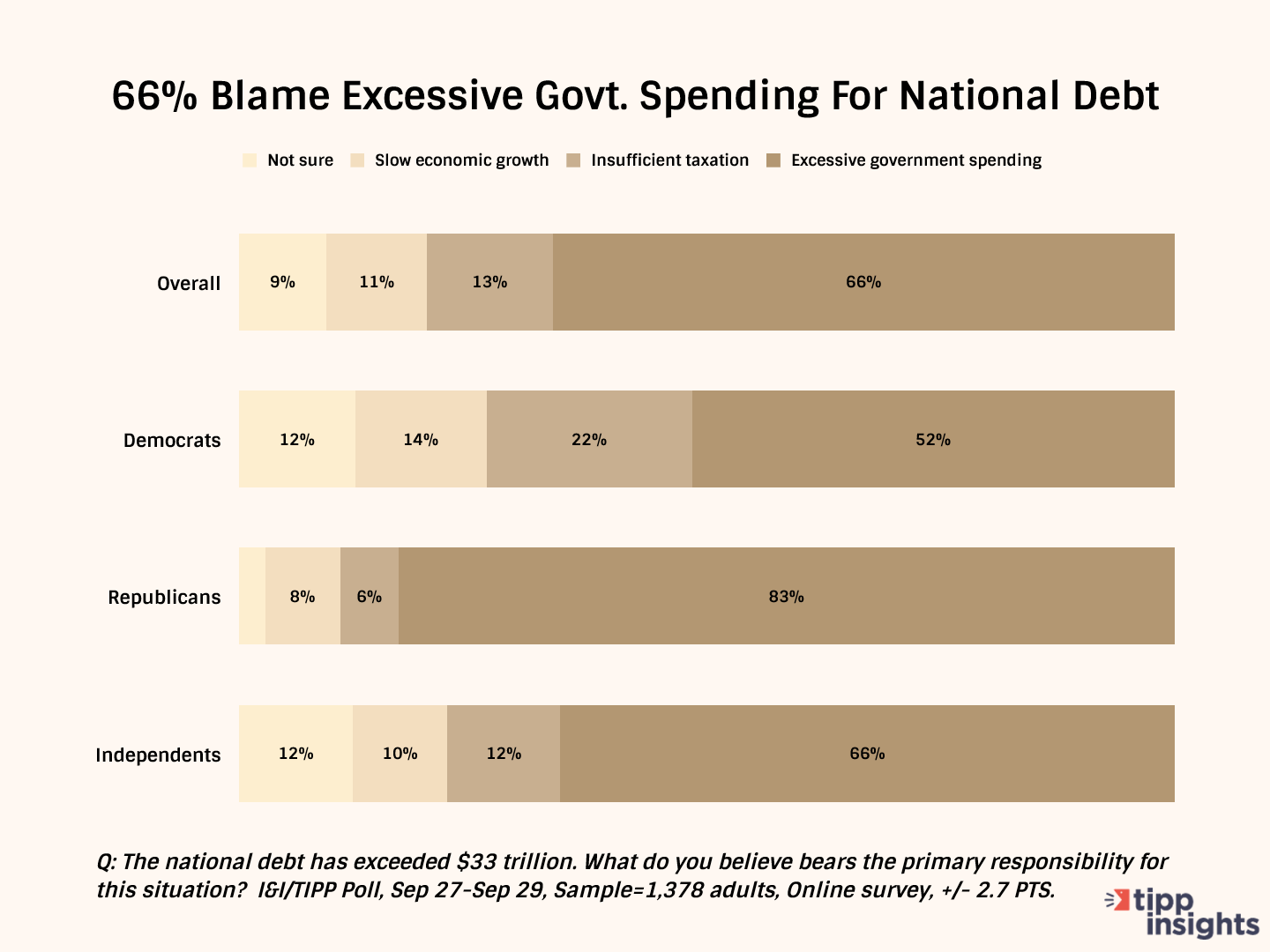
In short, two-thirds of Americans see too much spending as fueling our record debt. And perhaps the most surprising thing is that a majority in each major political group agrees.
Even among Democrats, 52% faulted spending for the debt buildup, while 22% said not enough taxes and 14% blamed slow economic growth. Another 12% weren’t sure.
For Republicans, no great shock, a hefty 83% fingered too much spending as the culprit, while 6% claimed insufficient taxes and 8% said not enough economic growth were to blame.
As usual, independents, many of whom are political refugees from the two parties, split the difference: 66% blamed too much spending for our debt woes, while only 12% faulted not enough taxes and 10% pointed to insufficient economic growth.
Among all the demographic groups tracked by the I&I/TIPP Poll, only two fell below 50% on blaming too much spending for our national debt surge: Hispanic voters (48%) and self-described liberals (47%). A majority of black voters, at 51%, pointed at too much spending as the cause of our rising debt.
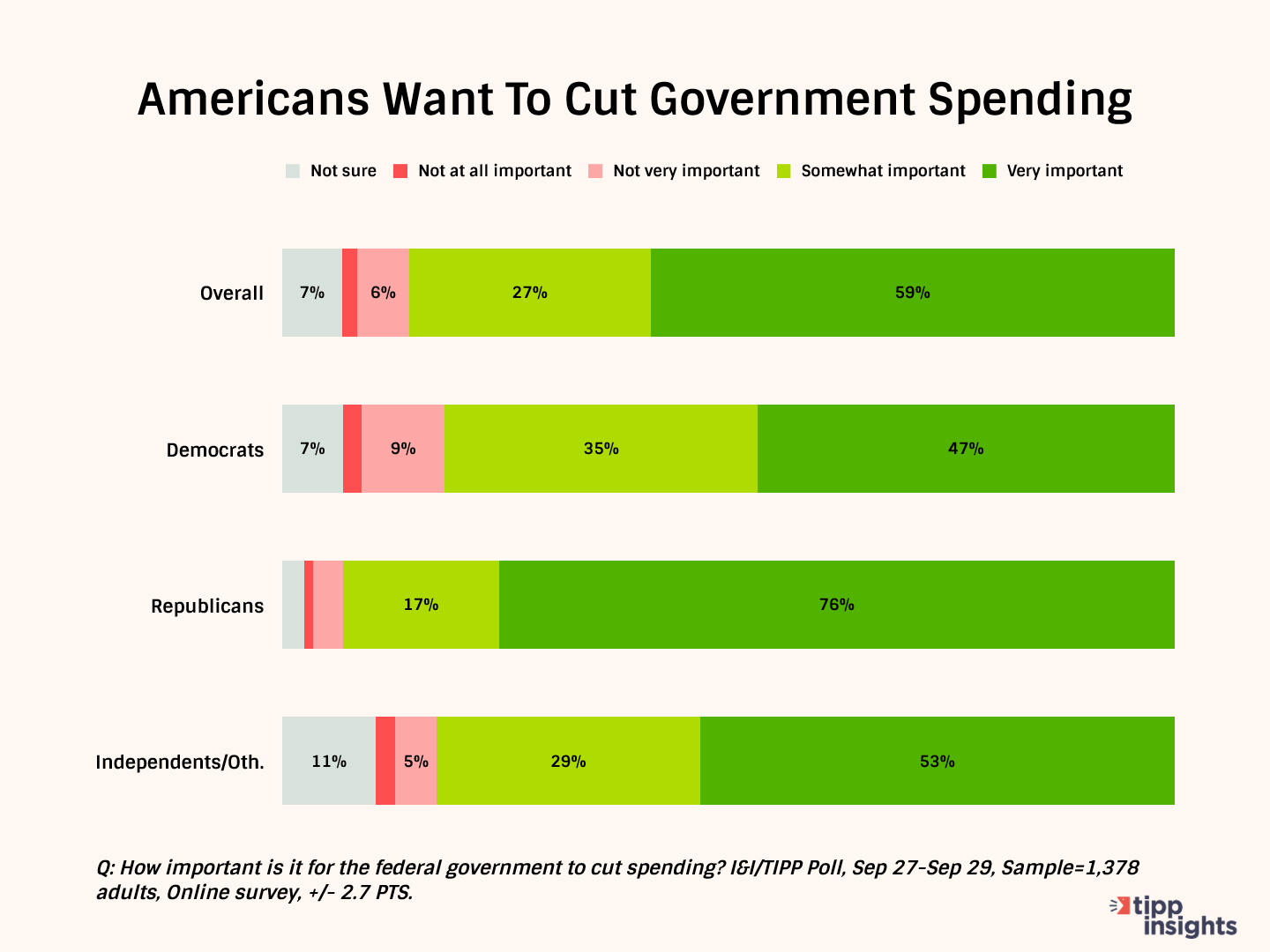
A follow-on question was asked: “How important is it for the federal government to cut spending?” Turns out, it’s consequential to almost all Americans. Among those answering, 86% called it either “very important” (59%) or “somewhat important” (27%).
Only about 7% (numbers don’t add up due to rounding) said cutting spending was either “not very important” (6%) or “not at all important” (2%). Another 7% weren’t sure.
And once again, the importance of cutting spending was overwhelmingly tri-partisan, with 82% of Democrats, 93% of Republicans and 82% of independents in clear agreement.
So it’s logical to ask: Will spending ever be cut? And when will the debt stop growing so fast? The just concluded budget negotiations, which narrowly avoided a shutdown, show why the gloomy answer to those questions likely is “no” and “never.”
Saturday’s last-minute agreement to keep the government open for another 45 days largely hinged on debates over funding for Ukraine’s war with Russia (Democrats), border security (Republicans), and disaster aid.
No doubt, eventually a final deal will be hammered out, and triumphant politicians will appear on the steps of the Capitol to hail their great budgetary statesmanship. As always, news outlets will laud the great compromise.
Lost amid all the back-patting, however, will be the fact that federal spending will remain swollen at pandemic levels and grow further in coming years, without the revenues to support them.
And there will be no cuts of any significance in government spending, even though fiscal conservatives had hoped to use the budget fight to reduce outlays and win concessions from Democrats on key policy issues. It didn’t happen.
“They lost that fight miserably,” The Hill observed, describing fiscal conservatives as among the biggest “losers” of the budget battle.
“After 21 conservatives sunk a GOP-only stopgap bill, (House Speaker Kevin) McCarthy ditched partisan strategies and rolled out a stopgap bill that continues funding at current levels, turning longtime conservative worries into reality. It cleared the chamber with more support from Democrats than Republicans,” the Hill wrote.
More spending means more debt. It’s inescapable.
Total federal debt today stands at $33 trillion, up from $21.5 trillion just five years ago. Put another way, one of every three dollars the U.S. owes has been borrowed in the last five years, a shocking level of debt growth that is now starting to pinch.
In short, government is spending way too much.
From August 2022 to this July, federal spending was roughly $6.7 trillion, an increase of 16%, while revenue came in at just $4.5 trillion. a 7% decrease, according to the nonpartisan Committee for a Responsible Federal Budget. This has pushed interest rates to 20-year highs.
It won’t get any better. This year, the deficit will hit $2 trillion again, on its way even higher, after briefly dropping last year to just $1 trillion in what was then hailed as a turnaround for the economy. More deficits equal more debt.
“The federal budget deficit in the first 10 months of the 2023 fiscal year has more than doubled compared to the same period last year, increasing by 122%,” according to a Washington Examiner analysis. “On Aug. 1, one of the three major credit rating agencies, Fitch, downgraded U.S. debt from a AAA rating to AA+ specifically because of that soaring debt.”
Now the deficit for the just-ended fiscal year is expected to hit $2 trillion, twice the level predicted, after briefly dropping in 2022 to “just” $1 trillion in what was then hailed as a fiscal turnaround for the economy.
The new debt issued to cover the federal government’s incessant spending growth will push up net federal interest payments to nearly $1 trillion a year by 2026, more than we will spend on either entitlements or defense and up from around $350 billion in 2021, as Issues & Insights showed recently.
But didn’t we need all that spending to save the economy? Hardly, as the Center for Budget Priorities points out, only 12% of spending today is “discretionary.” Everything else, all 88% of it, is spending that is almost impossible to cut without broad agreement in Congress.
Voters desperately want spending cut and less debt at the federal level, as the I&I/TIPP Poll clearly indicates. But as long as Americans vote for politicians who want more spending, more regulation and more debt, they’re likely to remain deeply disappointed.
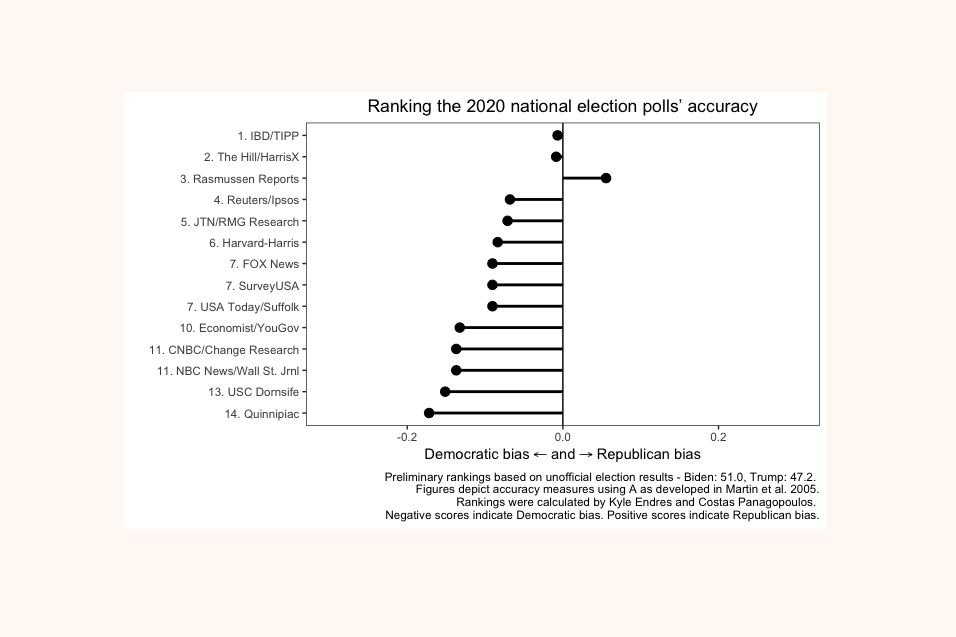
I&I/TIPP publishes timely, unique, and informative data each month on topics of public interest. TIPP’s reputation for polling excellence comes from being the most accurate pollster for the past five presidential elections.
Terry Jones is an editor of Issues & Insights. His four decades of journalism experience include serving as national issues editor, economics editor, and editorial page editor for Investor’s Business Daily.
Want to dig deeper? Download crosstabs from our store for a small fee!
Our performance in 2020 for accuracy as rated by Washington Post:
TIPP Takes
Geopolitics And Geoeconomics
1. Setback For Vladimir Putin As Russia Withdraws Black Sea Fleet From Crimea: Report – WION
Russia has pulled out its Black Sea Fleet from the occupied Crimea region, indicating that it resulted from increased Ukraine missile and drone attacks.

If the reports are accurate, this would be the biggest setback for Russian President Vladimir Putin, who occupied Crimea from Ukraine in 2014.
2. UK Warns Of Russia Laying ‘Sea Mines’ To Deter Black Sea Cargo Ships – Al Jazeera
Russia may use sea mines against civilian shipping in the Black Sea by laying them on the approach to Ukrainian ports, the United Kingdom has said, citing intelligence sources.

The warning comes as Ukraine’s navy said that 12 cargo vessels were ready to enter a fledgling Black Sea shipping corridor on their way to Ukrainian ports, a significant increase in maritime traffic to Ukraine in defiance of a de facto Russian blockade of the country’s sea ports.
3. Russia Claims Ukraine Fired Cluster Munitions At Border Town – Al Arabiya
“The border town of Rylsk was shelled with cluster munitions coming from Ukraine,” Roman Starovoit, governor of the Kursk region, claimed.

Moscow had criticized President Joe Biden’s administration for supplying Ukraine with cluster munitions. Minister of Defense Sergei Shoigu said in August that the U.S. had previously called cluster munitions a war crime. However, today, it is “committing this crime in Ukraine.”
4. Ukraine War: U.S. Gives 1.1 Million Rounds Of Ammunition Seized From Iran To Kyiv – BBC
The U.S. Central Command (Centcom) oversees operations in the Middle East, says the rounds were confiscated from a ship bound for Yemen in December.

Centcom says the Iranian rounds, 7.62mm caliber used in Soviet-era rifles and light machine guns, were transferred to Ukraine on Monday.
Iran backs the Houthi rebels in Yemen’s ongoing civil war, but arms transfers to the group are barred under a 2015 resolution by the UN Security Council.
5. Turkey To Host Gathering Of Allies To Discuss Peace In Ukraine – Bloomberg
The meeting is tentatively scheduled for later this month in Istanbul.

It follows similar gatherings in Denmark in June and Saudi Arabia in August. Participants will discuss ideas for reaching a lasting peace in Ukraine.
Russia is not invited and has denounced the previous meetings as illegitimate.
6. How China Is Fighting In The Grey Zone Against Taiwan – BBC
When Taiwan raised the alarm last month over a record number of Chinese fighter jets crossing the unofficial border between them, Beijing said that line did not exist.

So far, the maneuvers have stayed within a gray zone: military speak for tactics that fall between war and peace. Grey zone warfare tactics are aimed at weakening an adversary over a prolonged period – and that is exactly what China is trying to do with Taiwan, observers say.
7. Taiwan To Tighten Tech Safeguards Against China This Year – Nikkei Asia
Taiwan is set to announce this year a list of critical technologies it wants to protect from the reach of China, a top Taiwanese official said.

“The policy will define national core technologies and cover industries including semiconductors, agriculture, aerospace, and ICT [information and communication technology],” Wellington Koo, secretary-general of Taiwan’s National Security Council, said.
Taiwan shares concerns the U.S., Japan, and other governments hold about China’s push for advanced technologies.
8. China Seeks To Control Pak Media To “Combat Disinformation”: Report – PTI
In addition to working closely with Russia in the information space, China has attempted to enlist other close partners to counter unfavorable narratives, the U.S. State Department said in a report. Prominent among them is Pakistan, it said.

According to the report in 2021, China sought to negotiate significant control over Pakistani media as part of the China-Pakistan Media Corridor, including establishing a jointly operated “nerve center” to monitor and shape Pakistan’s information environment.
9. European Union Countries Agree On Plan To Reform Migration Rules – RFI
Ambassadors from the 27 countries struck the deal after Italy and Germany ironed out a last-minute row over charities rescuing migrants stranded in the Mediterranean.

The goal of the EU is to have the long-stalled reforms, summarized in the new Pact on Migration and Asylum, made law before the European elections next June that will usher in a new European parliament and commission.
10. Japan To Buy Tomahawks From U.S. In FY 2025, 1 Yr Sooner Than Planned – Kyodo News
Japan will start procuring Tomahawk cruise missiles a year earlier than initially planned in response to the worsening Asian security environment, Defense Minister Minoru Kihara said.

As part of preparations to acquire “counterstrike” capabilities, or the ability to hit enemy bases should the need arise, Japan plans to purchase 400 Tomahawks with a strike range of about 1,600 kilometers.
11. South Korea Warns N. Korea Will Face End Of Regime In Event Of Nuclear Use Attempt – Yonhap
The South Korean defense ministry issued the warning after the North convened a key parliamentary meeting last week, with its leader Kim Jong-un in attendance, to stipulate the policy of strengthening its nuclear force in the constitution.

The ministry also said the North is making undisguised efforts to advance its nuclear capabilities at a time when the livelihoods of its people have been ravaged.
12. South Korea, U.S. Closely Monitoring N. Korea For Signs Of Nuclear Reactor Halt – Yonhap
The allies’ intelligence authorities have detected signs indicating the 5-megawatt reactor in the Yongbyon nuclear complex temporarily stopped operations late last month.

South Korean and U.S. officials believe the move could be related to reprocessing spent fuel rods to extract weapons-grade plutonium.
In April, 38 North, a U.S. website dedicated to analyzing North Korea, said North Korea appeared to be expanding and refurbishing the complex in Yongbyon, citing commercial satellite imagery.
13. Voice Referendum: Indigenous Rights Vote Is A Reckoning For Australia – BBC
On 14 October, Australia will vote in a historic referendum that cuts to the core of how it sees itself as a nation.

If successful, the proposal – known as the Voice – will recognize Aboriginal and Torres Strait Islander people in the constitution while creating a body for them to advise governments on the issues affecting their communities.
14. Hottest September On Record, With 2023 On Track For Hottest Year Ever – RFI
Global average temperatures from January to September were 1.4 degrees Celsius higher than the pre-industrial average (from 1850 to 1900), almost reaching the 1.5-degree warming limit set by the 2015 Paris Agreement, made at the COP21 UN climate conference.

The limit was seen as essential to avoid the most catastrophic consequences of climate change.
15. Women Are Asking For Promotions, But Men Keep Getting Them: Report – Bloomberg
For every 100 men promoted to a manager role in 2022, only 87 women received the same boost, according to the Women in the Workplace report.

Sheryl Sandberg’s LeanIn.Org and McKinsey & Co conducted the study. The survey found that the number of women promoted increased from 86 in 2021, but they’re still getting overlooked despite asking for promotions at the same rate as men.
Please email [email protected]
Republished with permission from TIPP Insights