- Bidenflation at 17.3% erodes Americans’ purchasing power
- Annualized Bidenflation hits 5.9%, nearly double the CPI
- Core prices are stubborn at 3.9%
- Real wages lag by 2.0% since Biden took office
- RELATED: Economic Shock: 2/3 Of Americans Living ‘Paycheck To Paycheck’ Under Biden: I&I/TIPP Poll

The dark reality of Bidenomics is 17.3% inflation under the President’s watch. When he took office, inflation was at just 1.4%. Inflation has stayed above the Federal Reserve’s 2% target for 35 consecutive months since March 2021.
Average hourly earnings for all employees dropped 2.0% to $11.16 in January from $11.39 in January 2021 when Biden assumed office. Despite nominal salary increases at their fastest pace in years, 58% of Americans say they are now worse off than when the President took office.
In short, prices have increased by 17.3%, while real wages have declined by 2.0%, meaning Americans have taken a 2.0% pay cut under the current administration. To put it differently, people now need 19.3% more income than they had in January 2021 to maintain their living standards. According to some estimates, Americans need an extra $11,400 a year to make ends meet.
How do Americans make up the shortfall?
The Labor Department reported earlier this month that 8.13 million Americans had multiple jobs in January, up from 7.87 million a year earlier. Their share of the U.S. workforce is 5.1%, up from 5% a year before.
Americans also use credit cards to make up for the shortfall. Credit card debt has climbed 40% over the past two years and is near $1.1. trillion. For example, Discover’s credit card customers are carrying $102 billion in balances on their credit cards, up 13% from last year. The charge-off rates and 30-day delinquency rates have also climbed.
Inflation acts as an indirect tax on citizens. Due to entrenched inflation without corresponding real wage growth, most Americans (60%) live paycheck to paycheck, cutting expenses to make ends meet. A quarter (24%) have nothing set aside for financial emergencies.
Rising rent and the end of pandemic-era protections are contributing to the homelessness crisis. Bidenflation and the Fed’s eleven rate hikes to reduce inflation have made housing unaffordable for many people and caused displacements.
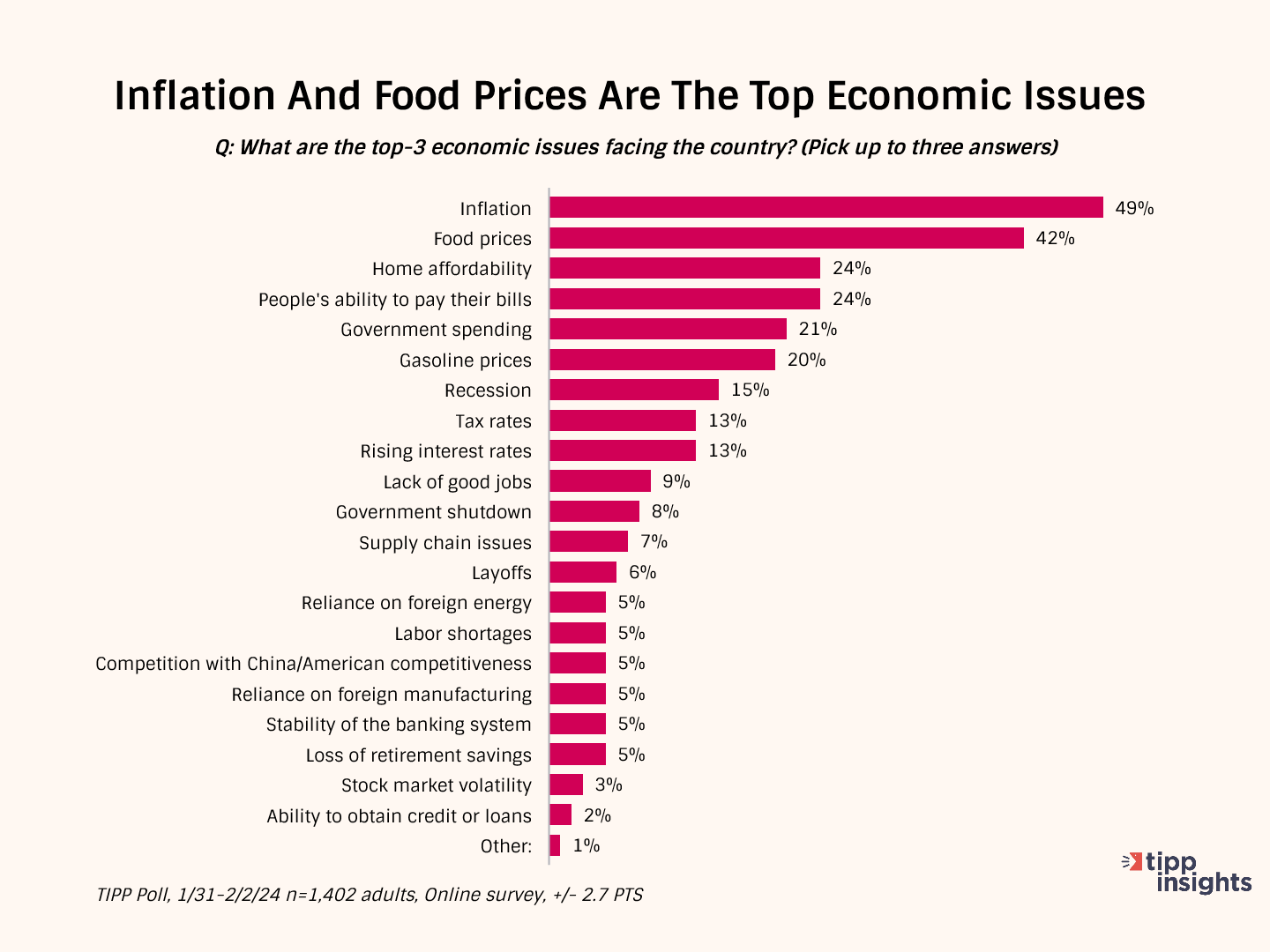
Therefore, it is no surprise that inflation and food prices emerged as Americans’ top economic issues in a recent nationwide TIPP Poll.
CPI Report
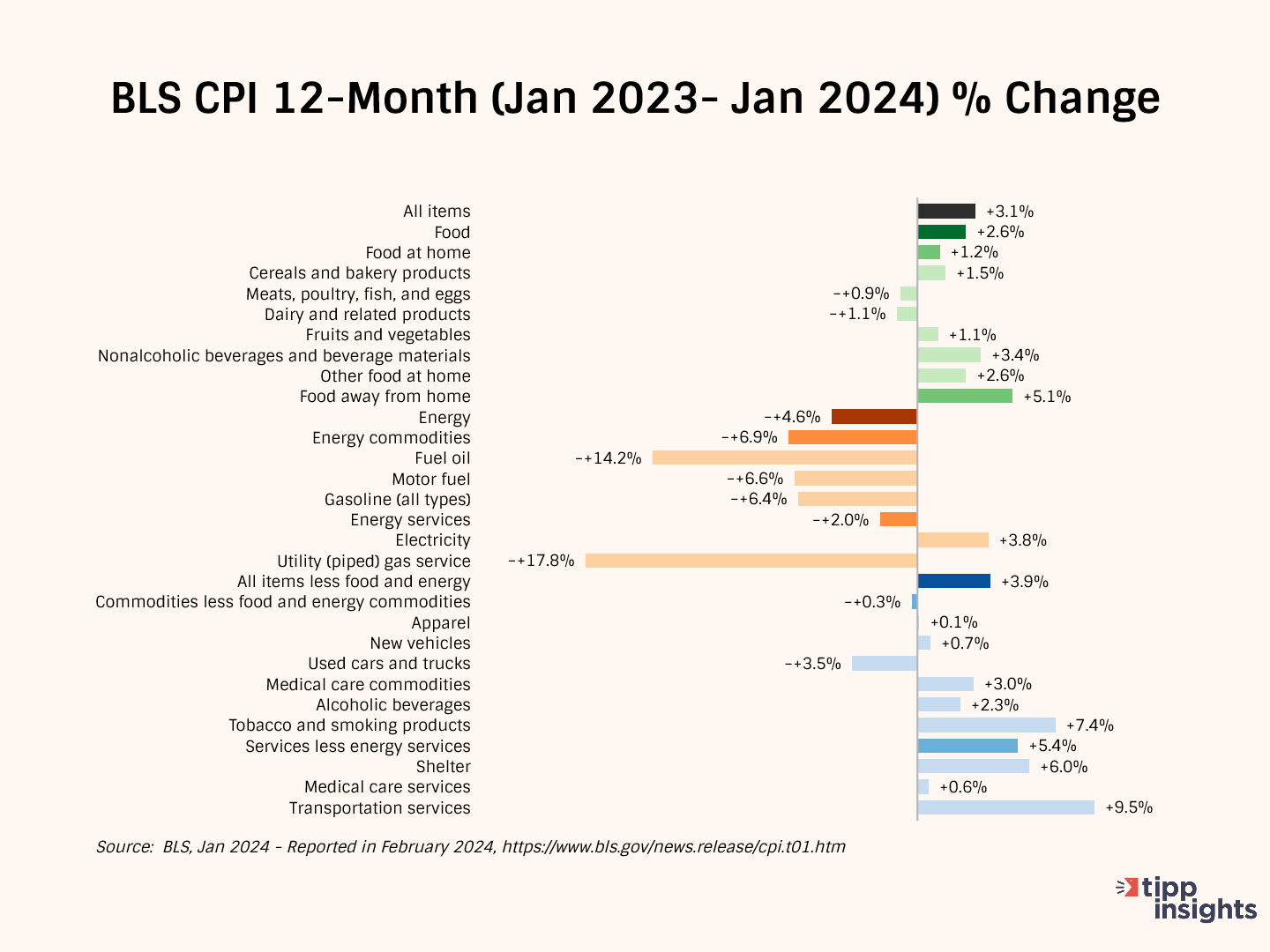
The Consumer Price Index (CPI) released by the government on Thursday showed a 3.1% year-over-year price increase from January 2023 to January 2024.
The CPI rate had declined steadily for 12 consecutive months from a 40-year high of 9.1% in June 2022 to 3.0% in June 2023. In July, it broke that run and increased to 3.2%. Since then, it has moved sideways in the 3.1% to 3.7% range.
After adjusting for seasonality, the CPI increased by 0.3% between December 2023 and January 2024. In the same period, Food prices rose by 0.4%, Energy prices declined by 0.9%, and All items except food and energy (Core) increased by 0.4%.
TIPP CPI
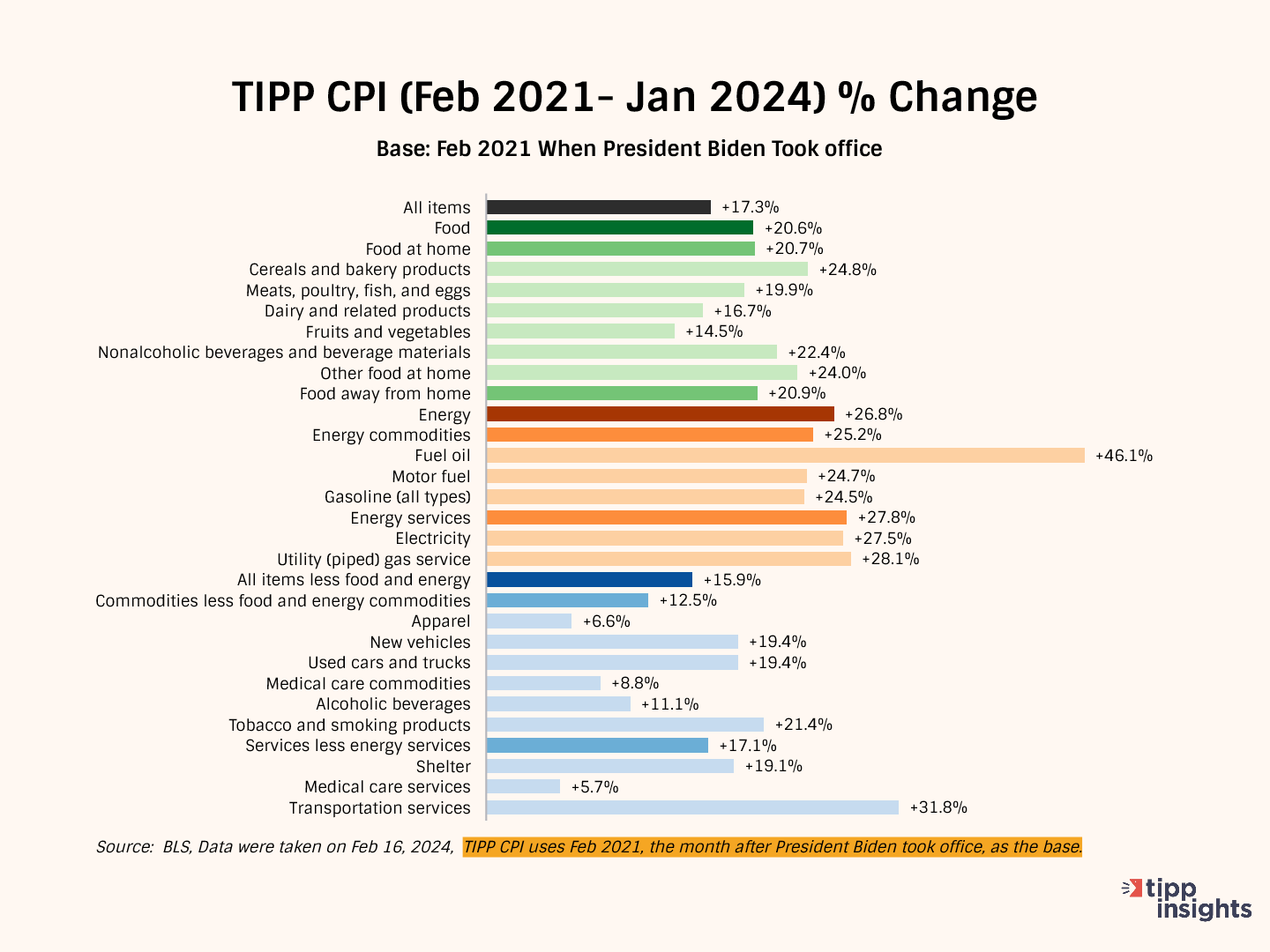
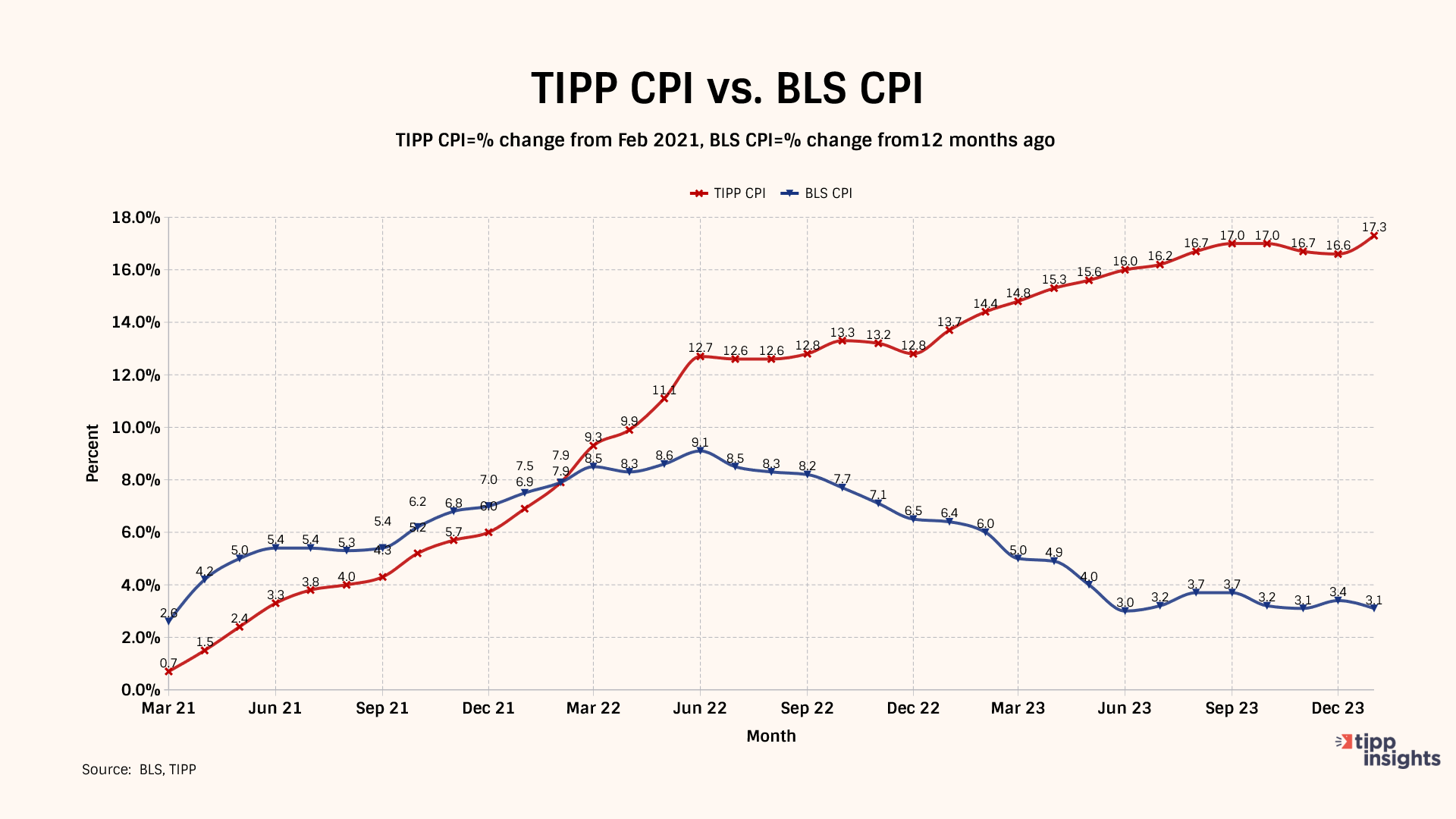
We developed the TIPP CPI, a metric that uses February 2021, the month after President Biden’s inauguration, as its base to measure the rate of change. All TIPP CPI measures are anchored to the base month of February 2021, making it exclusive to the economy under President Biden’s watch.
What is the motivation behind the TIPP CPI?
The BLS CPI rate doesn’t accurately capture Americans’ inflation struggles. Further, the media and some economists frequently use the low CPI rate to present a rosy economic outlook supporting Biden’s policies. The official BLS CPI year-over-year increases will compare prices to already inflated bases in the coming months, and these statistics could mask the full impact.
In contrast, the TIPP CPI rate is more objective, offering a clearer understanding of Americans’ economic challenges under President Biden. We use the relevant data from the Bureau of Labor Statistics (BLS) to calculate the TIPP CPI, but we adjust the period to Biden’s tenure. When discussing the TIPP CPI and the BLS CPI, we convert the index numbers into percentage changes to better understand and compare them. CPIs are like index numbers that show how prices affect people’s lives, similar to how the Dow Jones Industrial Average reflects the stock market.
Bidenflation, measured by the TIPP CPI using the same underlying data, increased to 17.3% in January. It was 16.6% in December, 16.7% in November, and 17.0% in October.
TIPP CPI vs. BLS CPI
The following four charts present details about the new metric.
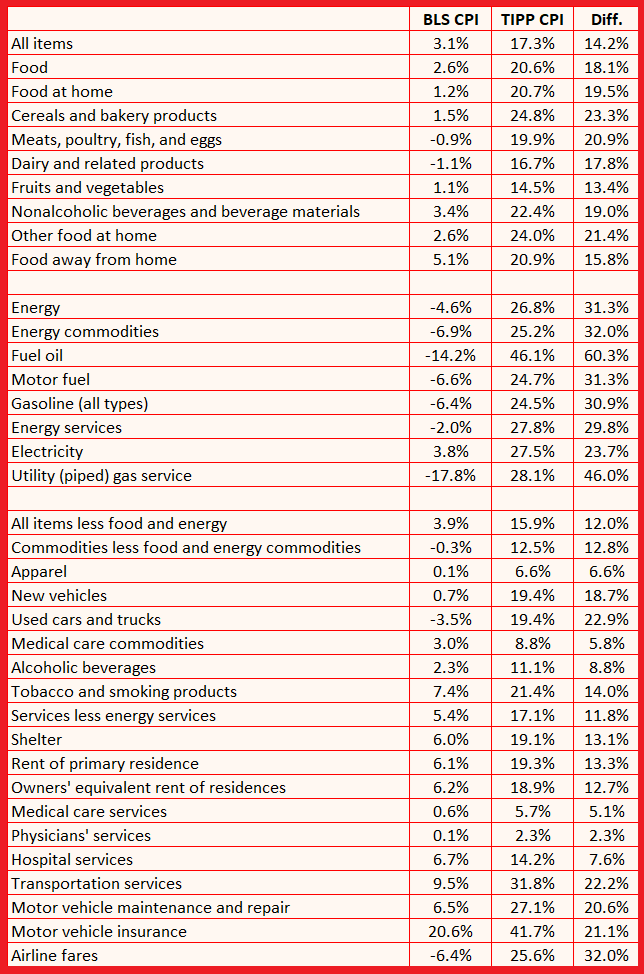
For January 2024, the BLS reported a 3.1% annual CPI increase. Compare this to the TIPP CPI of 17.3%, a 14.2-point difference. Prices have increased by 17.3% since President Biden took office. On an annual basis, TIPP CPI is 5.9%.
Food prices increased by 20.6% under Biden compared to only 2.6% as per BLS CPI, a difference of 18.1 points.
TIPP CPI data show that Energy prices increased by 26.8%. But, according to the BLS CPI, energy prices improved by 4.6%. The difference between the two is a whopping 31.3 points.
The Core CPI is the price increase for all items, excluding food and energy. The Core TIPP CPI is 15.9% compared to 3.9% BLS CPI in the year-over-year measure, a 12.0-point difference.
Further, gasoline prices have increased by 24.5% since President Biden took office, whereas the BLS CPI shows that gasoline prices have improved by 6.4%, a difference of 30.9 points.
TIPP CPI finds that Used car prices have risen by 19.4% during this President’s term. Meanwhile, the BLS CPI reports that the prices have dropped 3.5%, a difference of 22.9 points.
Inflation for air tickets is 25.6% compared to the BLS CPI’s finding of an improvement of 6.4%, a difference of 32.0 points.
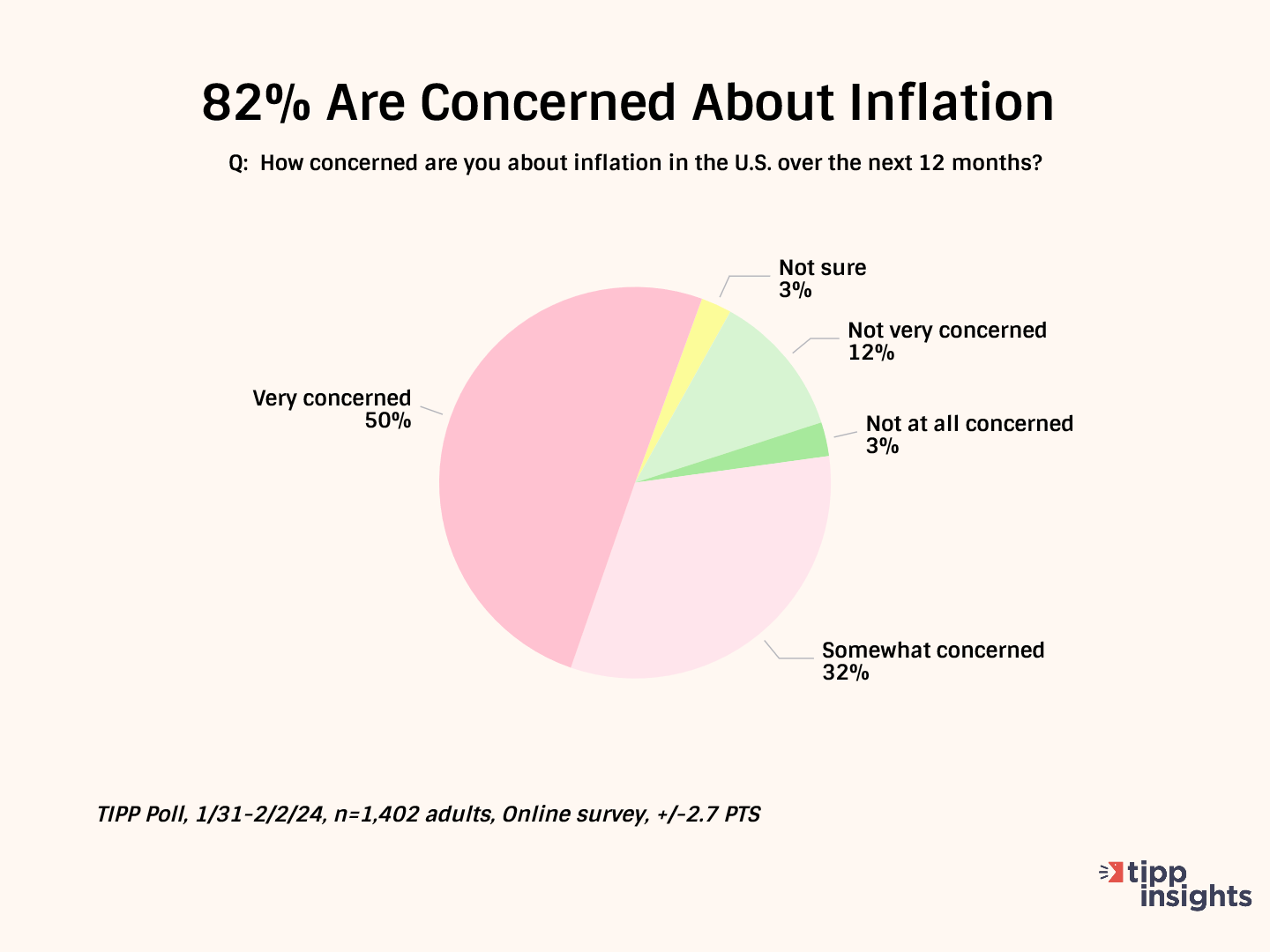
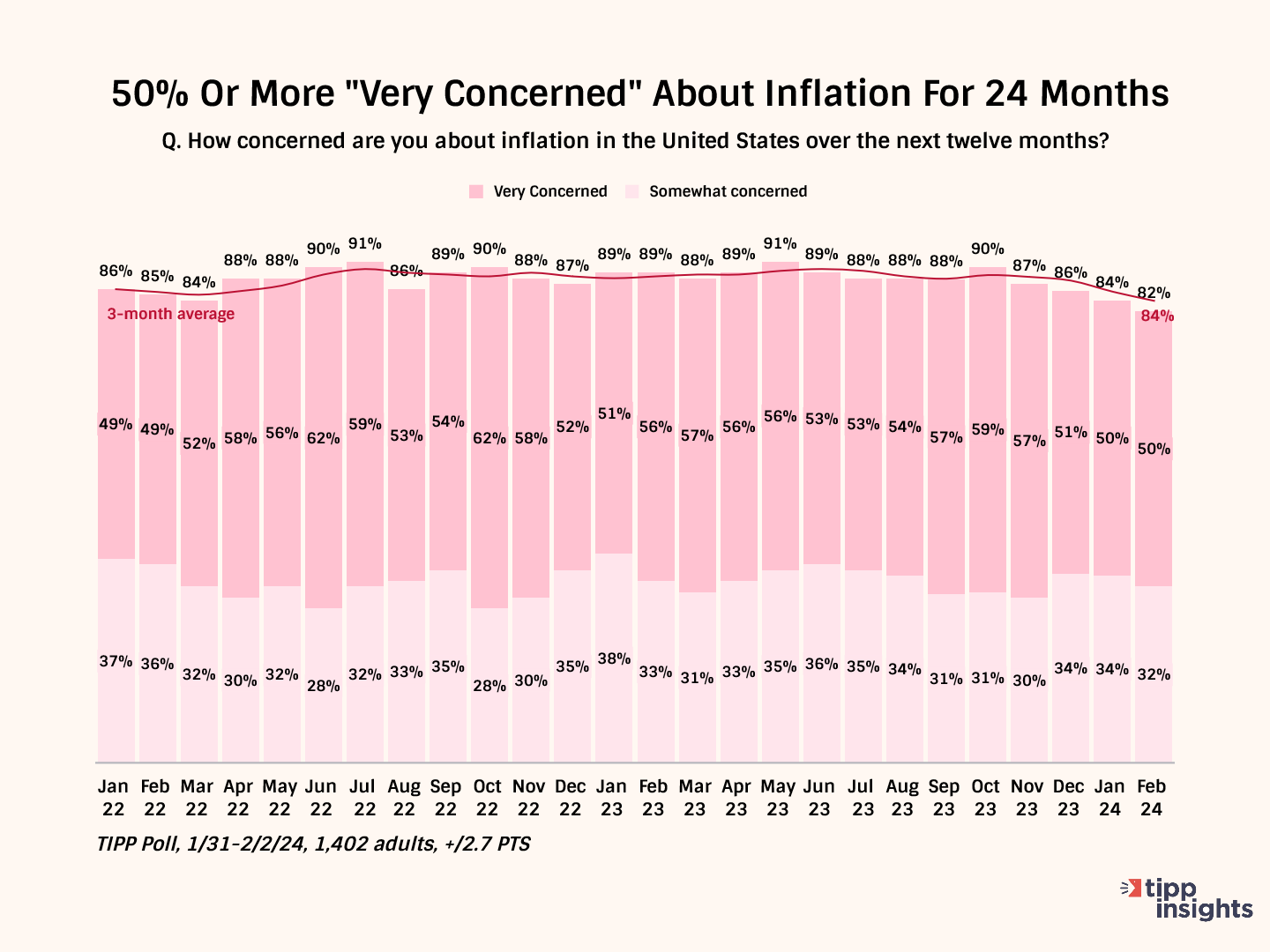
The latest TIPP Poll, completed earlier this month, shows over eight in ten (82%) survey respondents are concerned about inflation. Since January 2022, inflation concerns have stayed above 80%. The “very concerned” share has been at least 50% for twenty-four months.
Why do we track this measure?
It shows that despite the decline in the CPI rate, Americans still feel the pinch of high prices without wage increases. It also fact-checks President Biden’s claims that Bidenomics is working.
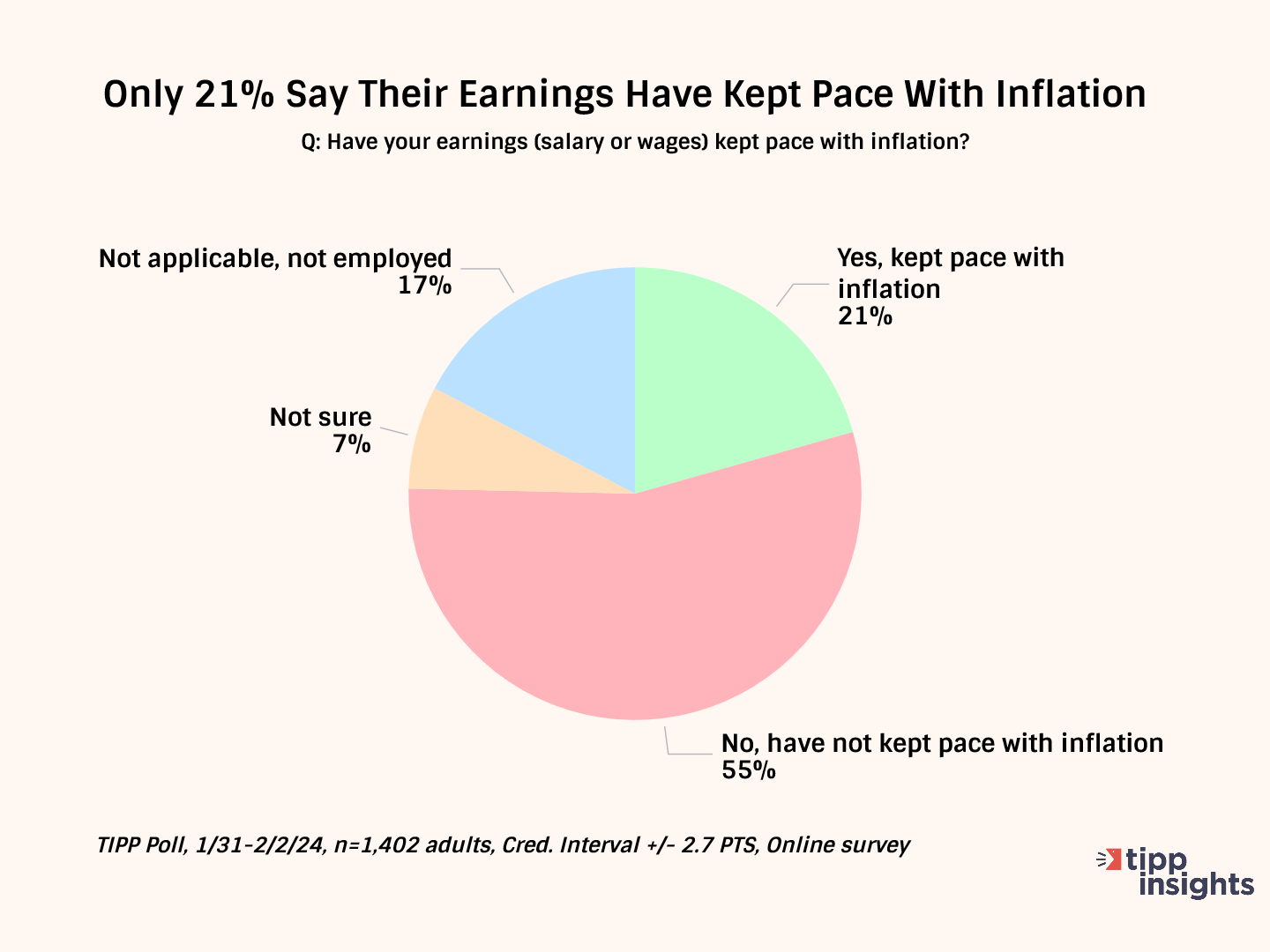
Nearly six in ten (55%) say their wages have not kept up with inflation. Only 21% say their income has kept pace with inflation.
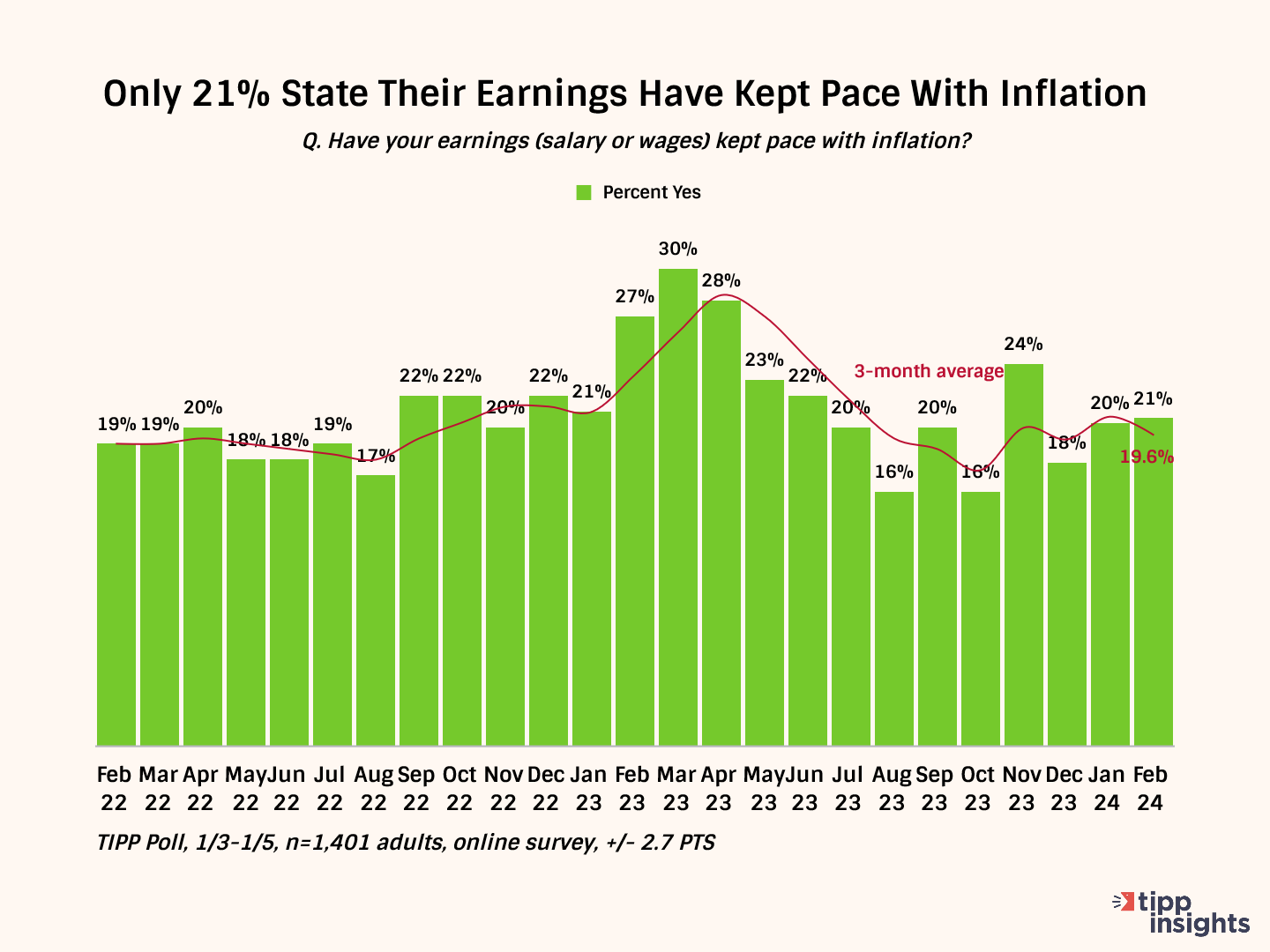
This statistic hovered in the low twenties for most of 2022. The positive change between January 2023 and March 2023 has petered out since May 2023. Notice the steady descent from March last year. It dropped to 21% in February 2024, with a three-month average of 19.6%.
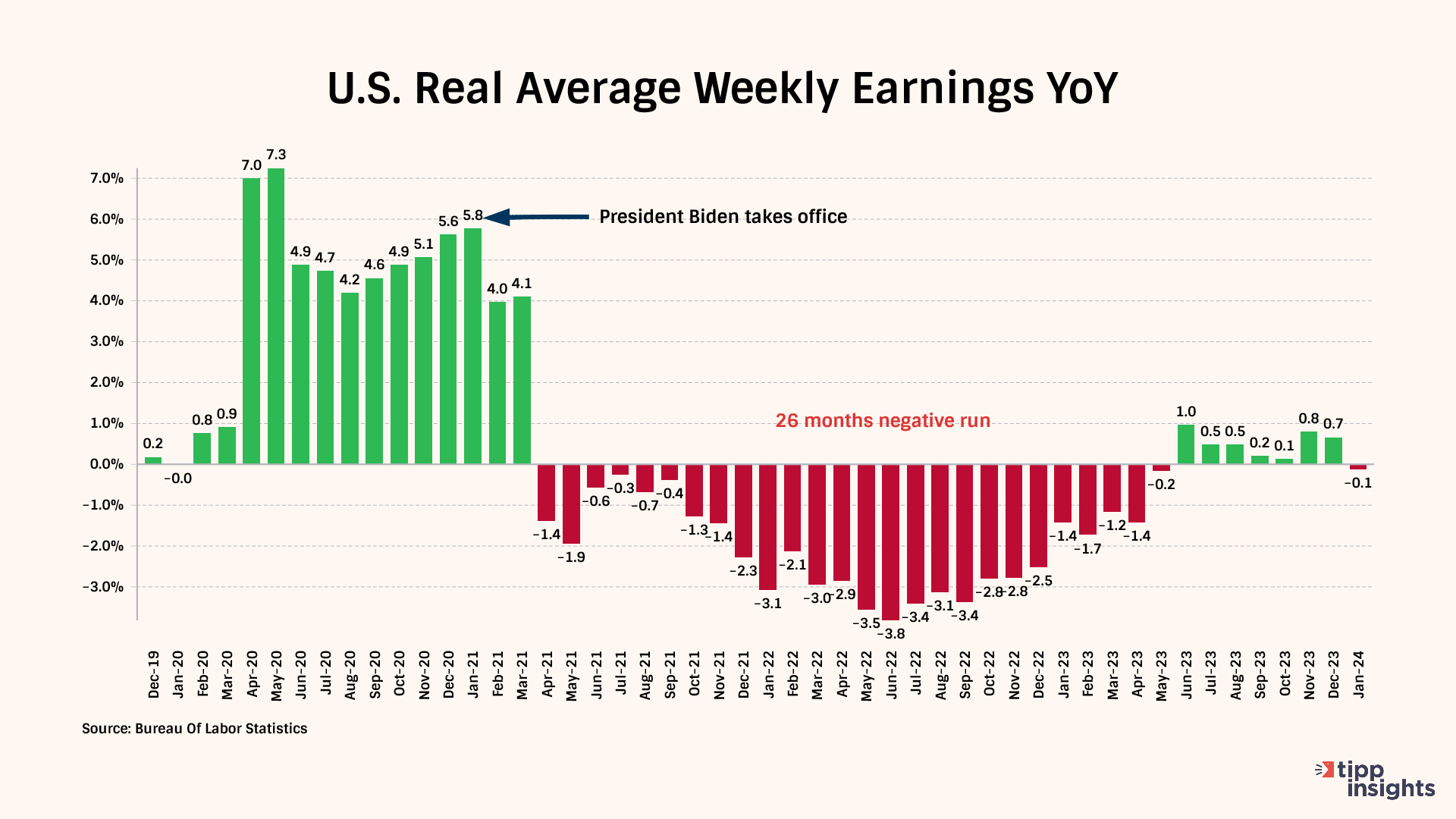
Nominal wages represent the amount of money one earns without considering changes in the cost of living. On the other hand, real wages consider inflation and measure the purchasing power of wages. Real wages provide a more accurate reflection of what is affordable with the income earned by factoring in the changes in the cost of living.
Real weekly wages, measured year-over-year, showed negative readings for 27 out of the 36 months during the Biden presidency from February 2021 to January 2024. The 26-month negative streak was broken in June. The measure posted positive readings for seven months between July 2023 and December 2023, only to record a negative reading in January 2024.
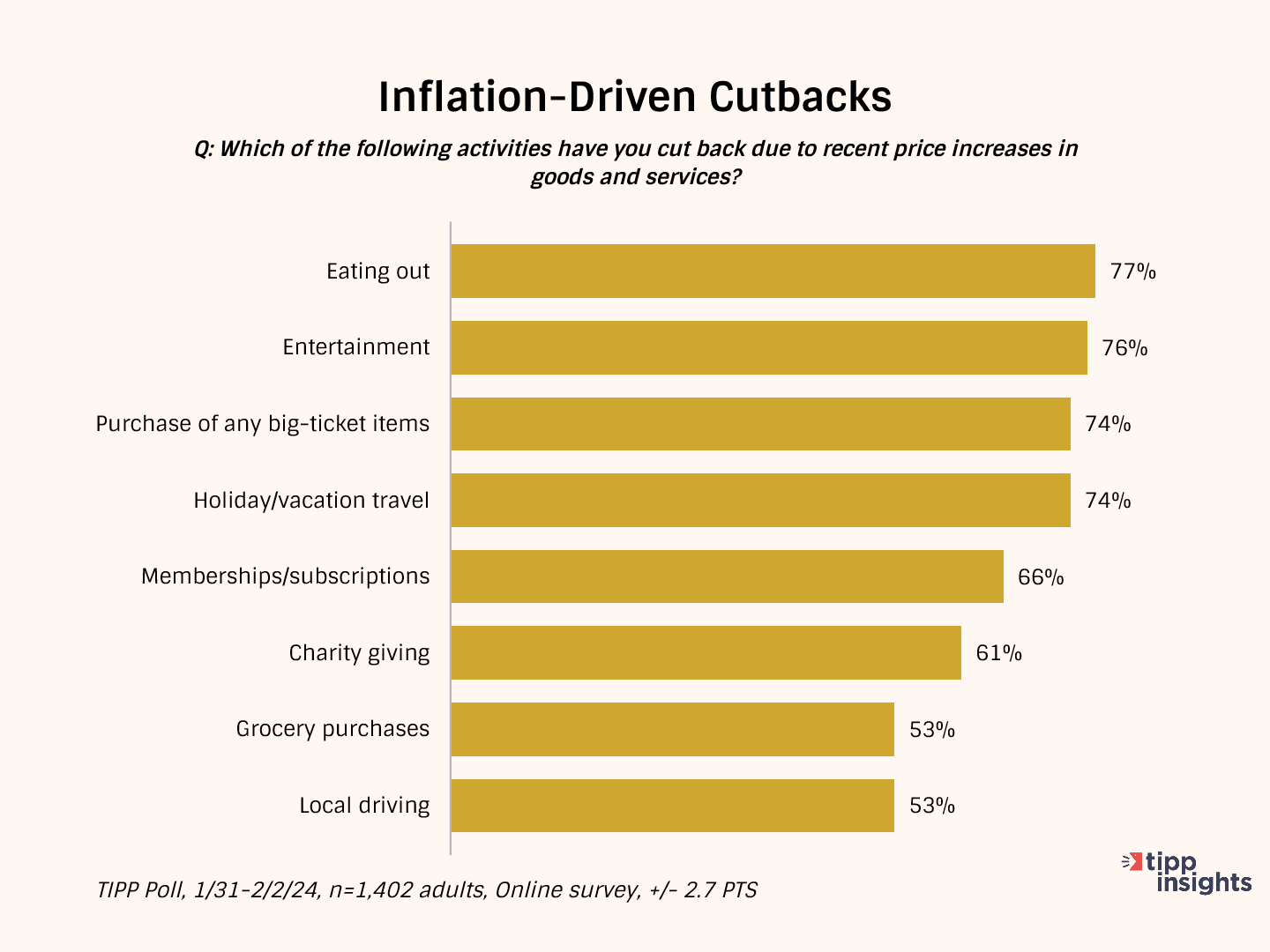
As a result of inflation, Americans are cutting back on household spending.
They are cutting back on eating out (77%), entertainment (76%), purchasing big-ticket items (74%), holiday/vacation travel (74%), and memberships/subscriptions (66%).
Nearly two-thirds (61%) are cutting back on charity giving. Over one-half (53%) of households spend less on groceries. The high gasoline prices forced 53% to cut back on local driving.
Inflation Direction
The chart below compares the 12-month average of monthly changes against the 6-month and the 3-month averages. We also show the reading for January 2024.
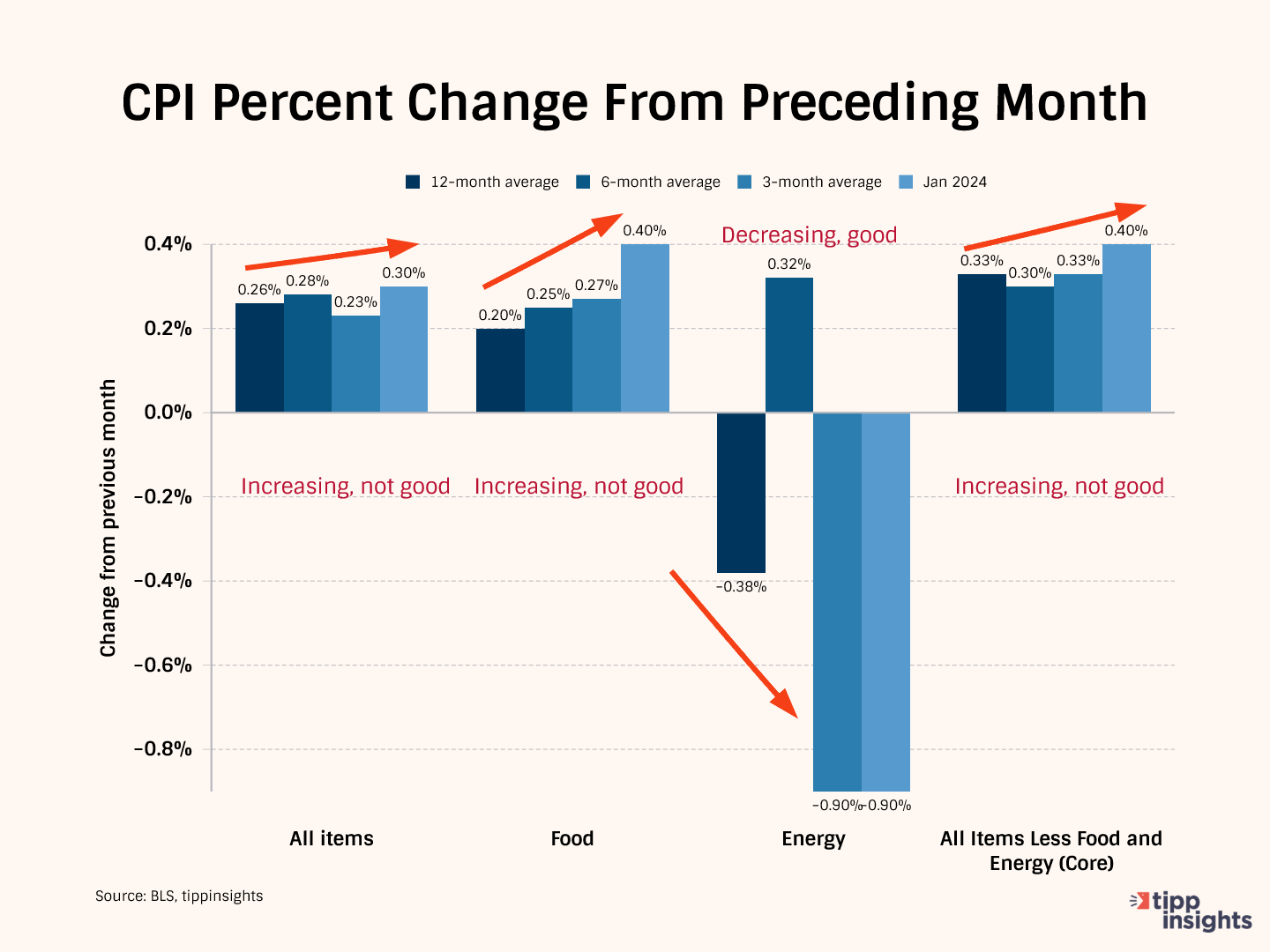
The 12-month average considers 12 data points and presents a long-term reference, while the six-month and three-month averages consider recent data points.
Typically, we compare the data from January 2024 to the three-month average to gain a clearer perspective. In January 2024, the price increase for All items was 0.30%, bigger than the three-month average of 0.23%. This shows a significant deterioration in January.
Meanwhile, the three-month average of 0.23% is lower than the six-month average of 0.28%, indicating a recent slowdown in the rate of increase over the last three months.
Furthermore, the six-month average of 0.28% is greater than the twelve-month average of 0.26%, a deterioration in the trend over the last six months.
This pattern suggests that price increases sharply accelerated in January, a cause for concern.
In January, Food prices rose by 0.40%, greater than the 3-month average of 0.27%, the 6-month average of 0.25%, and the 12-month average of 0.20%. The overall increasing pattern signifies the worsening of food prices and is concerning.
Meanwhile, Energy prices decreased by 0.90%, similar to the three-month average of -0.90%, indicating recent stability. It also outperformed the 12-month average of -0.38% and the six-month average of 0.32%. In summary, the energy situation is improving.
All items less food and energy, known as “core inflation,” was 0.40%, higher than the three-month average of 0.33%, indicating deterioration for the month. Meanwhile, the three-month average of 0.33% was greater than the six-month average of 0.30%. The recent sharp increase in January is worrisome.
In summary, except for energy, we see deterioration in the price of food, core, and all items in January.
Monetary Policy
Since March 2022, the Fed has raised interest 11 consecutive times, bringing its benchmark interest rate to 5.25%, the highest level in 22 years.
With the core CPI entrenched at 3.9% and geopolitical tensions that could lead to volatility in the energy markets, we are unsure of what lies ahead. We believe it won’t be easy to bring CPI inflation down to the Fed’s target of 2.0% with interest rate cuts. Further, the Fed has to strike a delicate balance between election-year pressures and achieving its goals.
In January, the national debt crossed $34 trillion. One downside of ballooning federal debt is that refinancing becomes challenging. Supply and demand in the bond market will drive interest rates. If there is a high supply of government bonds (due to high debt levels), interest rates may need to stay high to attract investors and ensure that the government can continue borrowing money.
Most Americans are concerned about the sustainability of this trajectory. The high interest rates are also hurting Americans and sapping their confidence.
Federal Reserve Chair Jerome Powell echoed Americans’ struggles in a recent interview with “60 Minutes:
People are experiencing high prices. If you think about the basic necessities like bread and milk and eggs and meats of various kinds, prices are substantially higher than they were before the pandemic.
Powell succinctly summed up living in Biden’s America and must tell it to the President, who believes Bidenomics has been a stellar success.
To access the TIPP CPI readings each month, you can visit tippinsights.com. We’ll publish the TIPP CPI and our analysis in the days following the Bureau of Labor Statistics (BLS) report. The upcoming release of TIPP CPI is on March 13, 2024. We’ll also post a spreadsheet in our store for download.
Hey, want to dig deeper? Download data from our store for a small fee!
Want to understand better? We wrote an explainer on inflation that sixth graders could understand. Everyone can benefit from it. Milton Friedman’s Priceless Lessons On Inflation.
We could use your help. Support our independent journalism with your paid subscription to keep our mission going.
TIPP Takes
Geopolitics, Geoeconomics, And More
1. Israel’s Defense Chief Says Military ‘Thoroughly Planning’ Offensive In Rafah – A.P.
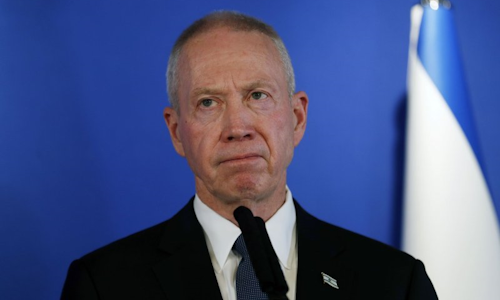
Defense Minister Yoav Gallant said that Rafah is “the next Hamas center of gravity” Israel plans to target.
President Joe Biden has urged Israel not to carry out the operation without a “credible” plan to protect civilians and to instead focus on a cease-fire, while Egypt has said an operation could threaten diplomatic relations between the countries. Many other world leaders have issued similar messages of concern.
2. Israel-Gaza War: Satellite Images Show Construction On Egypt’s Border – BBC
Satellite images appear to show extensive construction work in progress along Egypt’s border with Gaza, which reports claim is being carried out in preparation for housing Palestinian refugees.

Unnamed Egyptian sources reportedly said the work is being done to set up an isolated buffer zone containing a walled enclosure in Egypt’s North Sinai province in case Israel goes ahead with its planned ground offensive in Gaza’s southernmost city, Rafah. Egypt has publicly denied making any such preparations.
3. U.S. Quietly Working To Resolve Lebanon-Israel Conflict: Amos Hochstein – Al Arabiya
“A more comprehensive war is not the solution,” senior White House advisor Amos Hochstein said.

Pentagon and Biden administration officials said the deployment of thousands of U.S. troops to the region, as well as warships off the coast of Israel, were meant to deter Hezbollah and other Iran-backed groups from opening a second front on Israel.
4. World Court Holds Hearings On Israel’s Occupation Of Palestine – Reuters
A record 52 states will present arguments about the legal consequences of Israel’s occupation of the Palestinian territories at the International Court of Justice (ICJ), the UN’s highest legal body.
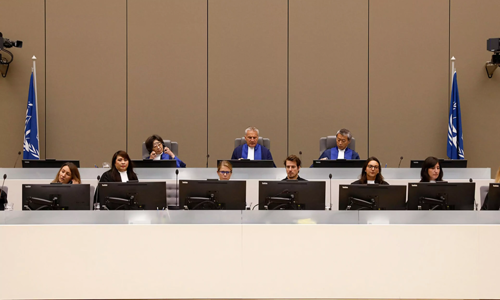
The ICJ’s six days of hearings, starting on Monday, come after the UN General Assembly asked the court in 2022 for an advisory or non-binding opinion on the occupation. While Israel has ignored such opinions in the past, it could add political pressure over its ongoing operation in Gaza.
5. Russia Announces Death Of Opposition Leader Alexey Navalny In Prison – Al Jazeera
Imprisoned Russian opposition leader Alexey Navalny has died, state media reported, citing the prison service of the region where he had been serving a 19-year sentence on charges of extremism.

In a statement quoted by state media, the federal prison service said Navalny “felt bad” after a walk and lost consciousness “almost immediately.” There was no immediate confirmation of the 47-year-old’s death from his team on Friday.
The Russian prosecutor’s office has warned Russians against participating in a mass protest in the center of Moscow after news of the death was reported.
6. ‘Putin Is Responsible’ – Biden Speaks Out After Report Of Navalny’s Death – BBC
President Joe Biden says Vladimir Putin is “responsible” after reports of Navalny’s death triggered a wave of condemnation from leaders around the world.
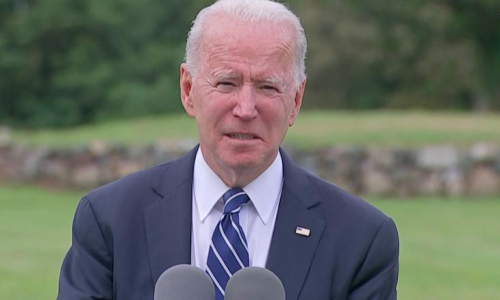
The Biden administration is calling for an investigation into the death of Russian opposition leader Alexei Navalny. This call echoes a statement that we heard earlier from the UN Human Rights Office, which went on to add that when a person dies in state custody, the presumption is that the state itself is responsible.
7. Ukraine Withdraws Troops From Avdiivka Amid Acute Shortage Of Ammunition – Reuters
Ukrainian troops withdrew from the devastated eastern town of Avdiivka, Ukraine’s new army chief said, paving the way for Russia’s biggest advance since May 2023 when it captured the city of Bakhmut.
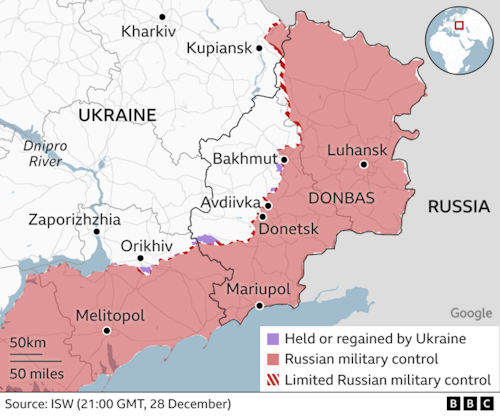
The withdrawal, announced as Ukraine faces acute shortages of ammunition with U.S. military aid delayed for months in Congress, aimed to save troops from being fully surrounded by Russian forces after months of fierce fighting, Kyiv said.
8. Russia’s Invasion Of Ukraine Has Probably Cost Up To $211 Billion, U.S. Official Says – Reuters
Russia has probably spent up to $211 billion in equipping, deploying, and maintaining its troops for operations in Ukraine. A senior U.S. defense official said that Moscow has lost more than $10 billion in canceled or postponed arms sales.

The war had cost Russia an expected $1.3 trillion in previously anticipated economic growth through 2026, and about 315,000 Russian troops had either been killed or injured so far, the official added.
9. Zelenskyy Inks French, German Defense Pacts – D.W.
Ukrainian President Volodmyr Zelenskyy signed off on “ambitious” security deal with French President Emmanuel Macron in Paris.

The deal will last ten years and includes a French promise of up to €3 billion ($3.2 billion) in aid for 2024. Also, German Chancellor Olaf Scholz and Zelenskyy signed a bilateral security agreement valued at €1.1 billion ($1.18 billion) to help fight against Russia’s invasion.
10. China Private Investment Firms Face Growing U.S. Scrutiny, Analysts Say – Nikkei Asia
The Pentagon’s addition of IDG Capital Partners, a private equity and venture capital firm, to a list of companies with alleged close ties to China’s military underscores growing sanctions risks for the industry and is likely to result in pressure for more investment self-scrutiny, analysts say.

The entities identified as “Chinese military companies” operating in the U.S. are seen as helping to support the “modernization goals” of the Chinese military by “ensuring it can acquire advanced technologies and expertise.”
11. U.S., China Agree To Hold Follow-Up Talks On North Korea, Middle East – Kyodo News
U.S. Secretary of State Antony Blinken agreed with China’s top diplomat Wang Yi that senior officials should follow up the pair’s discussions on North Korea and the Middle East, the State Department said.
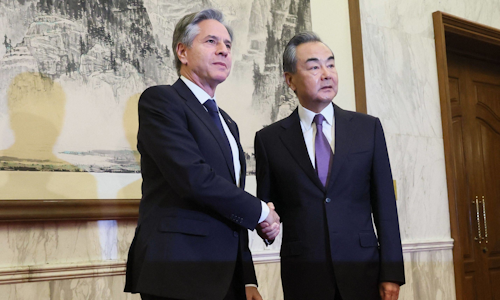
Blinken also raised concern over China supporting Russia’s aggression against Ukraine and stressed the importance of maintaining peace and stability across the Taiwan Strait, as well as in the South China Sea, according to the department’s top spokesman, Matthew Miller.
12. Hong Kong Activist Jailed For Sedition – AFP
Koo Sze-yiu, 78, an activist with terminal cancer, was jailed for attempted sedition over plans to protest against China’s political clampdown with a coffin.

Chief magistrate Victor So sentenced Koo to nine months in prison for “attempted sedition” — the second time the veteran activist was hit with the charge.
Koo is among the handful of outspoken government critics remaining in the city after Beijing crushed Hong Kong’s huge and sometimes violent democracy protests nearly five years ago.
13. North Korea Denounces S. Korea, U.S. Over Aerial Surveillance – Yonhap
In a commentary carried by the Korean Central News Agency, the North said that Seoul and Washington have been stepping up their “spying activities” this month, calling such a move a “stern provocation” against the country.
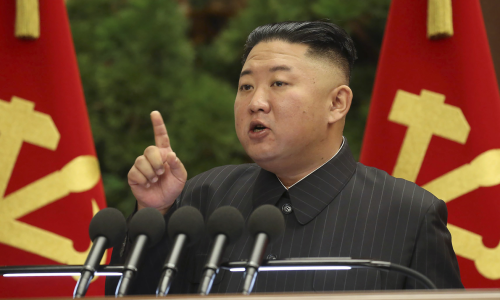
The North claimed the countries attempted to secure information on the North’s inner regions by conducting surveillance activities with the U.S. RC-135 Combat Sent and RC-135W Rivet Joint and South Korea’s advanced high-altitude unmanned aircraft Global Hawk and E-737 Peace Eye early warning aircraft.
14. Japan OKs Plan To Boost Child Allowances To Tackle Falling Birthrate – Kyodo News
The Cabinet approved a bill to expand the coverage of monthly child allowances to high school-age children as Prime Minister Fumio Kishida aims to stem the sharp drop in Japan’s birthrate.
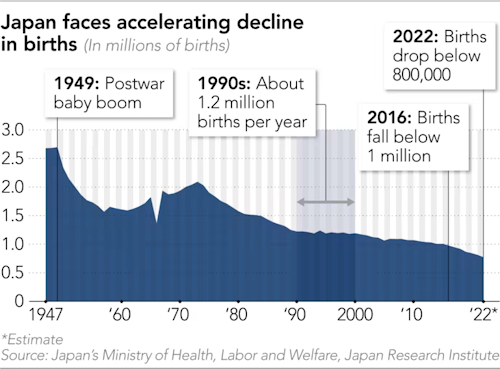
The existing income limit for households receiving the benefits will be removed. A new funding scheme will be set up, requiring each person to pay an additional 300 to 500 yen ($2 to $3.3) in monthly health insurance premiums from fiscal 2026.
15. OpenAI, Amazon, Google Sign Pact To Fight AI Abuse In 2024 Elections – Bloomberg
OpenAI, Amazon.com Inc., Google, and 17 other major players in artificial intelligence technology have formed a consortium to prevent AI from being used to deceive voters in upcoming global elections.

The companies announced the agreement at the Munich Security Conference, committing to detecting AI-enabled election misinformation, responding to it, and raising public awareness about the potential for deception.
16. EU Digital Services Act To Take Effect For All But Smallest Online Platforms – UPI
Starting this weekend, the new regulations apply to “all online platforms” with users in the bloc except for “small and micro enterprises,” which the commission defined as those with fewer than 50 employees and an annual turnover of less than $10.1 million.

With the expansion, most online platforms in the EU will be subject to DSA requirements to provide users with a means to report illegal content, protect minors from advertising based on their data, inform users why they are being shown advertisements, etc.
17. Review Of Studies Confirms Exercise Alleviates Depression – UPI
A review of studies of the most effective depression therapies has confirmed the apparent efficacy of exercise, with or without counseling and medication. However, the more vigorous the activity, the greater the benefits.

The international study of studies analyzed the results of 218 trials, finding that walking, jogging, yoga, and strength training achieved the best results. These were effective on their own or combined with psychotherapy and drug treatment, according to the review.
Republished with permission from TIPP Insights