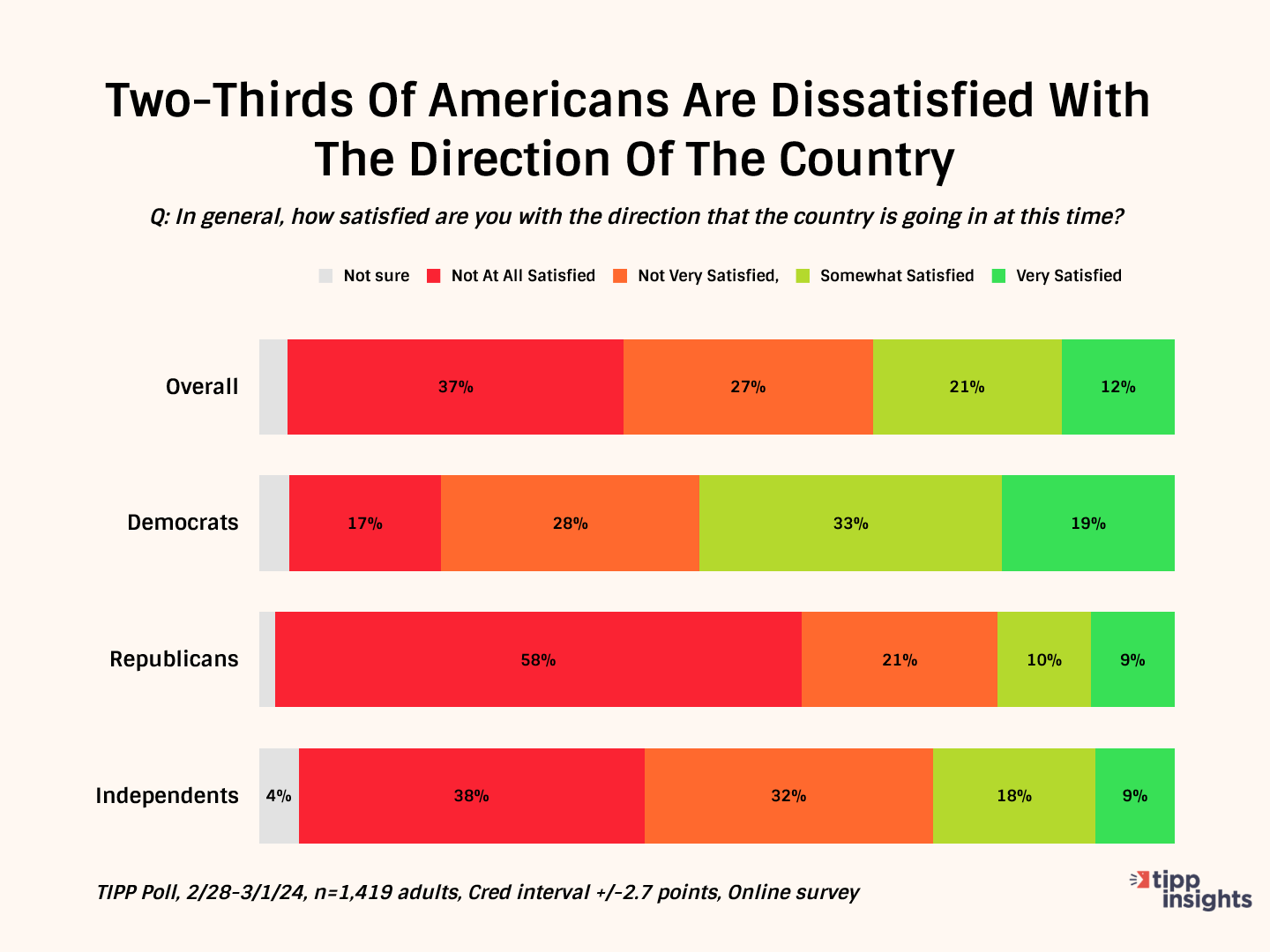
- Over two-thirds express dissatisfaction with the direction of the country
- Immigration/border security and gun violence are top concerns
- Nearly one in two picked the economy as the country’s most important issue
- RELATED: Biden’s José Antonio Ibarra Is Dukakis’s Willie Horton
One reason behind the gloom that prevails in the country is Americans’ lack of confidence in Biden’s leadership. The president is often forgetful, mixing names and places. Even Robert Hur, a Special Counsel appointed by his own DOJ, concluded that no charges should be brought against President Biden for mishandling classified documents, citing his well-meaning nature and failing memory.
Simply put, will Biden’s SOTU address lift the country out of the prevailing funk, or will it push it even further into the abyss?
In this data-driven article, we objectively examine the issues backed by statistics.
First, as President Biden gives his State of the Union speech this Thursday, what are Americans’ priorities?
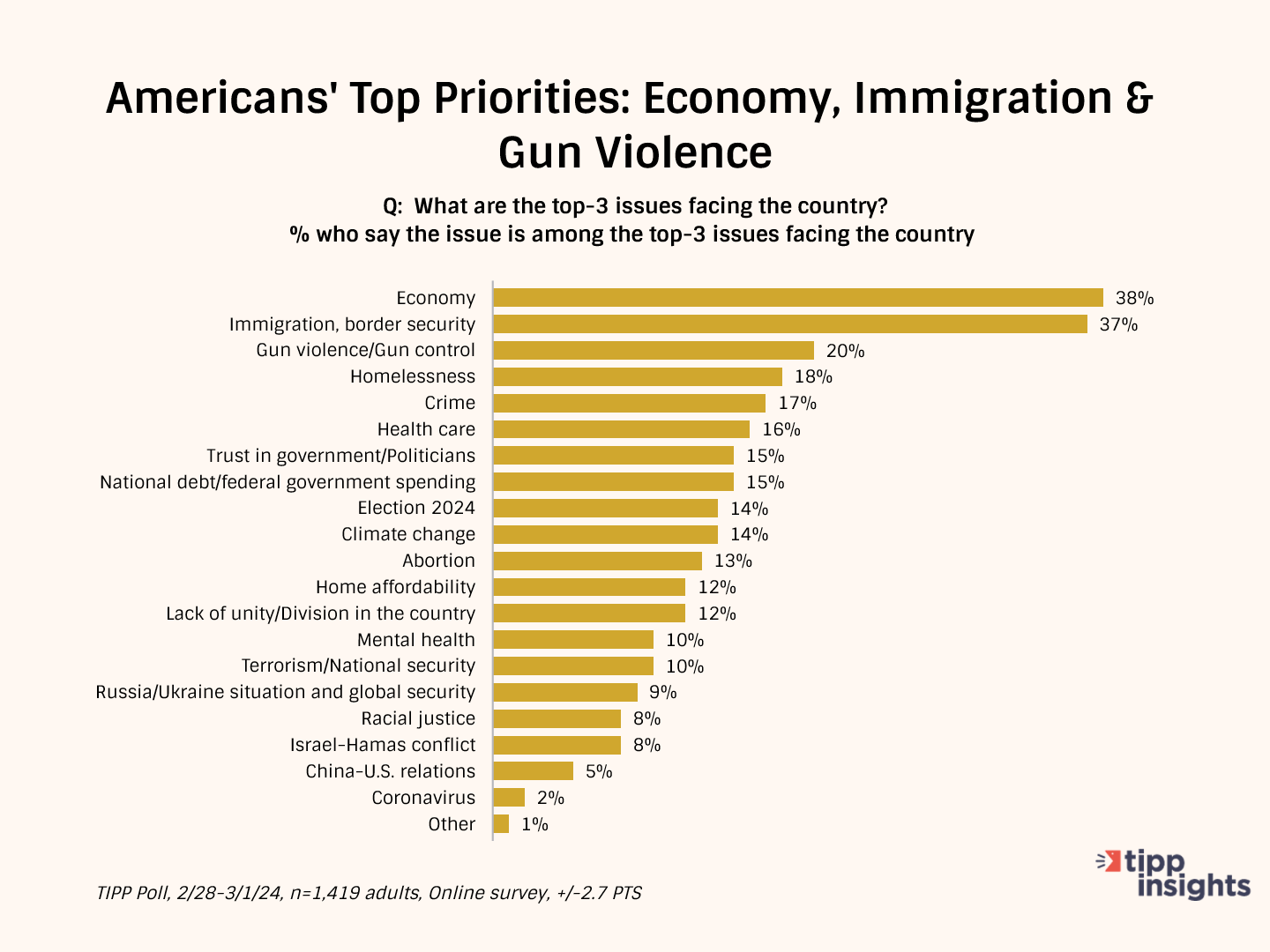
These results are from the latest TIPP Poll, which surveyed 1,419 Americans from February 28 to March 1. The credibility interval for the survey is +/- 2.7 percentage points. The poll asked participants, “What are the top three issues facing the country?”
Nearly four in ten (38%) Americans picked the economy as the country’s most important issue, followed by immigration/border security at 37 percent and gun violence/gun control at 20 percent as the other top concerns. Interestingly, the importance of immigration increased sharply from 29% in December to 36% in January, and since then, it has remained steady around that level.
Besides these, one in five respondents (18%) rated homelessness as an issue of concern.
Eleven other issues received double-digit scores – crime (17%), health care (16%), trust in government/politicians (15%), and national debt/federal government spending (15%).
Meanwhile, election 2024 (14%), climate change (14%), abortion (13%), home affordability (12%), lack of unity/division (12%), mental health (10%), and terrorism/national security (10%), were seven other issues that received 10 percent or more.
Russia/Ukraine situation and global security (9%), the Israel-Hamas conflict (8%), and racial justice (8%) fell in the 5% to 10% range.
Coronavirus ranked last with 2%, sharing the bottom two positions with China-U.S. relations (5%).

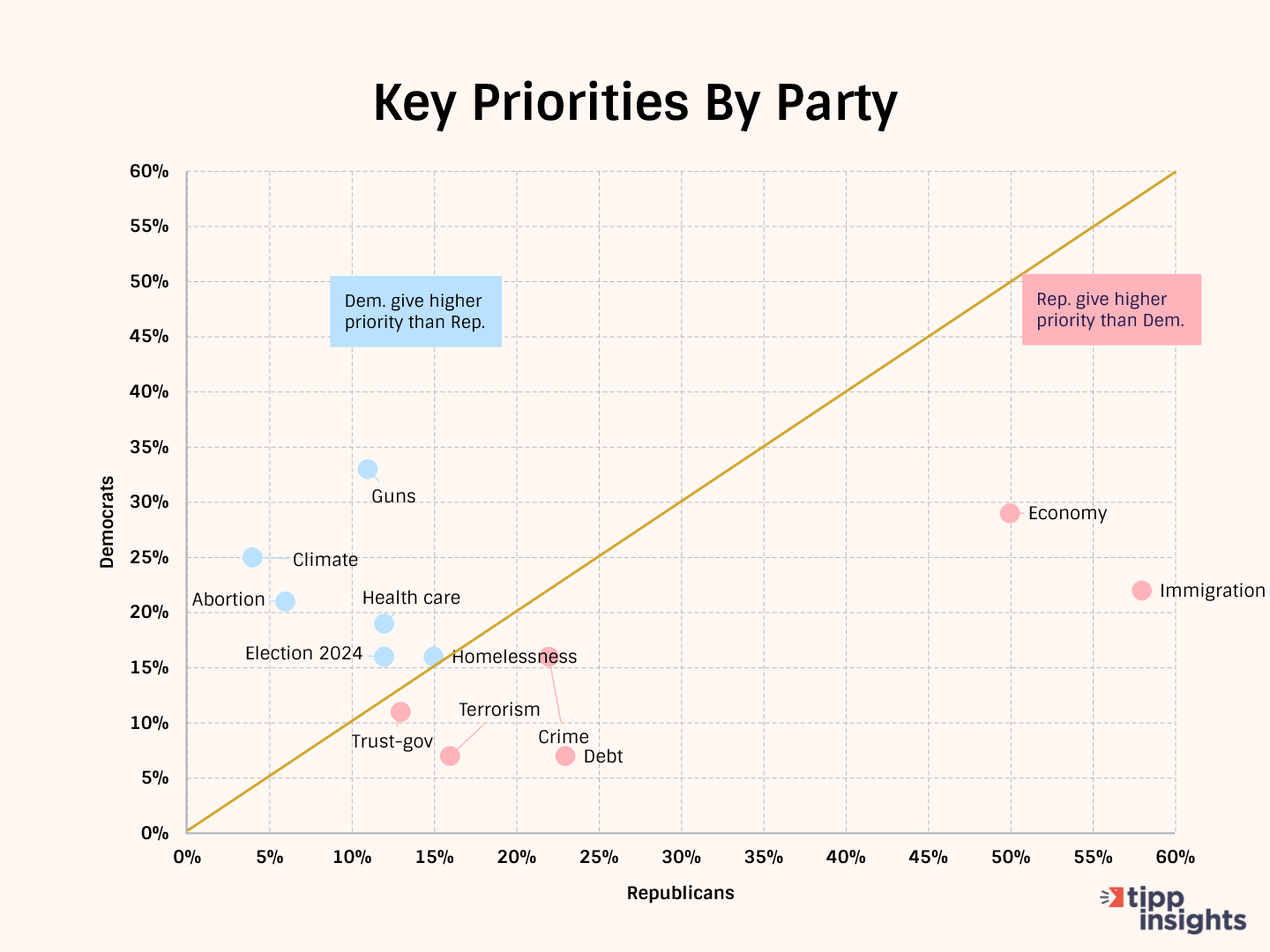
Priorities varied along party and ideological lines. However, Democrats, Republicans, and independents share concerns regarding the economy and immigration.
For Democrats, the top issues are:
33% Gun violence/Gun control
29% Economy
25% Climate change
22% Immigration/Border security
21% Abortion
19% Health care
16% Election 2024
16% Crime
16% Homelessness
For Republicans, the top priorities are:
58% Immigration/Border security
50% Economy
23% National debt/Federal government spending
22% Crime
16% Terrorism/National security
15% Homelessness
Independents’ priorities:
37% Economy
33% Immigration/Border security
23% Homelessness
21% Trust in government/Politicians
16% Home affordability
16% Health care
15% National debt/Federal government spending
15% Gun violence/Gun control
Top Economic Issues
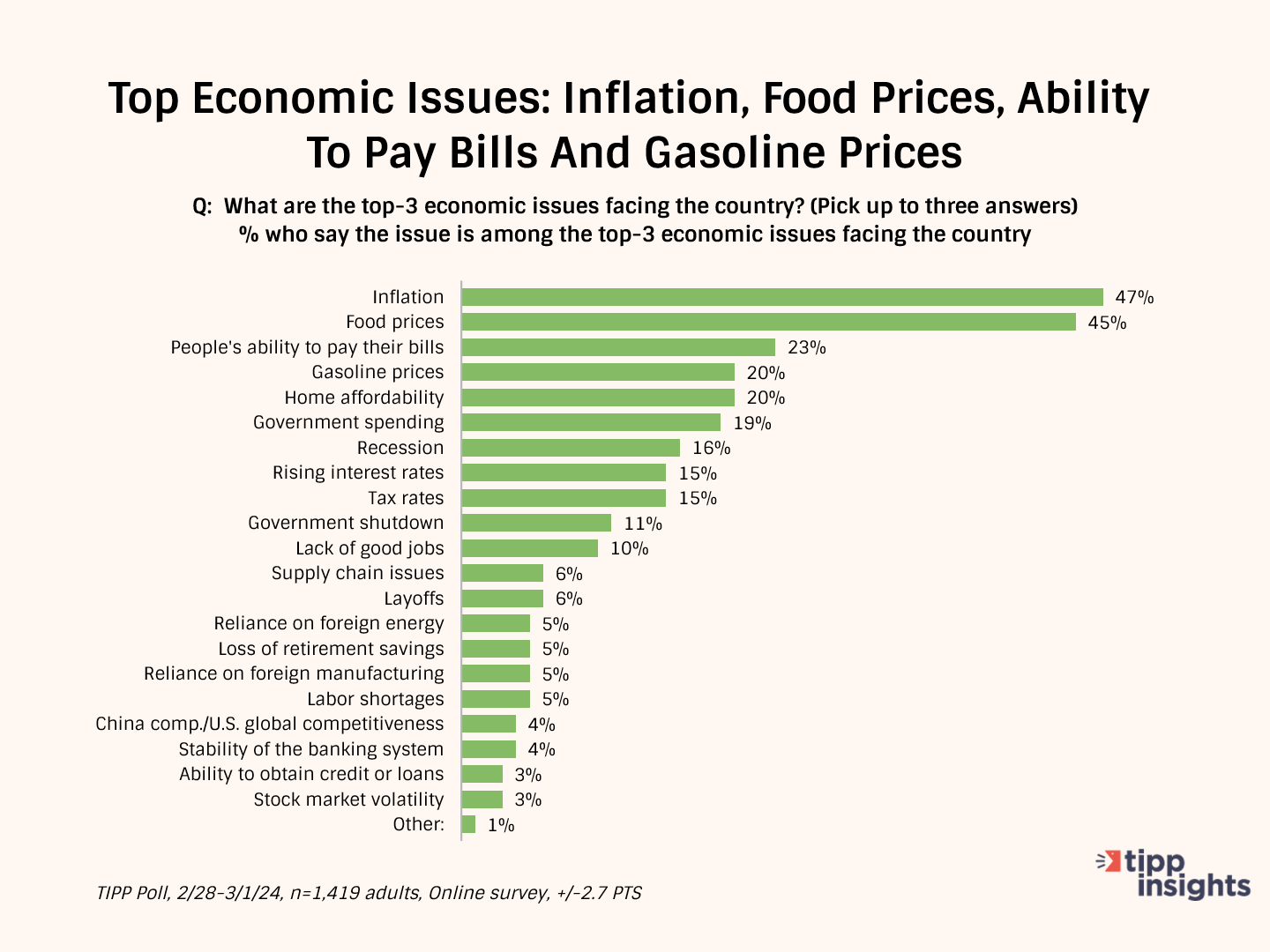
From a list of 21 economy-related issues, the survey respondents picked their top three concerns.
Inflation (47%), food prices (45%), and people’s ability to pay their bills (23%) are the top three economic issues facing Americans.
Gasoline prices (20%), home affordability (20%), government spending (19%), recession (16%), rising interest rates (15%), tax rates (15%), government shutdown (11%), and lack of good jobs (10%) received double-digit responses.
Direction Of Country
Each month, the TIPP Poll probes the general sentiment regarding the country’s direction using the survey question, “In general, how satisfied are you with the direction that the country is going in at this time?”
Nearly two-thirds (64%) are dissatisfied with where the country is headed. 37% said they are not at all satisfied, and 27% are not very satisfied. Most Republicans (79%) and independents (70%) expressed dissatisfaction. One-half (52%) of Democrats are satisfied and 45% are dissatisfied.
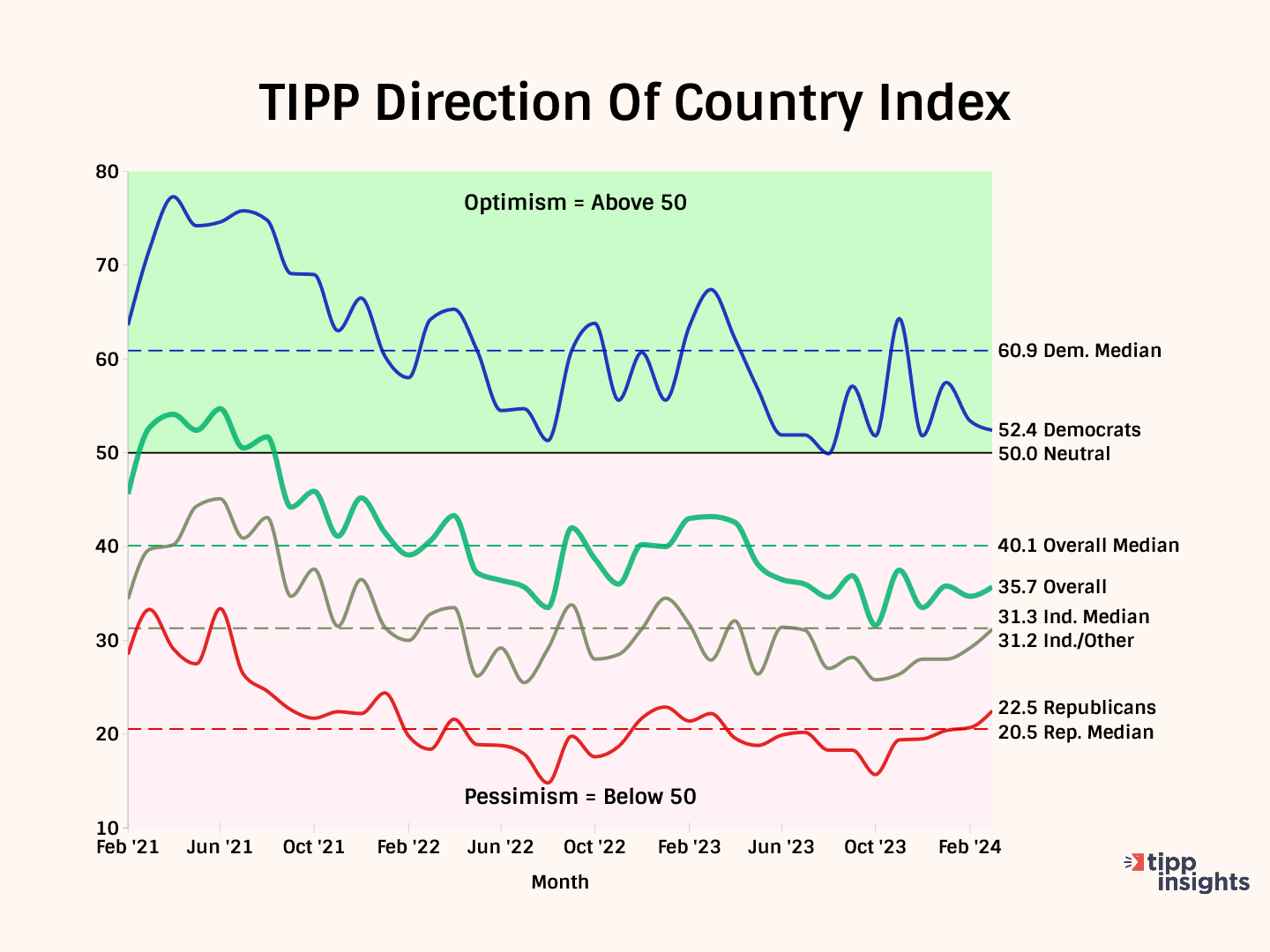
We also compute a compact index from responses to the question. The index ranges from 0 to 100. A score of 50 or above is positive, below 50 is negative, and 50 is neutral.
Overall, the index entered the negative zone in September 2021 and has remained there for 31 months. The March reading is 35.7.
Democrats have the most optimistic reading, at 52.4. Republicans have the lowest score (22.5), indicating extreme pessimism. Independents are in the middle at 31.2.
Democrats fell 24.9 points from a high of 77.3 in April 2021 to 52.4 this month, a 32% drop.
Republicans’ slide began after the elections in November 2020, and they have been posting pessimistic readings (under 50) for 40 months in a row, with a median of 20.5 during Biden’s presidency.
Independents’ median during Biden’s presidency is 31.2.
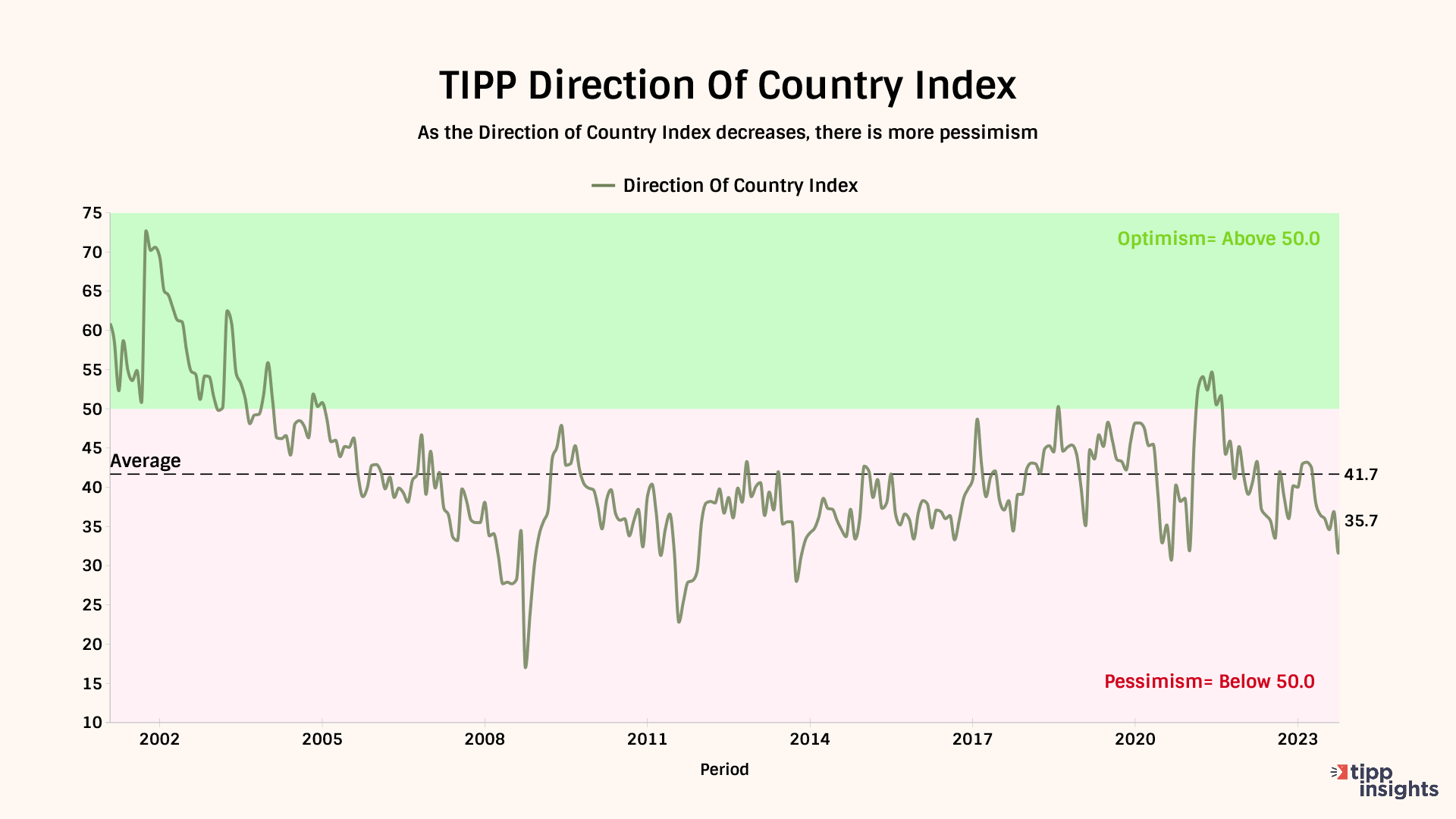
The chart below shows our tracking since February 2001. Interestingly, this month’s reading of 35.7 is six points lower than the 23-year average of 41.7.
America’s Standing In The World
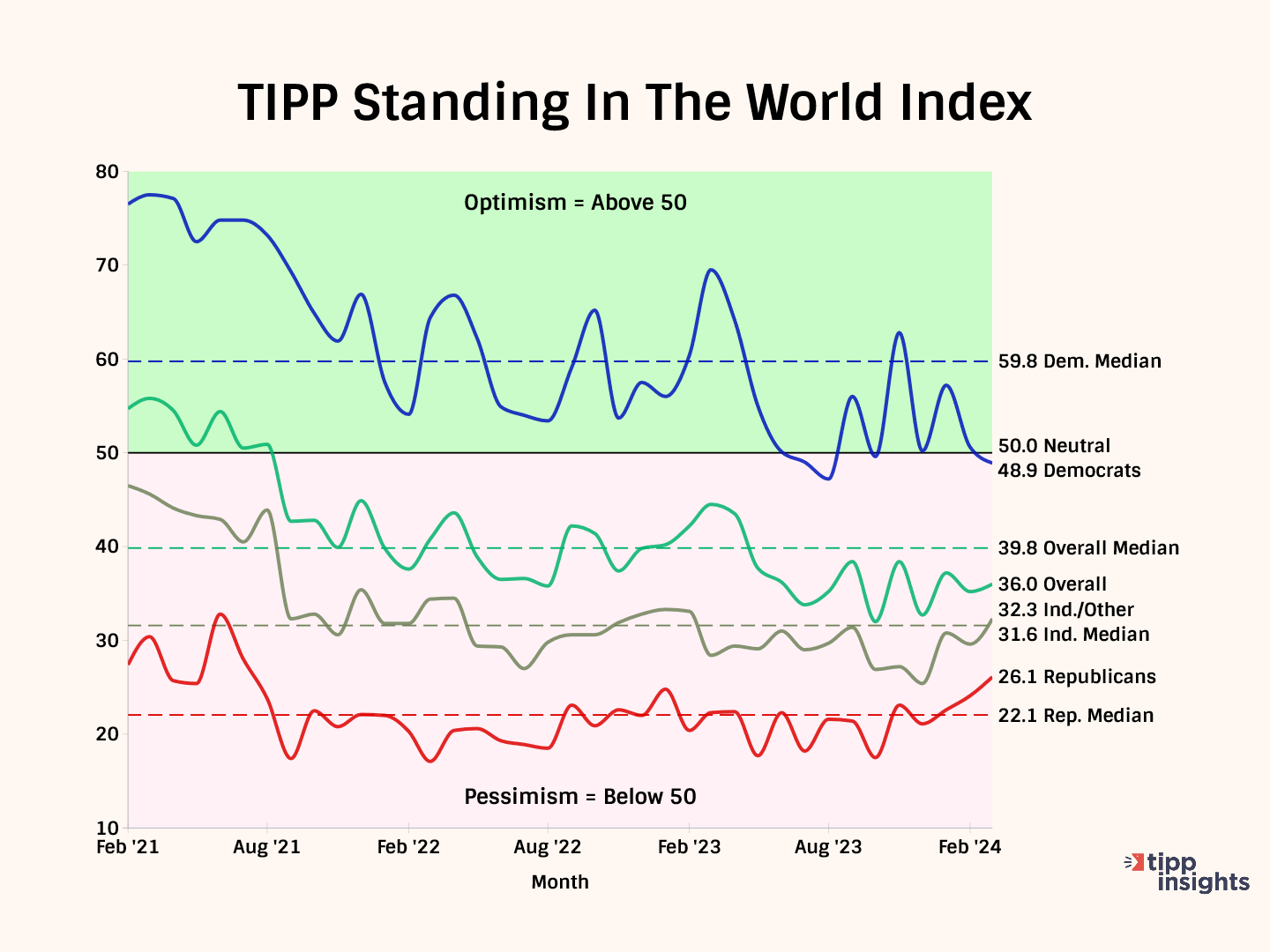
While Biden is not doing well on domestic issues, he is also faltering on foreign affairs. The TIPP Standing In The World Index measures how Americans feel about the nation’s standing in the world, a proxy measure of the effectiveness of the president’s foreign policy.
The index ranges from 0 to 100, where scores above 50 are considered positive, scores below 50 are negative, and 50 represents a neutral standpoint.
The overall index has been in the pessimistic region since August 2021. In March, Republicans (26.1) and independents (32.3) are pessimistic. Democrats also posted a pessimistic 48.9.
Biden Job Approval
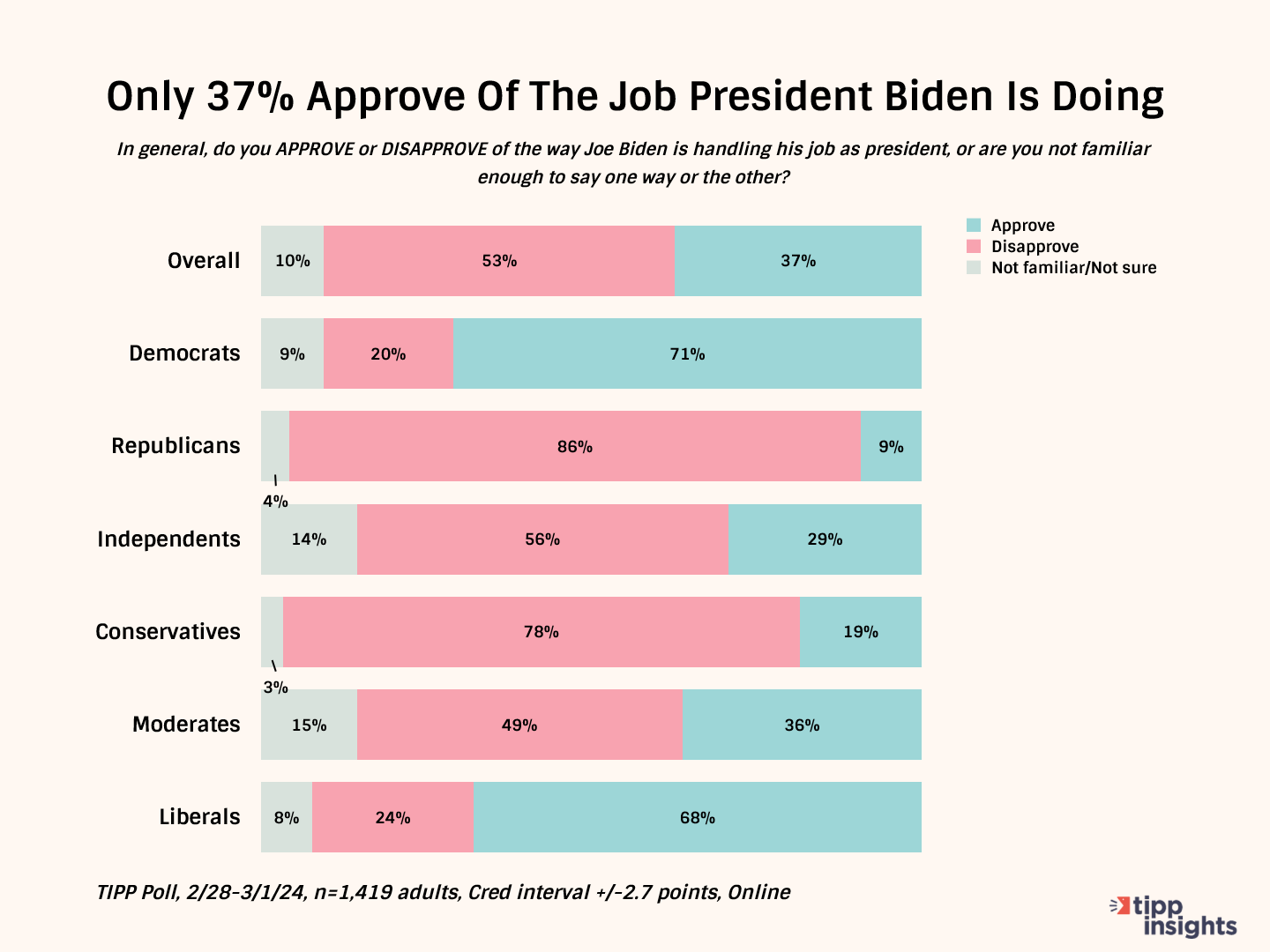
Bouncing off of his first term low of 33% in December, President Biden’s job approval ratings improved to 36% in January. It remains frozen at 36% in February and inched up to 37% in March.
Among Democrats, more than two-thirds (71%) approve of the job he is doing as President. In contrast, most Republicans (86%) and independents (56%) disapprove. While two-thirds (68%) of liberals approve, only 19% of conservatives and a third of moderates (36%) express approval.
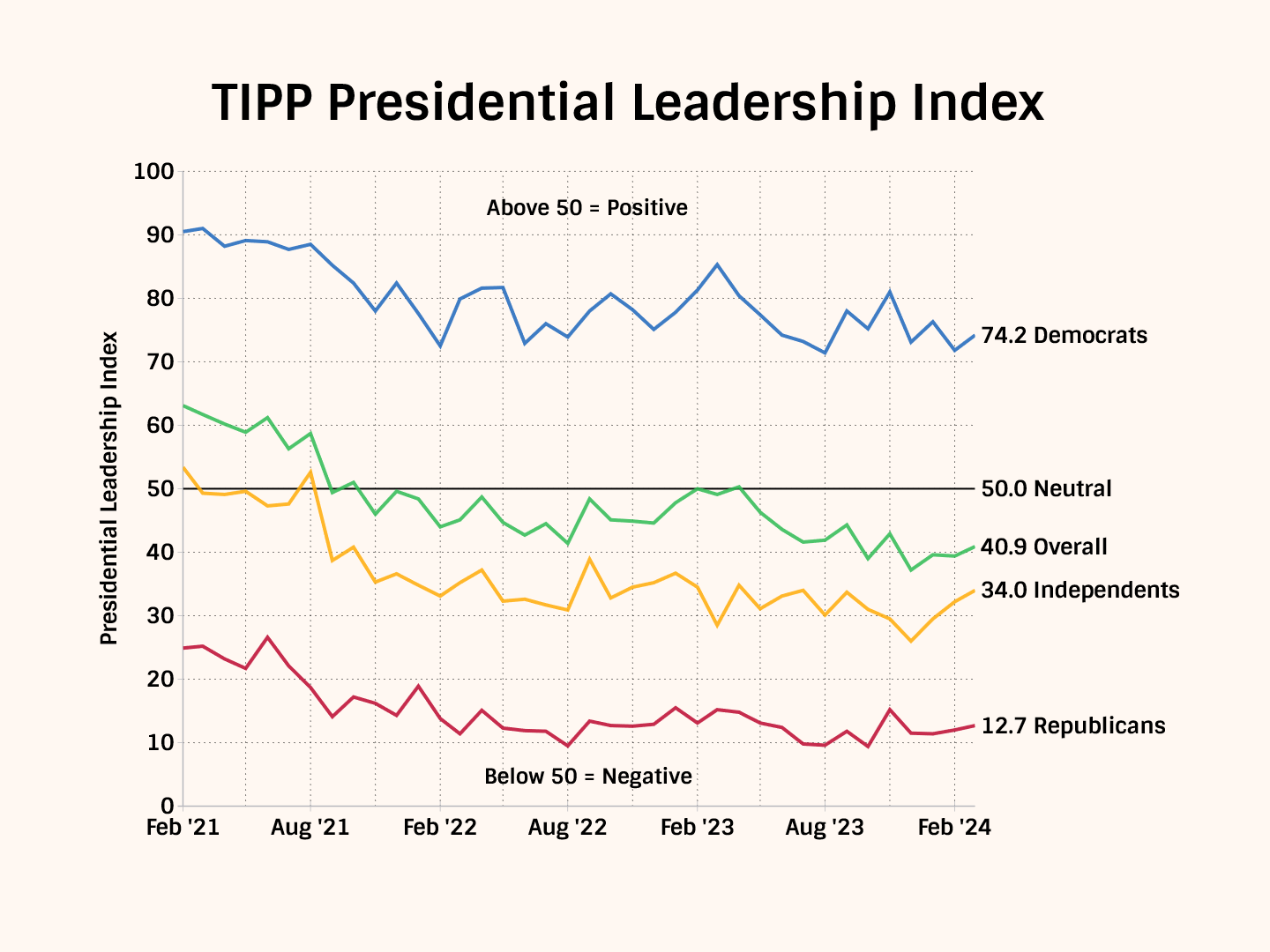
TIPP developed the Presidential Leadership Index to facilitate easy tracking, an innovative metric considering favorability, job approval, and Presidential Leadership.
The Presidential Leadership Index is calculated as the average of these three components. Readings above 50.0 signify approval, while readings below 50.0 indicate disapproval.
In March, Democrats are in the positive zone with an index score of 74.2, while independents (34.0) and Republicans (12.7) are in negative territories.
The key topics Biden must address are the economy, immigration, national debt, crime, the Russia-Ukraine war, and the Israel-Gaza conflict.
President Biden does not have a clear vision to end the Russia-Ukraine war. His request for $61 billion aid is stalled in the House. We expect him to make his case directly to Americans.
Being an election year, he will likely offer goodies, especially to the young voters abandoning him in droves. Student loan waivers, summer jobs, and tuition-free education may be in the offing.
Also, we expect him to offer special incentives to union households.
Global gasoline prices will likely rise as Russia stops exports for six months. We expect Biden to announce a further draw down from the Strategic Petroleum Reserve to stem escalation.
The nation is grappling with entrenched core inflation and increasing layoffs. High food prices and stagnant income have left households in dire straits. Government spending has spiraled out of control, resulting in a national debt exceeding $34 trillion. The debt is increasing by $1 trillion every 100 days. Prominent figures such as Ray Dalio, founder of Bridgewater Associates, Blackstone CEO Stephen Schwarzman, and JP Morgan CEO Jamie Dimon are sounding alarms about this debt spiral. Still, their concerns seem to fall on deaf ears among politicians who advocate for more spending.
Here’s a golden opportunity for the President to show that he is in command and deserves the people’s confidence. If the octogenarian fails to meet their expectations, it could further worsen his reelection chances.
TIPP Takes
Geopolitics, Geoeconomics, And More
1. Gaza Ceasefire Talks To Resume In Cairo On Sunday, Egyptian Security Sources Say – Reuters
Gaza truce talks are due to resume in Cairo on Sunday, two Egyptian security sources said on Saturday. However, an Israeli news outlet reported Israel would not send a delegation until it got a full list of Israeli hostages who are still alive.

The Egyptian sources said the parties had agreed on the duration of a Gaza truce, as well as hostage and prisoner releases, adding that the completion of the deal still requires an agreement on the withdrawal of Israeli forces from northern Gaza and a return of its residents.
2. Israel ‘More Or Less’ Accepts Six-Week Gaza Ceasefire Deal: U.S. Official – AFP
Israel has broadly accepted a deal for a six-week Gaza ceasefire, and it is now up to Hamas to agree to release the most vulnerable hostages for the deal to take effect, a senior U.S. official said Saturday.

“There’s a framework deal. The Israelis have more or less accepted it,” the Biden administration official said, speaking anonymously. “Right now, the ball is in the camp of Hamas.”
3. First U.S. Humanitarian Aid Successfully Air-Dropped In Gaza, Military Says – UPI
Aid shipments – including food – were delivered in conjunction with the Royal Jordanian Air Force, U.S. Central Command announced.

American officials said U.S. Air Force C-130 Hercules cargo aircraft dropped more than 38,000 meals along the coastline of Gaza.
Egypt, Jordan, the United Arab Emirates, Qatar, and France have all previously air-dropped humanitarian aid into Gaza.
4. Ship Sunk By Houthis Threatens Red Sea, Yemen Government, U.S. Military Say – Reuters
A UK-owned ship attacked by Houthis last month sank in the Red Sea, the U.S. military confirmed, as it echoed a warning from Yemen’s internationally recognized government that the vessel’s cargo of hazardous fertilizer posed a risk to marine life.

The Belize-registered Rubymar is the first vessel lost since the Houthis began targeting commercial ships in November.
5. Russia Publishes German Army Meeting On Ukraine – BBC
Germany has admitted the apparent hack by Russia of a military meeting where officers discussed giving Ukraine long-range missiles – and possible targets.

The head of Russia’s state-run RT channel posted audio of the video conference meeting to social media. The officers discuss how the missiles could hit the Kerch Bridge, which links Russia to the illegally annexed Crimea.
Russian politicians said the audio proved that its “sworn enemy” was planning attacks.
6. Berlin Investigates Russian Reports Of Recorded German Military Officials – Reuters
Germany is investigating an audio recording, which was published in Russian media and reported to be a conference call involving high-ranking German military officials talking about weapons for Ukraine.

Margarita Simonyan, head of the Russian state-run broadcaster RT, was the first to publish the audio on March 1. Among other matters, participants in the call discuss the possible delivery of Taurus cruise missiles to Kyiv, which Chancellor Olaf Scholz has publicly rejected thus far.
7. Zelensky Appeals To West Over Deadly Russian Drone Attack On Odesa – BBC
Ukrainian President Volodymyr Zelensky had called on Western allies to deliver more air defense systems after at least eight people were killed in a Russian drone strike on Odesa.

“Russia continues to wage war on civilians,” President Zelensky said. Russian troops have recently made gains in Ukraine, which faces arms shortages.
8. People Keep Paying Their Respects At Navalny’s Grave Despite Police Presence And Arrests – RFE/RL
Aleksei Navalny was laid to rest in a cemetery near his childhood home in Moscow as tens of thousands of supporters defiantly risked reprisals from the authorities as police kept them from joining in the services.

Police forces were out in large numbers across Russia, and although no immediate incidents were reported during the funeral ceremony, more than 120 people were later detained in Moscow and various other Russian cities for participating in rallies in Navalny’s memory.
9. NATO Nations Hit by GPS Attack Blamed On Russia – Newsweek
Norway is among northern European NATO members that have reported a spike in GPS (global positioning system) navigation disturbances amid speculation that Russia is responsible.

Jamming of the signals used by pilots, motorists, and emergency response services is of such a concern that Norwegian authorities have reportedly raised the issue with Russia’s main intelligence agency, the FSB.
On Saturday, the GPS jam website, which maps jamming across the world, showed high levels of GPS interference over much of northern Poland, Scandinavia, and the Baltic States, all of which are NATO members.
10. China Might Get New Foreign Minister As Key CCP Gatherings Set To Take Place: Report – WION
Beijing is ready to host China’s most influential political gatherings next week, known as “two sessions.” On March 4, a special session of China’s rubber-stamp parliament, the National People’s Congress (NPC), is set to begin.

A meeting of the nation’s top political advisory body, known as the Chinese People’s Political Consultative Conference, will convene alongside this. This time, the event attracts even more eyeballs in the face of the disappearance of two key leaders—Qin Gang, the ex-foreign minister, and Li Shangfu, the ex-defence minister.
11. China’s Record-Low Yields Flash Deflationary Warning Signs – Nikkei Asia
China’s benchmark yield has dropped to a record low amid deflationary pressures, signaling a heightened risk of the long-term economic stagnation that has plagued Japan.

Sluggish prices and population decline raise the risk of Japanification.
According to the London Stock Exchange Group, the yield on China’s 10-year government bonds briefly touched 2.341% on Thursday. This is the lowest reading in available LSEG data, dipping under the previous trough of 2.352% from June 5, 2002.
12. Turkey’s Ex-President Slams U.S. ‘Double Standards’ On Israel, Ukraine – Nikkei Asia
Turkey’s former President Abdullah Gul criticized the U.S. and its allies for playing a “dangerous game” with their “hypocritical double standards” on Israel and Russia, saying their policies would lead to them “isolating themselves from the rest of the world.”

Gul said in an interview with Nikkei Asia:
When Ukraine is concerned, they talk about territorial integrity, human rights, killing of civilians, saying Russia is breaking international law. But at the same time when Israel is killing a mass civilian population in a short time in Gaza … the U.S. vetoes a cease-fire [at the U.N. Security Council].
13. Hard-Liners Ahead In Tehran After Iranian Elections With Record Low Turnout Reported – RFE/RL
Iranian state media says hard-liners are ahead in the capital, Tehran, as vote counting progresses in Iran’s March 1 elections, which were marred by what appears to be a record-low turnout prompted by voter apathy and calls for a boycott by reformists.

The elections for a new parliament, or Majlis, and a new Assembly of Experts, which elects Iran’s supreme leader, were the first since the deadly nationwide protests that erupted following the September 2022 death while in police custody of 22-year-old Mahsa Amini, who had been detained for an alleged Islamic dress-code violation.
14. Argentina’s Milei Vows To Push Economic Reforms With Or Without Parliament – Al Jazeera
In a state-of-the-union-style address to lawmakers, Argentina’s libertarian President Javier Milei said he would “keep pushing forward” with sweeping economic reforms aimed at jolting the country out of decades of dysfunction and decline.

Milei laid down the gauntlet to parliament after lawmakers rejected his omnibus reform bill last month despite tough negotiations with the opposition that reduced the number of proposed changes by nearly half.
15. CDC Changes Isolation Guidelines For Those Infected With COVID-19 – UPI Health
The Centers for Disease Control and Prevention said the five-day isolation period is no longer needed for people who test positive for COVID-19; the CDC Director, Dr. Mandy Cohen, said the announcement “reflects the progress we have made.”

Cohen suggested that the general public still uses “common sense solutions we know work to protect ourselves and others from serious illness from respiratory viruses,” such as getting vaccinated, being treated, or simply staying home when symptoms begin to show.
Republished with permission from TIPP Insights