The United States Department of Justice filed an antitrust lawsuit against Apple, one of the world’s most renowned brands, alleging that the tech giant violated the Sherman Act.
The DOJ contends that Apple illegally maintains a smartphone monopoly by engaging in uncompetitive conduct by:
- Limiting cross-platform messaging
- Restricting smart watches not developed by Apple
- Blocking super apps
- Disallowing digital wallets
The government said in the lawsuit:
Each step in Apple’s course of conduct built and reinforced the moat around its smartphone monopoly.
This is not the first time that the federal government’s minions—who have zero experience running a private for-profit enterprise or even working in one—have pursued a rich tech company.
Assistant Attorney General Jonathan Kanter has focused on antitrust cases in both private and public practice. He began his career as an attorney for the Federal Trade Commission’s Bureau of Competition, switched to private law practice to help defend firms against antitrust lawsuits, and switched back to a government role to pursue companies.
The Federal Trade Commission’s courtroom presence has increased since the incumbent Chairperson, Lina Khan, took office. A diversity hire, she made a name for herself in academic circles when she wrote a seminal paper on antitrust matters at Yale Law School, arguing against Amazon’s anticompetitive practices. Never having worked in the private sector, Khan has faced defeat after defeat in court. We noted how her lack of tech industry acumen in bringing frivolous cases set a dangerous precedent in case law that could prevent the government from pursuing genuine complaints of anticompetitive behavior.
Congress passed the first antitrust law, the Sherman Act, in 1890 as a “comprehensive charter of economic liberty aimed at preserving free and unfettered competition as the rule of trade.”
On its face, the government’s Apple complaint is without merit. The long-standing requirement for monopolization is both –
- the possession of monopoly power in the relevant market and
- the willful acquisition or maintenance of that power as distinguished from growth or development as a consequence of a superior product, business acumen, or historic accident.
In the strict legal sense, Apple is not even a monopoly. According to IDC, while Apple is the #1 smartphone shipper, it has a global market share of only 20.1%. Other brands, such as Samsung, Xiaomi, Transsion, and Vivo, account for more than three-quarters of all phones sold. Had the United States not banned the sale and import of Chinese brands Huawei and ZTE, Apple’s share would have been even lower.
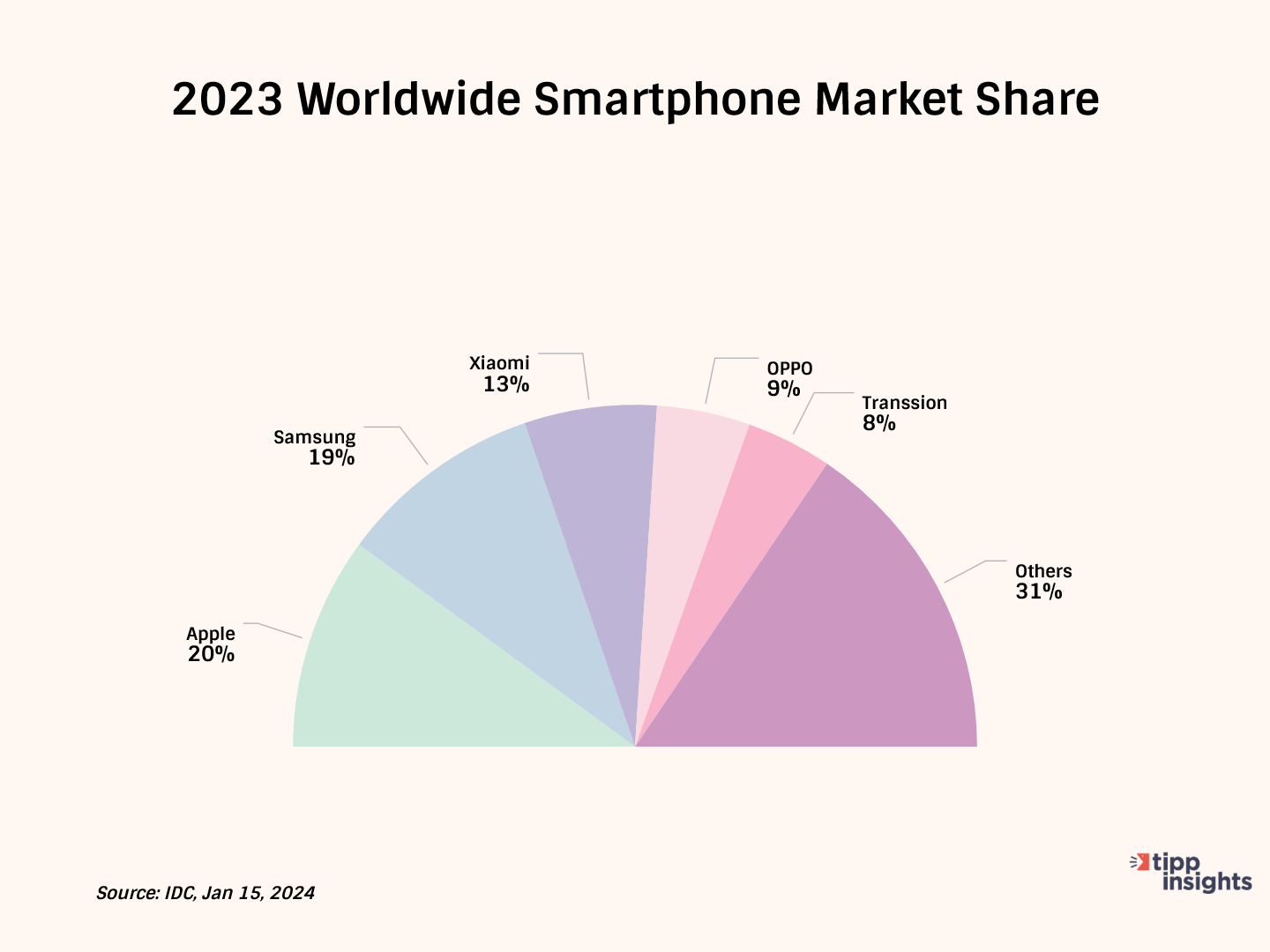
The government’s complaint concerns Apple’s operating system, iOS, the software that controls its iPhones and iPads. However, worldwide, Android is the dominant mobile platform. According to StatCounter, Android holds the largest market share, 70.77% globally, as of August 2023. iOS has a global market share of just 28.52%. StatCounter doesn’t even consider Huawei’s OS, Harmony, in its analysis. After the US Government forbade the distribution of the Android OS to Huawei’s phones, Huawei developed its own mobile OS, which is now present in over 700 million phones in China, overtaking Apple’s market position there.
Therefore, Apple is neither a monopoly nor a dominant player in the handset market or the Operating System domain. These facts are bound to come up when the case heads to trial.
The government’s complaint targets the very heart of Apple’s business model. When smartphones were first introduced, two vibrant business models competed with each other.
One, promoted by Google, gave away its Android OS practically for free to phone manufacturers worldwide, leaving the manufacturers to customize the user experience as they saw fit. The free giveaway rapidly increased Android’s dominance as an operating system but cannibalized Google’s own smartphone business. Google bought Motorola, struggled to deploy its phone brand, and remains far behind Samsung and other companies in the smartphone race.
The second model, promoted by Apple, was to tightly control the user experience on iPhones and affiliated devices. Apple designs every aspect in-house—the phone, the software, its numerous in-built apps, the chip, the electronics, the app store, and the various devices (Smartwatch, Airpods, iPads, Mac)—so that everything works seamlessly. In an increasingly dangerous world when phones are subject to sophisticated hacks, Apple’s business model ensures that even the oldest phones, even those that have changed numerous hands, will automatically get the latest software updates to keep the phones safe. Phones sold with the Android OS do not share this feature as they are subject to the manufacturer’s whims. Most manufacturers push OS updates only for a year and then stop, hoping that customers will return to them to buy newer models, leaving existing phones unprotected.
The government’s lawsuit attacks Apple’s business model, and the government is bound to lose in court. Apple, the most valuable company in market capitalization for years, is valued at nearly $2.75 trillion. It didn’t get there by accident. It is so successful because it won in the marketplace of ideas and innovation – a classic example of capitalism working. Kanter and Khan, please note.
Apple said in a statement:
This lawsuit threatens who we are and the principles that set Apple products apart in fiercely competitive markets. If successful, it would hinder our ability to create the kind of technology people expect from Apple—where hardware, software, and services intersect. It would also set a dangerous precedent, empowering the government to take a heavy hand in designing people’s technology.
Some of the government’s complaints border on the petty. For example, the government says Apple “undermines” the ability of iPhone users to send iMessages to Android users. So what? Haven’t DOJ lawyers ever used SMS or MMS messaging that works on all phones, even flip phones? If they don’t want to use the POTS network to send messages, don’t DOJ lawyers know that smartphone users can seamlessly send and receive messages on OS-neutral apps such as WhatsApp, Facebook Messenger, Telegram, and Snapchat? The lack of knowledge of technology in the lawsuit is mind-boggling.
The Biden administration has repeatedly shown itself to be incompetent. The DOJ lawsuit against Apple is one more example and will likely be tossed out in the courts.
TIPP Picks
Content selected by tippinsights
 TIPP Staff
TIPP Staff
TIPP Staff
TIPP Staff
TIPP Staff
TIPP Takes
Geopolitics, Geoeconomics, And More
1. U.S. To Bring Resolution Calling For Ceasefire In Gaza For Vote In UN On Friday – Reuters
The latest version of the draft resolution says an “immediate and sustained ceasefire” lasting roughly six weeks would protect civilians and allow humanitarian assistance to be delivered.

Nate Evans, spokesperson for the U.S. mission to the United Nations, said that the 15-member Security Council would vote on Friday morning on the text negotiated in “many rounds of consultations” with Security Council members.
A resolution needs at least nine votes and no vetoes by the U.S., France, Britain, Russia, or China to pass.
2. Efforts Continue To Deliver Aid Routes Into Gaza – Infographics – tippinsights
Airdrops of food, a new sea route, and trucks entering through border crossings have not yet delivered enough food and supplies to Gaza to meet the needs of an increasingly desperate and hungry population.

According to a new report from a global authority on food crises, as many as 1.1 million people could face deadly levels of hunger by mid-July.
3. Orban Congratulates Putin On Reelection – RFE/RL
Hungarian Prime Minister Viktor Orban has congratulated Russian President Vladimir Putin on his reelection despite condemnation of the vote by many Western governments.

Hungarian government spokesman Zoltan Kovacs said Orban congratulated Putin in a letter noting that the cooperation between Hungary and Russia “enables important discussions even in challenging geopolitical contexts.”
According to Orban, maintaining a dialogue is a “fundamental condition for establishing peace as soon as possible.”
4. EU Leaders Push To Arm Ukraine Amid Putin Aggression – AFP
EU leaders grappled at a summit meeting Thursday with how to get more weapons to Ukraine’s outgunned forces while also re-arming their own countries in the face of Russia’s emboldened President Vladimir Putin.

Addressing the EU’s 27 leaders via video link, Ukrainian President Volodymyr Zelenskyy told them the shortfall in ammunition facing his troops was “humiliating” for Europe.
5. IMF Approves $880 Million Loan Payment For Ukraine, Sees War Winding Down In 2024 – Reuters
The International Monetary Fund’s executive board approved a third review of Ukraine’s $15.6 billion loan program, allowing the release of $880 million for budget support and bringing total disbursements to $5.4 billion.

The global lender said the risks facing Ukraine remained exceptionally high, particularly the uncertainties surrounding the war with Russia and prospects for external financing. However, Ukraine mission chief Gavin Gray said the fund still expected the war to wind down by the end of 2024.
6. Apple Reportedly Removes Navalny’s Voting App At Russia’s Request – RFE/RL
Apple, at the direction of Russia’s media watchdog, Roskomnadzor, has removed an app (Photon-2024) created by the team of late Russian anti-corruption crusader Aleksei Navalny to help users vote for candidates other than President Vladimir Putin, Navalny associate said on X.

“By deleting it, Apple shows compliance in stifling dissent, betraying those fighting for democracy,” Ivan Zhdanov’s post said. Navalny died in a remote prison in February in unclear circumstances. Apple has yet to comment on the app’s status in its online store.
7. Russia, China Ties ‘Vital’ For Belgrade, Says Acting Serbian PM – RFE/RL
Serbian Foreign Minister Ivica Dacic, also acting prime minister, said that relations with Russia and China are in Belgrade’s “vital national interest.”

Speaking to Serbian media after meeting with Russian Foreign Minister Sergei Lavrov in Moscow, Dacic thanked Russia for its “firm” stance and support for Serbia on the issue of Kosovo. A U.S. State Department spokesman, in response to a request for comment, said the United States does not believe any country “should provide Mr. Putin a platform to promote or justify his ongoing war of aggression against Ukraine.”
8. China’s President To Visit France In Attempt To Repair Trust With EU – RFI
Chinese President Xi Jinping will visit France and Italy in May in a bid to improve faltering relations with the European Union. These relations are impacting EU trade with the world’s second-largest economy.

Analysts say European companies in China face more uncertain business conditions, forcing them to devote more resources to managing ballooning risks. This will be Xi’s first European trip amid mounting EU-China tensions in five years, following French President Emmanuel Macron’s visit to China in April last year.
9. China Chip Expo Shows Investment Buildup Amid Plans For Huge New Fund – Nikkei Asia
China is expanding semiconductor supply chain investments to sustain double-digit growth in homegrown chip production capacity. It is focusing on mature technology while eyeing a massive new national fund to support further advances.

At this week’s Semicon China expo in Shanghai, state-owned Naura Technology Group, China’s largest chip equipment maker, appears to tout in a video that there are machines in China that can handle the 7-nanometer production process that makes chips used in smartphones.
10. Chinese Residents Of North Korea Worry About Returning From China – RFA
Sources said Chinese residents of North Korea who went to China during the COVID-19 pandemic are starting to return, but some are wondering if they should have stayed, given the restrictions on bringing things into the country.

North Korean authorities denied returnees’ requests to import goods, including clothing and household goods, even those that they planned to sell or use in their own homes.
11. Secret RCMP Report Warns Canadians May Revolt Once They Realize How Broke They Are – National Post
Right from the start, the Royal Canadian Mounted Police (RCMP) report authors warn that whatever Canada’s current situation is, it ‘will probably deteriorate further in the next five years.’

“The coming period of recession will … accelerate the decline in living standards that the younger generations have already witnessed compared to earlier generations,” reads the report entitled Whole-of-Government Five-Year Trends for Canada.
The report labeled secret, is intended as “special operational information” to be distributed only within the RCMP and among “decision-makers” in the federal government.
12. 100,000 North Koreans Work Abroad, Earning US$500 Million A Year: UN – RFA
According to a report by the U.N. Security Council’s Panel of Experts covering July 2023 to January 2024, workers were sent to around 40 countries to work in construction, hospitality, medicine, and information technology.

“These workers are initially dispatched on student or tourist visas; some use false nationalities and identity cards,” the report said. “The vast majority are reportedly working in two countries.”
Though the report did not name those countries, sources have said that there are tens of thousands of North Korean workers in Russia and China.
13. ‘Malicious’ N.K. Cyber activities Account For Half Of Foreign Currency Income, Fund WMD Programs: UN Report – Yonhap
Pyongyang also funds 40 percent of its weapons of mass destruction (WMD) programs through “illicit cyber means,” the report said, noting it is investigating 58 suspected cyberattacks by the North on crypto-related firms from 2017-23, which are valued at roughly US$3 billion.

14. Yemen’s Houthis Have Carried Out 50 Attacks On Ships Since November: U.S. Official – Al Arabiya
Yemen’s Houthi militia has attacked civilian and military ships sailing off Yemen’s shores at least 50 times since its assaults began late last year, Assistant Secretary of Defense Celeste Wallander said.

The Iran-backed Houthis have been striking merchant vessels transiting the vital Red Sea trade route for months despite repeated U.S. and British airstrikes against them.
15. Nuclear Energy Offers Fossil Fuel Alternative — IAEA Chief – D.W.
International Atomic Energy Agency (IAEA) General Director Rafael Grossi said nuclear power, which is associated with much lower carbon emissions than fossil fuels, can play a key role in combating global warming.

But it is not without its challenges, Grossi said, especially since Russia’s invasion of Ukraine.
16. The UN Approves Its First Resolution On Artificial Intelligence – Al Jazeera
The United Nations General Assembly has unanimously adopted the first global resolution on artificial intelligence, which encourages the protection of personal data, the monitoring of AI for risks, and the safeguarding of human rights.

The resolution, sponsored by the United States and co-sponsored by 123 countries, was adopted by consensus with a bang of the gavel and without a vote, meaning it supports all 193 UN member nations.
17. Intermittent Fasting Linked To Risk Of Death From Heart Disease: Study – Bloomberg
A surprise finding from research presented at a medical meeting called into question the safety of intermittent fasting, a popular strategy for losing weight by limiting food intake to certain times.

Limiting mealtimes to a period of just eight hours a day was linked to a 91% increase in the risk of death from heart disease in the study released in Chicago.
Some doctors questioned the study’s findings, saying they could have been skewed by differences – such as underlying heart health – between the fasting patients and the comparison group.
18. Officials Warn Of Dangers Of Comfi Baby Walkers – UPI Health
Now-recalled Comfi Baby Infant Walkers could endanger your baby, the Consumer Product Safety Commission (CPSC) warned.

The walkers, sold on Amazon, “violate the federal safety regulations for infant walkers because they can fit through a standard doorway, are not designed to stop at the edge of a step, and have leg openings that allow the child to slip down until the child’s head can become entrapped,” the agency said in a statement.
19. Regular Exercise May Reduce Pain, Fatigue In Women With Advanced Breast Cancer – UPI Health
Researchers reported at the European Breast Cancer Conference in Milan, Italy, that patients who participated in a regular exercise program had less pain and fatigue and an improved quality of life.

The findings show that patients with breast cancer that’s spread should be offered exercise as part of their treatment regimen, said researcher Anouk Hiensch, an assistant professor of epidemiology and health economics at University Medical Center Utrecht in The Netherlands.
Republished with permission from TIPP Insights