For more than 33 years since the end of the Cold War, two identities on the European continent have been essentially in sync. There has always been NATO, going back to 1949, a predominantly defensive alliance that acted as a bulwark against Soviet aggression and the spread of Communism- both risks that were prevalent throughout the Cold War. In the last 25 years or so since the launch of the Euro, the European Union, as a bold experiment in integrating countries into a common bloc, Soviet-style, has more or less succeeded.
Since the Biden-Harris administration was sworn in, the NATO alliance has thrived, thanks to unfettered support from the United States- something that may not continue when the new Trump administration takes over. However, thanks to the Biden foreign policy team’s lack of foresight, the move has come at a severe cost to the EU’s economic and geopolitical stability.
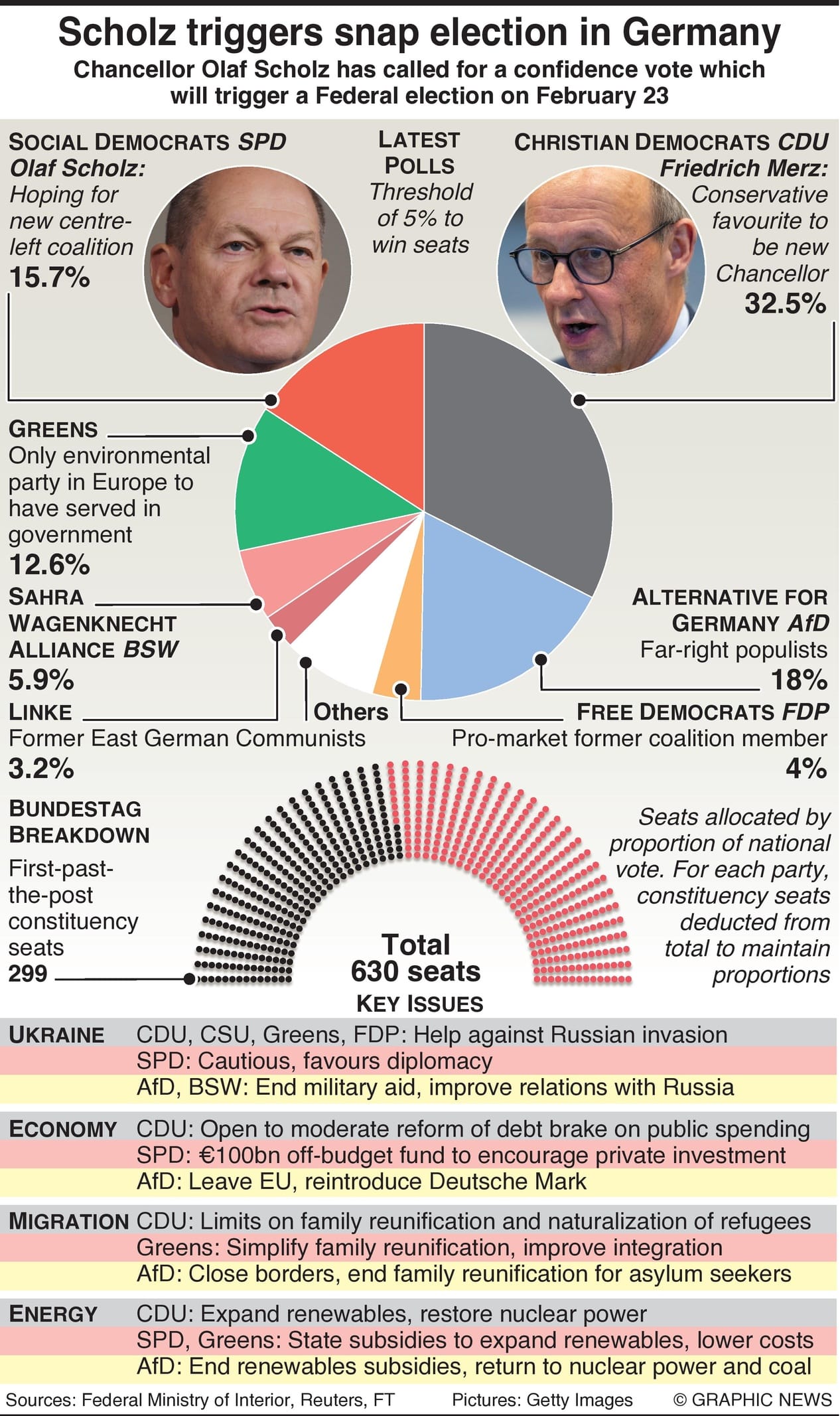
The latest victim is Germany, whose leader, Chancellor Olaf Scholz, lost a vote of confidence in the German parliament, where 394 members voted no, 207 voted yes, and 116 abstained. Scholz needed 367 yes votes to survive.
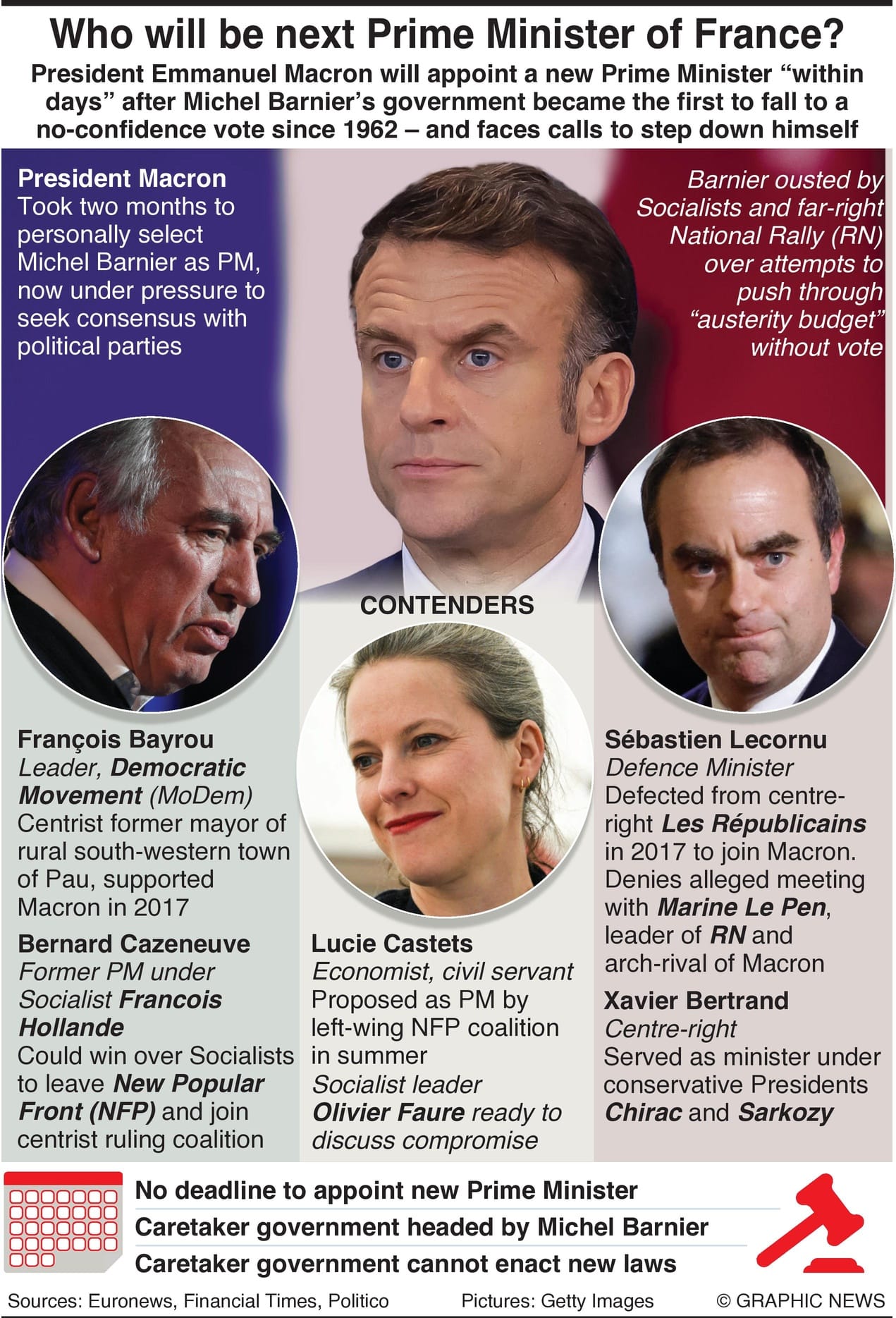
In neighboring France, lawmakers passed a no-confidence measure against Prime Minister Michel Barnier and his cabinet just two weeks ago. President Macron’s hand-picked leader needed 288 votes, but the margin of defeat was 43 votes, as 331 parliamentarians voted against the Prime Minister.
The votes expressed profound dissatisfaction with the political leadership in the two countries, and if the trend holds, the ruling parties are likely to suffer significant defeats in upcoming elections.
Initially, the concept of European Union integration made sense. If countries were contributing to the NATO alliance, it would make sense to have an economic partnership as well. Despite numerous cultural differences – and the fact that many of the EU countries were colonial powers with proud histories and legacies to defend- the European Union actually came into being. It was the ultimate formulation of the so-called rules-based international order, because only rules could govern such a diversity of traditions.
Then came the launch of the Euro as a competitor currency to the United States dollar. This milestone was especially problematic as proud countries had to give up their Deutschmarks, French francs, and Dutch Gilders to support a common currency. When the final piece of EU architecture was in place, it was unlike anything the world had ever seen.
The European Union Central Bank would dictate that the Bloc’s monetary policy (interest rates, value of the Euro) be standard across all member countries. However, the fiscal policy was left to the individual states, meaning that taxes collected, expenditures, deficits, and debt were independently managed at each state capital, albeit under broad EU guidelines.
During the 2008 financial crisis, the PIIGS countries (Portugal, Italy, Ireland, Greece, and Spain) almost ended the nascent EU experiment. Each country had amassed unsustainable public and private debt and could only survive after massive cash injections from the European Central Bank and the International Monetary Fund. Economic reforms imposed by creditors led to public dissatisfaction, political instability, and social unrest. Because wealthy economies like Germany and France were relatively healthy, the PIIGS countries survived- with a bailout.
Today, Germany and France are in deep trouble. Voters are upset at the high cost of living and the lack of economic growth. People are also beginning to question the wisdom of their countries sending billions of dollars to Ukraine when their citizens are suffering. Voters are also protesting the shipment of lethal weapons to Ukraine that allows Kyiv to attack Russia. War fatigue has set in, and voters want peace. [In Romania, when voters chose a presidential candidate who advocated for peace talks in the Russia-Ukraine war, a Constitutional Court annulled the election, saying that Russian interference tainted the election].
Germany’s and France’s economic growth problems are a direct result of the Biden administration’s policy. Since 1991, Russia, with its abundant natural resources- including oil, natural gas, chemicals, and coal- had been supplying them at very low cost to industries in Germany and France. However, the Biden administration convinced EU member states to abandon the economic integration that had developed with Russia for nearly 20 years, from 1995 to 2014, and to sanction Russian energy supplies. For every request from Washington to sanction Russia, the EU members merrily went along and stopped selling to Russian customers, yielding market share to China and other countries.
The result was immediate. The EU’s mega factories faced a severe energy shortage, forcing many to idle. The Bloc’s infrastructure had to be retooled to accept energy from new Liquefied Natural Gas terminals.
When the factories were finally operational, relying on expensive energy from the United States and other nations (powered by LNG), EU companies’ products were no longer competitive in world markets. They began to lose business to Chinese, Korean, and Japanese producers.
Germany, in particular, has seen its auto industry, a cornerstone of its economy, suffer irreversible consequences. As manufacturing costs rose, the country’s automakers, slow to embrace electric vehicles, have steadily lost business to Chinese and American competitors. Volkswagen, the country’s largest employer with an 87-year history, announced – for the first time – that it planned to shut at least three factories in Germany, lay off tens of thousands of staff, and shrink its remaining plants . The German economy continues to be in a recession.
Jana Puglierin of the European Council on Foreign Relations told the New York Times: “The timing is absolutely terrible for the EU — basically, these multiple crises are hitting the EU at the worst possible time because the bloc’s traditional engine is busy with itself.”
The Biden-Harris foreign policy team will be gone in about a month, but the EU’s problems will remain.
TIPP Picks
Selected articles from tippinsights.com
1. Would A Trump-Putin Agreement Bring Peace To Ukraine Or Just Set The Stage For More War? – James George Jatras, The Ron Paul Institute
2. The Slow Motion Death Of Syria – José Niño, Mises Wire
3. ‘A Dumpster Fire’: Conservative Lawmakers Slam ‘Fundamentally Unserious’ Spending Bill Negotiated By House Leadership – Adam Pack, DCNF
4. DOGE Climate And Energy Targets – Craig Rucker, CFACT
5. Why Are Americans Still Feeling the Economic Squeeze? – Richard Stern & Nicole Huyer, The Daily Signal
6. Freeing People From The Left Starts With The US Census – Mike Gonzalez, The Daily Signal
7. Report: Education Department Targets Christian Schools, Career Colleges – Tate Miller, The Daily Signal
8. Internal Watchdog Urges Biden’s Green Loans Office To Stop Working On New Loans Amid Conflict Of Interest Concerns – Nick Pope, DCNF
9. Postal Service, Biden Can’t Deliver On EVs – Editorial Board, Issues & Insights
10. The Economics Of Medical Waiting Rooms – Jane L. Johnson, Mises Wire
11. ‘Clever But Wrong’: Alan Dershowitz Describes The ‘Unconstitutional’ Decision From Judge In Trump Business Docs Case – Harold Hutchison, DCNF
12. Mark Halperin Says Kamala Harris’ Political Future Isn’t Looking So Hot — Even In Her Home State – Jason Cohen, DCNF
13. Congresswoman Sounds Alarm On Fundraising Platform Under Scrutiny for Raking In Millions With Thousands Of Tiny Donations – Elizabeth Troutman Mitchell, The Daily Signal
14. Time To Reinvigorate U.S. Uranium Mining – Duggan Flanakin, CFACT
15. Lawsuit Claims Top Universities, Including Cornell And MIT, Formed ‘Price-Fixing Cartel’ To Favor Wealthy Students – Mariane Angela, DCNF
16. ‘She Likes To Wear High Heels. Very High’: Republican Rep Reveals How Pelosi’s Fall Went Down – Nicole Silverio, DCNF
TIPP Takes
Geopolitics, Geoeconomics, And More
1. Israeli Airstrikes Kill Nine In Yemen: Houthis’ Al-Masirah TV – Reuters
Israeli airstrikes on Yemen killed nine people, said al-Masirah TV, the main television news outlet run by the Houthi movement controlling much of the country.

In a statement, Israel’s military said it “conducted precise strikes on Houthi military targets in Yemen, including ports and energy infrastructure in Sanaa.” The targets struck by the Israel Defense Forces were used by Houthi forces for military purposes, it added.
2. UN Calls For ‘Free And Fair’ Elections In Syria – Al Arabiya
Addressing reporters in Damascus, UN special envoy Geir Pedersen said, “There is a lot of hope that we can now see the beginning of a new Syria.”

“A new Syria that… will adopt a new constitution… and that we will have free and fair elections when that time comes, after a transitional period,” he said. Calling for immediate humanitarian assistance, he also said he hoped to see an end to international sanctions levied against Syria over the former president Bashar al-Assad’s abuses.
3. UN Security Council Told Of North Korean Missiles Used By Russia In Ukraine – Al Jazeera
North Korea is capable of producing ballistic missiles and supplying them to Russia for use in Ukraine in a matter of months, researchers have told the UN Security Council (UNSC), following the discovery of North Korean missile remnants on the Ukrainian battlefield.

Jonah Leff, head of the United Kingdom-based Conflict Armament Research, which traces weapons used in conflicts, including Russia’s war on Ukraine, told the UNSC that remnants of four missiles from North Korea recovered in Ukraine in July and August had included one that indicated it was produced in 2024.
4. At Least 100 N. Korean Troops Dispatched To Russia For Combat In Ukraine Killed: Spy Agency – Yonhap
In a briefing to the parliamentary intelligence committee, South Korea’s spy agency – the National Intelligence Service (NIS) – said the Russian military has complained that the North Korean troops lack drone response capabilities and are mainly mobilized as front-line stormtroopers.

The agency said it has detected signs North Korean leader Kim Jong-un is making preparations to train a special operation force to additionally dispatch to Ukraine.
5. Defense Department Report: China To Have 1K Nuclear Weapons In Arsenal By 2030 – UPI
The Chinese Communist Party intends to add more nuclear arms to its growing arsenal while expanding its global influence and sovereignty, a Department of Defense report says.

The report titled, “Military and Security Developments Involving the People’s Republic of China 2024,” states that China’s leadership is growing more confident in flexing the communist nation’s military might in pursuit of global political gains. “Beijing has demonstrated an increasing willingness to use military coercion and inducement to achieve these aims,” the Defense Department says.
6. Taiwan’s Ma: China Visit To Foster Cross-Strait Peace – AFP
Taiwan’s former leader, Ma Ying-jeou, traveled to China on a trip he said was aimed at building “a bridge for peace” after Beijing intensified military drills around the island last week.

Ma, who belongs to the Beijing-friendly main opposition Kuomintang, or Nationalist Party of China, led the self-ruling, democratic island from 2008 to 2016. He oversaw warmer relations between Taiwan and China, which culminated in a 2015 summit between him and Chinese President Xi Jinping — a rare meeting of Beijing and Taipei’s leaders.
7. United Front: China’s ‘Magic Weapon’ Caught In A Spy Controversy – BBC
According to its founding leader, Mao Zedong, and its current president, Xi Jinping, the People’s Republic of China has a “magic weapon.” It is called the United Front Work Department, and it is raising as much alarm in the West as Beijing’s growing military arsenal.

A decades-old and well-documented arm of the Chinese Communist Party, it has been mired in controversy before. Investigators from the U.S. to Australia have cited the UFWD in multiple espionage cases, often accusing Beijing of using it for foreign interference.
8.World Coal Use To Hit Record High In 2024: IEA Report – D.W.
The International Energy Agency (IEA)’s Coal 2024 report, projects coal demand will surpass 8.9 billion tons this year, marking a third consecutive annual record, and go on to hit a peak in 2027.

China remains the largest global coal consumer, responsible for over a third of the world’s coal use. India and Indonesia are also contributing to the usage, offsetting declines in advanced economies. Scientists have repeatedly called for the urgent need to drastically reduce greenhouse gas emissions to curb climate change and prevent catastrophic consequences for the planet and its inhabitants.
9. How To Invest In Wall Street’s Favorite Quantum Computing Stocks – Barchart
A recent major development in the industry – the launch of tech giant Google’s (GOOGL) new quantum computing chip, Willow – suddenly has Wall Street buzzing about the bullish prospects for quantum computing stocks.

Investors looking to take advantage of the opportunity can look at the Defiance Quantum ETF. The said ETF tracks the BlueStar Quantum Computing and Machine Learning Index, comprised of equity securities of leading global companies engaged in the research, development, or commercialization of systems and materials used in quantum computing among other cutting edge technologies.
10. The Stock Market Is on Track to Do Something It Hasn’t Done Since the Dot-Com Bubble in 1998 – The Motley Fool
The index rose by 33% in 1997 and then by 29% in 1998, fueled by the dot-com bubble, which drove stock valuations to dizzying heights. If the index does end 2024 with a gain of at least 25%, here’s what history suggests could happen next.

The S&P could deliver a positive return next year because the largest companies in the index are generating significant growth. The stock market is on a much firmer footing this time around compared to the irrationality during the dot-com boom.
11. Fed’s Anti-Bitcoin Stance Triggers Major Crypto Market Sell-off – CoinPedia
At the Federal Reserve rate cut meeting, Jerome Powell made a bold statement saying that we are not allowed to own Bitcoin and have no desire to change the laws.

This statement by the Fed chief shows that the U.S. central bank has no interest or intention to support a scenario where the government would accumulate a significant amount of Bitcoin. Regarding the legal issues surrounding Bitcoin ownership, Powell stated, “That’s the kind of thing for Congress to consider, but we are not looking for a law change at the Fed.”
12. Drinking Wine In Small Amounts Might Benefit Heart – HealthDay News
People who drank half to one glass of wine a day had a 50% lower risk of heart attack, stroke or heart disease, compared to wine teetotalers, researchers reported in the European Heart Journal.

Even light drinking — one glass a week, or less than half a glass a day — reduced heart risk by 38%, results showed. However, these benefits evaporated in people who had more than one glass of wine a day.
Republished with permission from TIPP Insights