On a trip to Florida, President Trump told reporters the truth about China: “The release of DeepSeek AI from a Chinese company should be a wake-up call for our industries that we need to be laser-focused on competing.”
For over three years, Biden and Western leaders focused almost exclusively on Ukraine and its defense against Russian aggression. They collectively committed over $250 billion in arms, training, and logistical support to protect the rules-based international order that no country should invade another. Laudable as the goal was, Biden should have accepted the peace deal the warring parties reached in Istanbul—just two months after hostilities began. By forcing Ukraine to continue fighting to weaken Russia and pushing Europe to sever its economic ties with Moscow, Washington attempted to reorder Europe’s decades-old security architecture.
In its compulsive obsession with scoring a victory over Russia, the West lost focus. Today, Russia is in a far superior position should peace talks ensue. The West lost even more as China, unburdened by the conflict, continued to invest resources to recover from COVID-19, reorganize its supply chain, and strengthen its focus on dominating critical industries of the future at the expense of the United States.
As someone who rose to become Chairman of the Senate Foreign Relations Committee, Biden was expected to bring his policy expertise to the White House. Instead, nearly every Biden action to counter and contain China has turned out to be a failure.
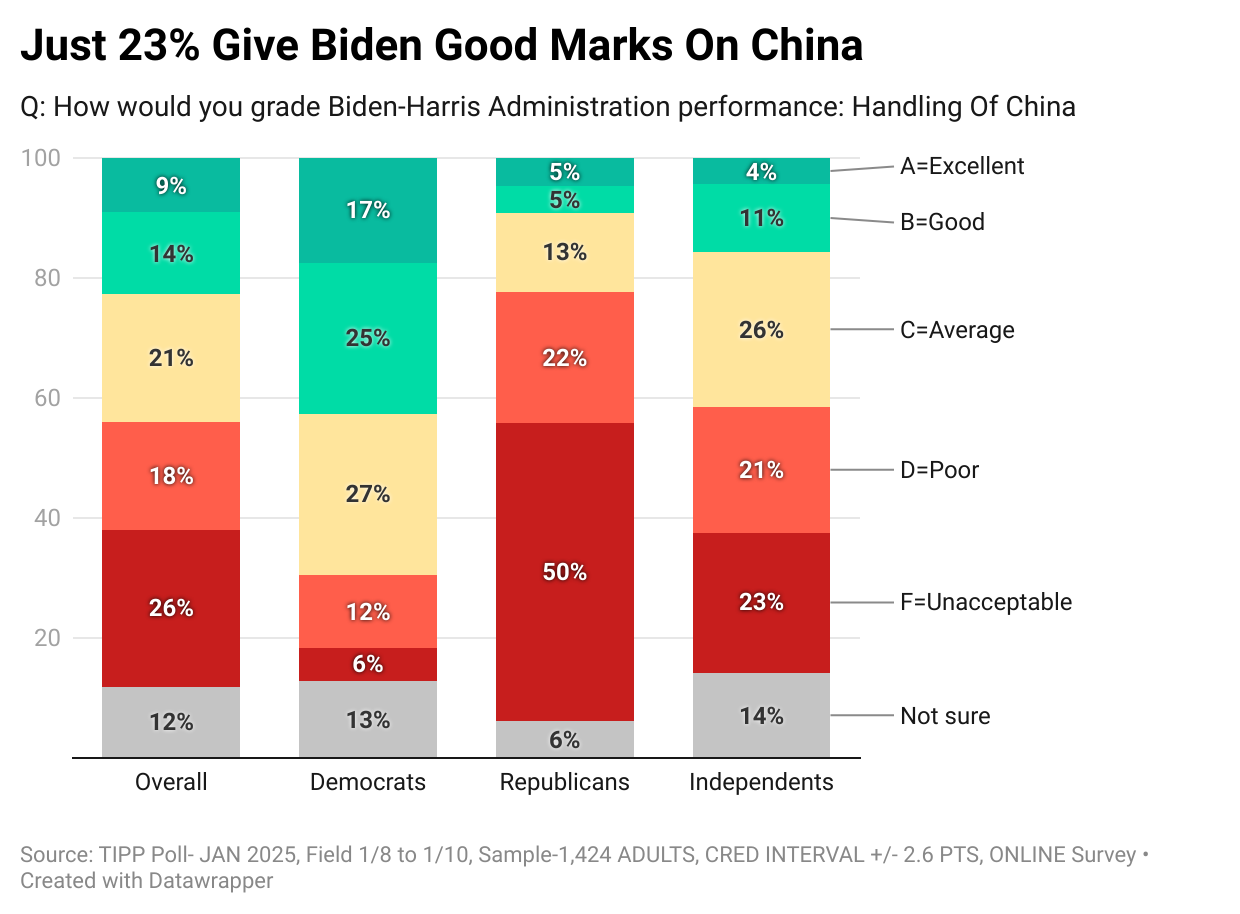
A TIPP Poll conducted this month reveals that only 23% of Americans rated former President Biden’s handling of China favorably, with a majority assessing his performance as poor or unacceptable. This widespread dissatisfaction across party lines underscores concerns about the previous administration’s approach to U.S.-China relations.
That China is an aggressive competitor and able challenger to the United States has been known for decades. While China continues to trample human rights in Hong Kong and terrorize the eleven million Uyghurs—a predominantly Muslim, Turkic-speaking ethnic group—the West’s response was to make human rights a make-or-break issue when dealing with Beijing. Worse, Biden refused to hold China responsible for the “China virus” that Trump so eloquently dubbed, which brought death and destruction to over 7 million people – a far more serious abrogation of global responsibility by Beijing. [Thanks to President Trump’s new CIA Director, John Ratcliffe, we now know the CIA concluded COVID-19 most likely originated in a laboratory.]
Biden railed against Trump’s tariffs (totaling approximately $300 billion annually) during the 2020 campaign but maintained them and even raised some tariffs further. He persuaded Congress to pass the CHIPS and Science Act to borrow federal funds to boost domestic semiconductor production, which indirectly aims to reduce reliance on Chinese manufacturing. In 2023, Biden signed an executive order restricting U.S. investments in sensitive technologies in China, explicitly targeting sectors like semiconductors, quantum computing, and artificial intelligence, citing national security concerns.
Despite Biden’s efforts to contain China, last week DeepSeek, a small AI research firm, released a clever, all-Chinese open-source model using relatively inexpensive chips from U.S. super-producer Nvidia—meeting or exceeding the performance of AI tools from OpenAI, Google, and Meta. Investors who had poured money into American companies caused tech-heavy stocks to tank on Monday, wiping out $1 trillion in market value.
Biden addressed concerns about China’s overcapacity in industries like solar panels, batteries, and electric vehicles by increasing tariffs and promoting domestic manufacturing to counter the effects of China’s market practices. These actions have also barely moved the needle as China’s domination in various industries continues and expands.
Over 60 percent of the world’s solar panels are produced in China, most of them used domestically for energy generation. With a substantial installed capacity and continuous investments in solar technology, China leads the world in solar energy production, including rooftop installations. So dominant is China’s positioning in the green sector that the country holds more than 80 percent of the world’s polysilicon, wafer, cell, and module manufacturing capacity. China invested $130 billion into the solar industry in 2023 alone.
In EVs, China’s auto exports, particularly new energy vehicles (NEVs), including all-electric and plug-in hybrids, rocketed 57.9 percent to a record of 4.9 million units in 2023. China made up more than 60 percent of global NEV sales last year. In battery production, China’s lithium-ion battery sector output surged 25 percent in 2023. The country accounted for approximately 57 percent of global demand for lithium-ion batteries in 2022.
Deep internal divisions in Washington have hampered America’s abilities to counter China. Xi Jinping became China’s leader on March 14, 2013, when President Obama was beginning his second term. Donald Trump had not even descended the golden elevators at Trump Tower when President Xi launched his ten-year industrial plan to transform China, MIC2025, short for Made in China 2025, set to conclude this May.
During this period, America went through a divisive 2016 election that put Trump in office, but Democrat and Liberal resistance tore Americans apart. The 2020 election was nastier, and its aftermath led Biden and his cohorts to engage in lawfare to oust Trump from the political scene permanently. Along the way, America had to contend with fighting COVID-19, runaway inflation, unprecedented illegal immigration, and supporting Ukraine and Israel when the Middle East exploded.
Meanwhile, all President Xi had to do was bring MIC2025 to a successful completion. Today, China dominates many industries, including iron, steel, aluminum, textiles, cement, cell phones, personal computers, shoes, chemicals, toys, electronics, rail cars, and ships. There is not a single advanced sector in the world in which China is not a key player.
Beijing also threatens American hegemony by offering low-interest loans to its companies—support unavailable to businesses in other countries. China absorbs domestic manufacturing output, forcing companies dependent upon state enterprises to consume products, thereby increasing economies of scale and lowering costs. It requires foreign countries that receive Chinese aid to source products from China, thereby helping open new markets for Chinese companies. Beijing is ruthless in requiring foreign companies to share intellectual property with Chinese companies as a price to enter China’s huge market.
China’s approach to attaining global dominance is unparalleled. No other country works so closely with its industries solely to win, sell, and consolidate market power. Beijing is using every power it has, including geopolitical, economic, and military, to further the dominance of its existing industries and those of future ones.
Every international and needless internal conflict the United States engages in takes time and effort away from the “laser-focus” that President Trump correctly says Americans should have to counter China. We heard you, President Trump.
TIPP Takes
Geopolitics, Geoeconomics, And More
1. Israel Says Its Troops In Syria Will Remain Atop Mount Hermon Indefinitely – Reuters
Israeli troops who seized strategic ground in southern Syria after the fall of Bashar al-Assad will remain on the summit of Mount Hermon indefinitely, Defense Minister Israel Katz said after visiting troops there.

Mount Hermon, a huge cluster of snowcapped mountain peaks towering above the Syria-Lebanon border, overlooks the Damascus countryside as well as the Israeli-occupied Golan Heights, which Israel captured from Syria in the 1967 Middle East war.
2. Hezbollah Chief Rejects Cease-Fire Extension; Says Israel Must Withdraw Without Delay – UPI
Hezbollah leader Sheikh Naim Qassem said that Israel should withdraw from the occupied border areas in southern Lebanon, rejecting the extension of the cease-fire arrangements to Feb. 18.

His remarks came after the White House announced in a statement Sunday that a U.S.-brokered cease-fire agreement that ended the war between Lebanon and Israel on Nov. 27 “will remain in effect until Feb. 18.” Lebanon has accused the Israeli military of procrastinating its troop withdrawal.
3. Ukraine Giving Up Nukes Was ‘Absolutely Stupid, Illogical And Very Irresponsible,’ Zelenskiy Says – RFE/RL
In an interview, Ukrainian President Volodymyr Zelenskiy said he was optimistic about U.S. pressure on Moscow to end Russia’s all-out war on Ukraine, though he said he thought President Donald Trump was unclear how to do that.

Zelenskiy said he reminded Trump about the 1994 Budapest Memorandum, the deal under which Ukraine agreed to give up its small holdings of nuclear weapons in exchange for security guarantees – from Russia, the United States, and Britain. Giving up the weapons was “absolutely stupid, illogical and very irresponsible,” the Ukrainian leader said.
4. Russian Diplomats Arrive In Syria To Smooth Ties – D.W.
Russian diplomats arrived in Syria for the first time since the fall of former dictator Bashar Assad in December. Moscow was a crucial ally of Assad’s regime and has two military bases in Syria.

Russian state broadcaster RT and semi-official Syrian newspaper Al Watan reported that the Russian delegation – that included Deputy Foreign Minister Mikhail Bogdanov and Syria envoy Alexander Lavrentyev – would meet with Syria’s new leader, Ahmed al-Sharaa. Russia is seeking to maintain its Tartous naval base and an air base near the Mediterranean coast.
5. North Koreans Are ‘Disciplined’, Armed With High-Quality Ammo, Says Ukraine – Al Jazeera
Ukraine, which has recently captured several North Korean soldiers, says overall, its new enemies are learning on the battlefield, becoming increasingly disciplined.

In the early weeks of engagement, Ukrainian units posted aerial footage of North Koreans shooting aimlessly at the drones that killed them with grenades. In recent days, however, Ukrainian units confessed that their North Korean adversaries were tough and disciplined fighters who spearheaded assaults for Russians.
“They go first. If successful, the Russian troops go to consolidate and take up defence,” said Petro Gaidashchuk of Ukraine’s 80th Air Assault Brigade operating in Kursk.
6. Images Show China Building Huge Fusion Research Facility, Analysts Say – Reuters
Experts at two analytical organizations say China appears to be building a large laser-ignited fusion research center in the southwestern city of Mianyang. This development could aid nuclear weapons design and work exploring power generation.

Satellite photos show four outlying “arms” that will house laser bays, and a central experiment bay that will hold a target chamber containing hydrogen isotopes the powerful lasers will fuse together, producing energy, said Decker Eveleth, a researcher at U.S.-based independent research organisation CNA Corp.
7. China Targeting U.S. Service Members On Social Media In “Virtual Espionage” Spy Efforts – CBS News
The Chinese intelligence officer who convinced Thomas Zhao to hand over sensitive information about the U.S. military seemed to know the 24-year-old U.S. Navy petty officer had a passion for the stock market.

The Zhao case represents a new dimension to Chinese covert activities that counterintelligence officials are calling “virtual espionage.” The practice, in which Chinese intelligence officers target members of the military and others of high interest on social media, draw them into correspondence, and extract sensitive information from them, is a rising threat, officials told CBS News.
8. Italy’s Meloni Probed Over Release Of Alleged Libyan Warlord – D.W.
Italian Prime Minister Giorgia Meloni is under investigation over the release of a suspected Libyan warlord, she announced.

Ossama Anjiem, also known as Ossama al-Masri, was detained in Turin earlier this month under an International Criminal Court (ICC) arrest warrant for alleged crimes against humanity. Last week, he was freed on a technicality and flown home on an Italian state aircraft. The ICC said it was not consulted over the decision and has demanded an explanation from Italian authorities.
9. Danish PM In Whirlwind EU Trip As Greenland Unease Grows – BBC
Denmark’s Prime Minister Mette Frederiksen met with German Chancellor Olaf Scholz in Berlin, French President Emmanuel Macron in Paris, and NATO leader Mark Rutte in Brussels over the course of a day.

Although the leaders were said to have discussed issues including Ukraine and hybrid Russian attacks in the Baltic Sea, the Danish PM’s whirlwind trip betrayed the nervousness felt in Denmark over Trump’s repeated comments. The Arctic island of Greenland is an autonomous Danish-dependent territory.
10. Honda Plans Sub-$30,000 EV Model For North America – Nikkei Asia
Honda will introduce the new electric vehicle in North America as early as 2026, as the Japanese automaker aims to attract customers after purchase incentives are removed under the current U.S. administration of President Donald Trump.

The new U.S. president has signed an executive order to end EV promotion measures put in place by his predecessor, Joe Biden.
11. North Korea’s Kim Inspects Nuclear Facilities, Warns Of ‘Vicious’ Hostility – RFA
North Korea’s leader visited a nuclear-material production base and Nuclear Weapons Institute and warned that “confrontation with the most vicious hostile countries is inevitable,” and his country must bolster its nuclear forces, the North’s state media reported.

Kim Jong Un’s warning came days after President Donald Trump signalled he might be willing to resume the engagement he embarked on with North Korea during his first term in office. North Korea has reported Trump’s return to power but has not said anything about his comments.
12. Doomsday Clock Moved Closest Ever To Destruction – BBC
The Doomsday Clock, symbolizing how close humanity is to destruction, has been moved one second forward to 89 seconds to midnight—the closest it has ever been.

The Bulletin of the Atomic Scientists (BAS) – which sets the clock annually – said nuclear threats, potential misuses of advances in biology and artificial intelligence, as well as climate change, were the key factors. Daniel Holz, chair of the Bulletin’s Science and Security Board, said the latest move was “a warning to all world leaders”.
13. Alibaba Releases AI Model It Claims Surpasses DeepSeek-V3 – Reuters
Chinese tech company Alibaba released a new version of its Qwen 2.5 artificial intelligence model that it claimed surpassed the highly acclaimed DeepSeek-V3.

The unusual timing of the Qwen 2.5-Max’s release, on the first day of the Lunar New Year when most Chinese people are off work and with their families, points to the pressure Chinese AI startup DeepSeek’s meteoric rise in the past three weeks has placed on not just overseas rivals, but also its domestic competition.
“Qwen 2.5-Max outperforms … almost across the board GPT-4o, DeepSeek-V3 and Llama-3.1-405B,” Alibaba’s cloud unit said in an announcement posted on its official WeChat account.
14. Coinbase Launches In Argentina, Targeting 5 Million Daily Crypto Users – Bitcoin.comNews
Crypto exchange Coinbase (Nasdaq: COIN) announced that it has received regulatory approval to operate in Argentina, securing Virtual Asset Service Provider (VASP) registration from Argentina’s National Securities Commission (CNV).

This approval enables the platform to provide its services legally in a country where cryptocurrency plays a significant role in the financial system. A survey commissioned by Coinbase reveals the strong potential of cryptocurrency in Argentina: 87% of respondents believe crypto can enhance financial independence, while 79% are open to receiving salaries in digital assets.
15. Report: Obesity, Diabetes, High Blood Pressure Remain On The Rise In U.S. – HealthDay News
These risks are thwarting efforts to save lives from heart disease, heart attack, stroke and other lethal heart-related diseases, says the report published in the American Heart Association’s journal Circulation.

The report indicates that heart-related deaths appear to be leveling out after a major uptick during the COVID-19 pandemic, the report says — but heart disease remains the No. 1 killer in the United States. Dr. Keith Churchwell noted that heart disease and stroke together kill more people than all cancers and accidental deaths — the No. 2 and No. 3 causes of death — combined.
16. How To Raise Grateful Kids In An Era Of Thankless People – Time
If you’ve been trying to make kindness part of your family culture and there’s still a lot of complaining, it’s time to take further steps to teach and practice gratitude.

- Cultivate the virtues that support thankfulness.
- Appreciate family members.
- Take the “no‑complaints challenge.”
- Be “gratitude proactive” as a parent.
Republished with permission from TIPP Insights