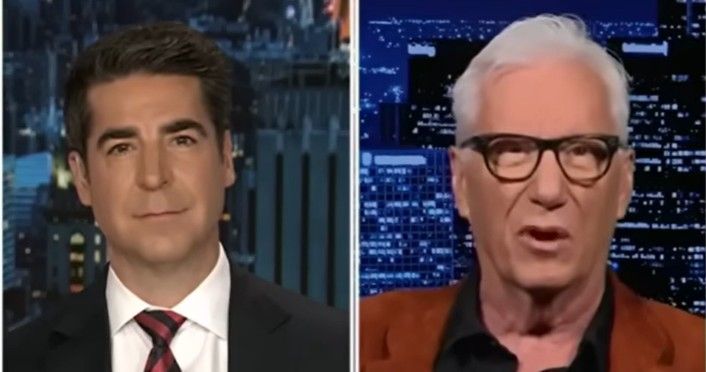
When legendary actor James Woods sat down with Jesse Watters, the conversation began with Hollywood—but it quickly became something deeper: a meditation on loyalty, patriotism, moral clarity, and a nation unraveling in real time.
Woods, never one to shrink from controversy, offered something rare in today’s scorched-earth political culture: honesty without hatred, conviction without dehumanization, and grief without ideological blindness.
Woods opened with a deeply personal account of his relationship with filmmaker Rob Reiner—a man whose politics could not be more different from his own, yet whose personal integrity Woods never questioned.
“At a very, very down point in my career, Rob literally saved my career… and really put me back on track in a way that was so important and rewarding in my life.”
At the time, Woods was considered wildly miscast for Ghosts of Mississippi.
“I was 32 years too young for the part… virtually nobody agreed with it… but he really believed that I was right and could do it.” That belief changed Woods’ life. “I went from really being basically out of a job to getting an Academy Award nomination, and I give all the credit to Rob.”
In an industry notorious for ideological purity tests and blacklist mentalities, Woods emphasized something unfashionable: gratitude. Woods knows exactly what people think when they see him speak warmly about a Hollywood liberal.
“People would see us laughing… and they’d go, ‘How is it that you and Rob Reiner are friends?’” His answer cuts through the hysteria of modern politics:
“First of all, I judge people by how they treat me.”
And then the line that defines the entire interview:
“I think Rob Reiner is a great patriot.”
Woods was clear-eyed about their disagreements.
“Do I agree with many of his ideas on how that patriotism should be enacted? No. But he doesn’t agree with me either.” Yet mutual respect remained. “We had a different path to the same destination, which was a country we both loved.”
That sentence alone is more patriotic than most cable news shouting matches. Woods expressed frustration at how disagreement now automatically becomes dehumanization.
“Because you disagree with people doesn’t mean that you have to hate people.” He contrasted this with today’s intellectual decay:
“He was a real thinker when you had a chance to talk to him, and a lot of people just don’t think anymore.”
It’s a subtle but devastating indictment of modern activism masquerading as moral superiority.
When Woods learned of the brutal murders of Rob and Michelle Reiner, the shock was overwhelming. “You know when you can’t breathe? I literally said—uh.” The pain was not abstract. It was personal.
“I just felt my heart drop… and I just thought, what Tracy’s going to go through.” Woods was visibly angered by those who used the tragedy to score political points.
“When people say horrible things about Rob right now, I find it infuriating and distasteful.”
He made his position unmistakable: “Did I agree with his politics? I did not. Did I love him as a friend, as an artist, as an icon of Hollywood, and as a patriot? I most certainly did.”
The conversation then turned to the broader picture—and Woods did not mince words. “The world is going insane.”
From Ivy League shootings to migrant violence to random knife attacks, Woods sees patterns others refuse to confront. He raised a question few in media are willing to ask:
“You look at the fine print… suicidal tendencies, homicidal tendencies… if everybody’s on this stuff, just the sheer mathematical possibility of insane behavior… has got to be taking place.” On campus radicalization, he spoke from personal history.
“I grew up seven miles from Brown University… It’s gone very left-leaning in its teaching protocols.” And when a young conservative was murdered: “It doesn’t surprise me… it wouldn’t shock me if she was targeted.”
Woods spoke candidly as a Roman Catholic and as an American watching the West unravel. “There is now a jihad against Jews in the world, and people are just up front about it.”
And then, the warning conservatives have been sounding for years:
“There has been an invasion in this country… that is going to end this country as we know it if we don’t figure it out.” The solution, in his view, is obvious:
“We’ve got to lock down the borders, and we have to stop being so insane.”
James Woods remains what Hollywood desperately lacks: a man capable of gratitude, grief, patriotism, faith, and courage—without surrendering his principles.
You can love your country without hating your neighbor.
You can disagree without destroying.
And you can tell the truth—even when it costs you.