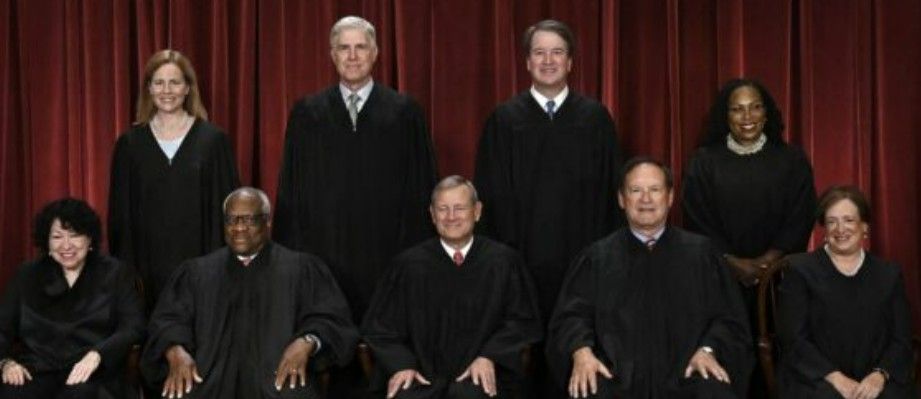
Call it the legal version of “if you’re standing on the porch, do you own the house?” — and Samuel Alito wasn’t buying what the other side was selling.
In a tense Supreme Court showdown Tuesday, Alito took a sledgehammer to a key argument from lawyers representing migrants, zeroing in on a deceptively simple question: if you’re stopped at the border, are you actually in the United States — or just knocking on the door?
The case now before the Supreme Court of the United States stems from a Trump-era challenge to a ruling by the notoriously liberal Ninth Circuit, which had declared that migrants blocked on the Mexico side of a port of entry could still count as having “arrived” in the U.S. — and therefore qualify for asylum.
That ruling, if left standing, could keep the asylum floodgates wide open, allowing would-be entrants to claim legal protections even before they set foot on American soil.
Kelsi Corkran, representing asylum seekers, insisted the distinction between “arriving at” and “arriving in” the United States is basically grammatical nitpicking.
According to her argument, the phrases mean the same thing — a claim that didn’t sit well with Alito.
“So there’s been talk about knocking at the door,” Alito said. “Do you think someone who comes to the front door and knocks at the door has arrived in the house? The person may have arrived at the house?”
Corkran tried to parry: “No, but that’s past tense… Are they arriving in the house?”
Alito wasn’t letting it go. He pressed again: if someone is still outside knocking, how can they be considered inside?
Corkran’s response raised eyebrows: “Yes, I think here the door is open.”
That’s one way to put it.
Corkran argued that migrants lingering at the “threshold” should count as having arrived — effectively blurring the line between being outside the country and inside it.
An allied brief from the HIAS Foundation backed her up, warning that denying asylum to those not physically on U.S. soil would create what it called a “legal no-man’s land.”
“People are left in limbo in dangerous border towns, unable to access the process our laws guarantee,” the group argued.
Critics, however, say that “limbo” looks a lot like a loophole — one that’s been exploited by migrants filing shaky asylum claims and then disappearing into the interior, never to show up for court.
On the other side, Solicitor General D. John Sauer cut through the wordplay, arguing bluntly that “arrive in the United States” does not include people stopped in Mexico. Period.
It’s a common-sense argument that hinges on geography — and reality.
Federal law allows migrants to seek asylum if they claim fear of persecution, a process that can ultimately lead to legal residency. But the fight here is over when that right kicks in — and whether simply reaching the border is enough.
The stakes are massive. With border surges continuing to strain resources, the Court’s decision could redefine how — and where — asylum claims begin.
And if Tuesday’s exchange is any indication, at least some justices aren’t ready to declare that standing outside America somehow means you’re already inside.
A ruling is expected by June — just in time to pour gasoline on an already white-hot immigration debate.