Full video below
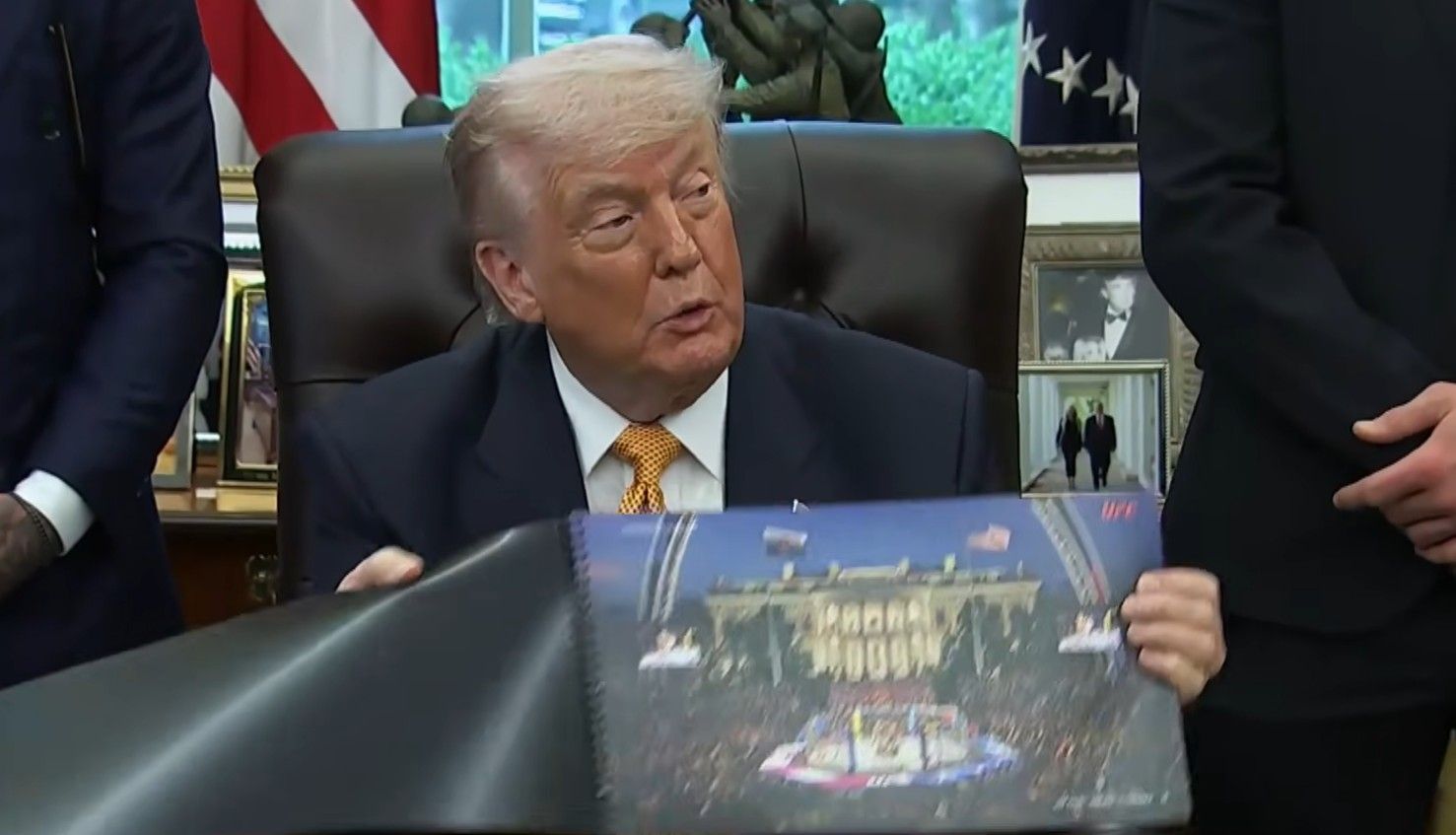
During an unscheduled Oval Office appearance Wednesday, President Trump slipped comfortably back into his old promoter-in-chief role as he hyped the upcoming “UFC Freedom 250” event set for June 14 outside the White House.
Standing shoulder-to-shoulder with UFC stars including Justin Gaethje, Ilia Topuria, Alex Pereira and Ciryl Gane, Trump grinned like a guy opening a new casino floor in Atlantic City.
“As you know, June 14th. We’re having a big fight,” Trump told reporters. “It’s never gonna happen again. Never happened before. And it’s all of the best fighters, best four fighters standing right behind me, and all champions. And it is gonna happen right in front of the White House.”
Trump wheeled out glossy renderings showing a massive octagon planted on the South Lawn with the White House looming behind it like some kind of red-white-and-blue gladiator movie.
The setup sounds less like a government event and more like WrestleMania crashed into Mount Rushmore. Trump says about 4,000 lucky fans will score seats directly outside the White House, while another crowd estimated between 75,000 and 100,000 people will watch from giant screens set up on the Ellipse.
“Our country is invited to this; it’s free,” Trump said. “And you know, in the park right across the street, they’re going to have, I guess, anywhere from 75,000 to 100,000 people free. They’re gonna set up eight big screens, and they’re gonna have the fight. And then out here, we’re gonna have 4,000 seats right in front of the front door of the White House. The hardest ticket I’ve ever had.” That line alone probably sent Georgetown cocktail-party regulars into cardiac arrest.
The media class is howling that the White House is becoming “too entertainment-driven” — as if Americans haven’t spent decades watching presidents stage photo ops with schoolchildren and celebrity chefs. At least this one involves actual testosterone.
And Trump, never one to pretend he’s suddenly become a monk because he moved into 1600 Pennsylvania Ave., openly admitted mixed martial arts isn’t exactly his personal hobby.
“They really love the sport,” he said of the fighters. “They come out of a ring, the most incredible fight you’ve ever seen. And they say this is the greatest sport… you know, I’d rather sink a three-footer personally. But there’s no better thing to watch than this.”
The event itself is shaping up to be one of the most bizarrely American spectacles in recent memory — a UFC title fight on Flag Day, outside the White House, during the nation’s 250th birthday celebration, with Trump presiding over it like a Vegas sportsbook king who somehow won the presidency twice.
UFC boss Dana White has reportedly called it “the most historic sporting event of all time,” while critics on social media are melting down over the optics.
But here’s the reality Democrats can’t stand: Trump understands modern America better than the consultants and bureaucrats who sneer at this stuff.
Millions of Americans watch UFC. Millions more think politics has become unbearably fake, overproduced and sanitized. Trump’s answer? Put a cage on the White House lawn and let the fighters swing.
For people who generally support Trump but are uneasy about this idea, the concern isn’t about mixed martial arts or even large public events themselves—it’s about the setting and symbolism. The White House carries a meaning that goes beyond any one administration or political moment. Turning its grounds into a venue for a high-profile fight card may feel, to some, like a blurring of lines between national institution and entertainment spectacle. Even if the intention is celebration, the question some supporters are quietly asking is whether every venue is the right venue.
There’s also a practical layer that goes beyond optics. Large-scale events on or near the White House bring security complexity that is very different from a typical stadium or arena. Coordinating tens of thousands of attendees, media infrastructure, and high-profile guests in such a sensitive location inevitably raises questions about cost, logistics, and risk management. Supporters who favor strong leadership and order may reasonably wonder whether the tradeoff is worth it, even for a unique patriotic showcase.
At a cultural level, some Trump supporters who appreciate his outsider approach still value the idea that certain institutions should feel steady and above the churn of daily entertainment cycles. They may enjoy UFC as a sport and respect its athletes, but still feel that the presidency gains something from occasional restraint—moments where it signals seriousness rather than spectacle. That tension doesn’t require rejecting the event outright; it simply reflects a desire for balance in how the office is presented.