

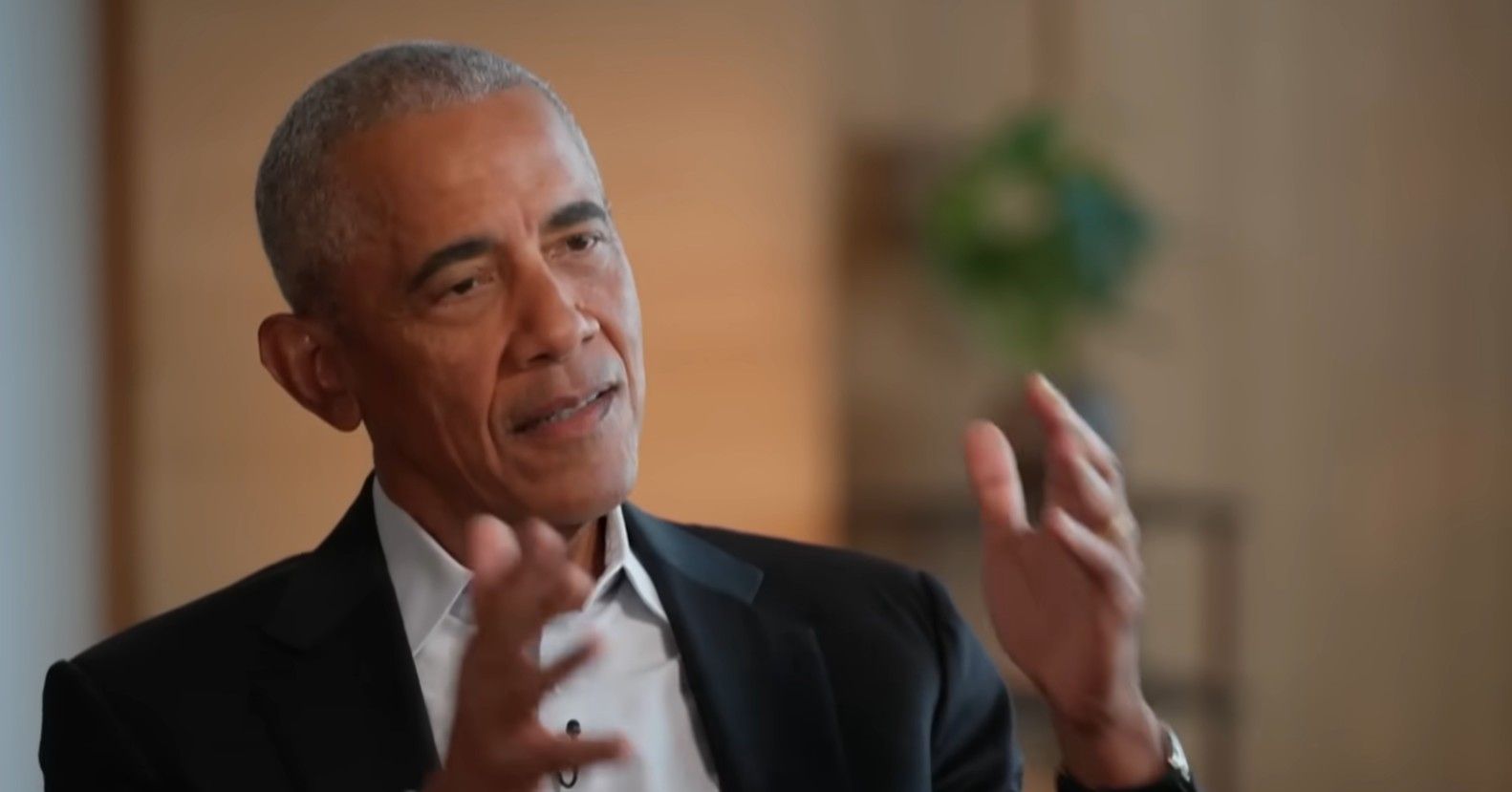
Former President Barack Obama is back on the lecture circuit defending his signature Iran nuclear deal — insisting his administration managed to tame Tehran without firing a shot, even as the regime today sits closer than ever to weapons-grade uranium.
During a friendly sit-down on The Late Show with Stephen Colbert, Obama dusted off the talking points from the 2015 Iran agreement and argued that diplomacy, not military pressure, was the smarter play.
“We went about trying to negotiate a diplomatic agreement that would get the enriched uranium out of Iran, that would assure they could not get to a nuclear weapon without us knowing about it…and that there were mechanisms in place to enforce it and verify it,” Obama told host Stephen Colbert.
“And we pulled it off without firing a missile,” he added.
That agreement — formally known as the Joint Comprehensive Plan of Action — was sold by the Obama White House as the ultimate diplomatic masterstroke: sanctions relief in exchange for limits on Iran’s nuclear program.
Critics, however, warned at the time that the deal merely hit the snooze button on Tehran’s nuclear ambitions while handing billions in economic relief to one of the world’s leading state sponsors of terrorism.
Obama acknowledged during the interview that his administration seriously weighed military action against the Iranian regime but decided force should remain “a last resort.”
“My basic theory was that Iran couldn’t become a nuclear state, that the regime itself was murderous, oftentimes towards its own people, engaged in state-sponsored terrorism, was a threat to the United States and allies of ours, so the idea that they would have nuclear weapons would be extraordinarily dangerous,” Obama said. “What I also believed was that the regime was not entirely irrational, that they had a survival instinct, and that when you carry out the military force, innocent people die.”
The negotiations dragged on for months before Iran agreed to slash much of its enriched uranium stockpile and open facilities to international inspectors. Under the deal, Tehran reduced its uranium reserves by roughly 98% while still being permitted to maintain low-level enrichment for civilian energy use.
Obama insisted the arrangement delivered exactly what it promised. “There’s no dispute that it worked, and we didn’t, we didn’t have to kill a whole bunch of people or shut down the Strait of Hormuz,” he argued.
That claim remains fiercely disputed in Washington. President Donald Trump torched the agreement during his first term, pulling the United States out in 2018 and branding it “a horrible, one-sided deal that should have never, ever been made.” The Trump camp — along with many Republicans and Israeli officials — argued the deal’s so-called “sunset provisions” guaranteed Iran would simply wait out restrictions before revving its nuclear program back up. And that’s largely what happened.
After the U.S. withdrawal, European allies tried to keep the agreement on life support, but Tehran eventually blew past enrichment caps and accelerated production. International watchdog reports now show Iran possesses uranium enriched up to 60% purity — dangerously close to the 90% threshold generally considered weapons-grade. That reality has fueled renewed tensions as the U.S. and Iran exchange strikes and threats amid a shaky regional ceasefire brokered in part through Pakistani intermediaries.
Trump, meanwhile, continues insisting he can secure a tougher agreement than Obama ever did — one that permanently blocks Iran from obtaining highly enriched uranium. “If a Deal happens under ‘TRUMP,’ it will guarantee Peace, Security, and Safety, not only for Israel and the Middle East, but for Europe, America, and everywhere else,” Trump declared in an April Truth Social post. “It will be something that the entire World will be proud of, instead of the years of embarrassment and humiliation that we have been forced to suffer due to incompetent and cowardly leadership!”
Obama may still be celebrating a deal he says avoided war. But with Iran now sitting far closer to nuclear capability than when the ink dried on the agreement a decade ago, critics say the former president’s diplomatic trophy is looking less like a peace breakthrough — and more like a very expensive timeout.











Iran is within years, a year, months, a week, days, Fn hours at getting a nuke! Funny, I’ve heard this from so many presidents, I’ve lost track!
It’s become a permanent line to keep us scared so the military complex and the CIA can up their funds!
I’m tired of the same Fn bulls$$t!
Also the lines, hey we need to attack them there before they attack us here! That line has been used on how many wars and battles? Fn sheep.
Why does Obama still try to be relevant? The guy was a colossal failure. Man, just shut up and go away.
P.S. – he is NOT “President Barack Obama.” The title belongs to the office, not the officeholder. Our president is Donald Trump. Senator Barack Obama is a has-been.