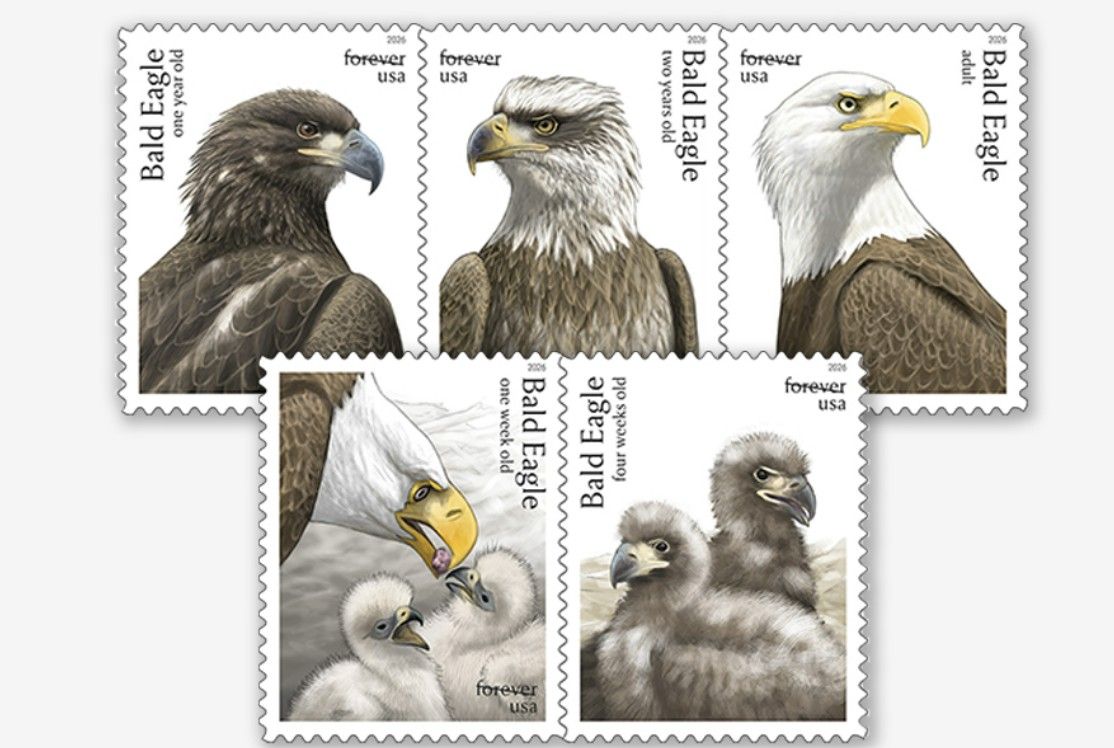
To mark the nation’s upcoming 250th birthday, the U.S. Postal Service unveiled a new collection of bald eagle stamps Thursday — a rare patriotic gesture in an era when many institutions seem more comfortable apologizing for America than celebrating it.
The special-edition stamps, revealed at the National Eagle Center in Wabasha, Minnesota, trace the bald eagle’s life from awkward fluff-ball hatchling to the fierce white-headed predator Americans know from the Great Seal and countless Fourth of July commercials.
And unlike most government projects, these tiny pieces of paper actually tell a story. “The fact that we’re seeing the eagles in all different stages of its life, it’s sort of making us look back at the stages of the life of our country,” Postal Service historian Steve Kochersperger said. “At one time, we were just fuzzy little hatchlings, too.”
Corny? Sure. But he’s not wrong.
The bald eagle has represented the United States since Congress adopted the Great Seal in 1782 — back when America was still a scrappy experiment instead of a bloated administrative state arguing over pronouns on Zoom calls. Yet despite serving as the country’s unmistakable symbol for nearly 250 years, the eagle was only officially designated as the national bird in 2024.
Better late than never.
Kochersperger said the eagle embodies “strength, freedom and independence,” which explains why Americans still rally around it while activists spend their time trying to replace national pride with land acknowledgments and self-loathing history lectures.
And despite the endless myths repeated every Thanksgiving, Benjamin Franklin never seriously pushed to make the turkey America’s national bird. The old tale stems from Franklin criticizing the eagle’s scavenging habits in a private letter, not launching some colonial poultry campaign.
The eagle’s story also happens to be one of the greatest conservation success stories in modern American history — something environmental alarmists rarely emphasize because it proves the system can actually work.
By the 1960s, bald eagle populations had cratered after widespread use of the pesticide DDT weakened eggshells and devastated reproduction rates. Americans responded with a mix of conservation laws, public pressure and old-fashioned national pride.
“The public relations campaign brought greater awareness that, ‘Hey, this is our national symbol, but they may all be gone if we don’t change our ways,’” Kochersperger said. “And that turned out to be very effective.”
The federal government banned DDT in 1972. Bald eagles were added to the endangered species list in 1978. By 2007, the species had recovered enough to be removed from the endangered list entirely.
Today, according to the U.S. Fish and Wildlife Service, there are more than 300,000 bald eagles across the continental United States — a stunning rebound for a bird that once looked headed for extinction.
In other words: Americans saw a problem, fixed it, and saved their national symbol without turning the country into a climate cult.
The artwork for the stamp series was created by famed bird illustrator David Sibley, who spent nearly a year designing the collection digitally. Sibley said he wanted people to think about the eagle not just as a patriotic emblem, but as a living part of the natural world. “Maybe seeing a bald eagle on the stamp as a bird, living its life from nestling to adult, will hopefully make people think about the natural world and how important things like eagles are, not as a symbol but as part of the ecosystem around us,” he said.
Fair enough. But let’s be honest: the reason Americans care so much about bald eagles is precisely because the bird means something bigger.
The eagle isn’t just another animal. It’s the symbol of American resilience — scarred, nearly wiped out, then roaring back stronger than ever. That’s probably why the image still drives the professional America-haters nuts.
Even the Postal Service’s Kochersperger managed to sneak in a surprisingly thoughtful line about stamps themselves. “A stamp does not demand your attention, but it rewards it,” he said. “A tremendous amount of planning and effort went into producing that tiny little piece of paper.”