

video below…
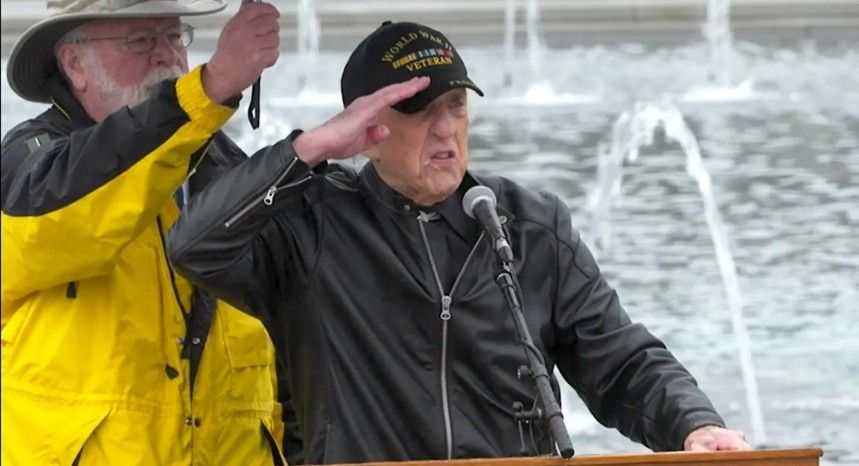
He stood in the rain at the National World War II Memorial in Washington, D.C., voice cracking, posture still sharp with duty, and delivered the kind of message modern America rarely hears without scrolling past it.
David Yoho, a 97-year-old former Merchant Marine who enlisted at just 16, didn’t show up to flatter the crowd or soften history. He showed up to remind them — bluntly — what war actually costs, and who paid it.
“Tell them about veterans and say to them that we gave up our yesterdays for your tomorrows,” he said, his voice breaking as he addressed the Memorial Day weekend gathering.
Then he doubled down, anticipating the inevitable social-media paraphrase and distortion that usually follows moments like this. “And if they say to you then, who did you hear speak these words?” he continued. “Tell them it was a 16-year-old boy in the heart and mind and body of a 98-year-old veteran of World War II.”
It was the kind of unscripted, emotionally raw moment that doesn’t survive long in today’s sanitized civic culture — and, of course, it immediately went viral.
Yoho delivered the remarks at the National World War II Memorial, honoring the more than 16 million Americans who served after Pearl Harbor and the roughly 400,000 who never came home.
Yoho reminded listeners that war didn’t just draft adults — it swallowed teenagers whole. He entered service at 16, when America had already lowered enlistment ages to fill the ranks. “When you’re 16, you’re a child playfully in your streets, and the day you enter the military, that stops,” he said, pounding the lectern as rain fell around him.
There was no polish to it. No focus-group phrasing. Just memory, age, and the weight of survival.
He also took time to honor the Merchant Marines — the often-overlooked civilian mariners who ferried troops and supplies through submarine-infested waters, suffering staggering losses in return.
According to Yoho, roughly 250,000 served in the Merchant Marine during the war, many never making it home from routes like the brutal Arctic convoys to Murmansk. “So who are we here today? We are here to toll the bell, toll the bell for those who we honor in rest,” he said. “Toll the bell for every military unit.”
And then came the broader warning — the kind that lands differently in 2026 than it might have even a generation ago. “We were a country of 130 million and we put 16,200,000 of them in uniform, and 440,000 of them didn’t come home,” he said, making the scale of sacrifice impossible to ignore.
He didn’t just speak about numbers, though. He spoke about people — the families behind the names etched into stone, each star representing lives that never returned to normal, if they returned at all. “And when you see a star representing 100 men, contemplate that each one of these people had an attachment to a mother, father, son, daughter, brother, sister,” he said.
His message wasn’t complicated. It wasn’t subtle. It was the kind of civic reminder that used to be common currency in American life: freedom is inherited, not self-generated, and it came at a price too large for modern comfort to fully grasp. “I add my thank you for your being here today,” Yoho said. “We are the last of a breed who you sponsored to represent you, your families.”
And before stepping away, he left the crowd with a final line that summed up both gratitude and warning in one breath: “We lost 733 ships and the highest mortality rate of any group that served in that war, but God is great and God is good and he kept this old sucker alive… I have a deep affection for everything here and what they stand for.”
For a generation increasingly detached from living memory of World War II, Yoho’s message wasn’t just history — it was a challenge: remember it, or risk forgetting what it cost.




“video below”. What BS!!!