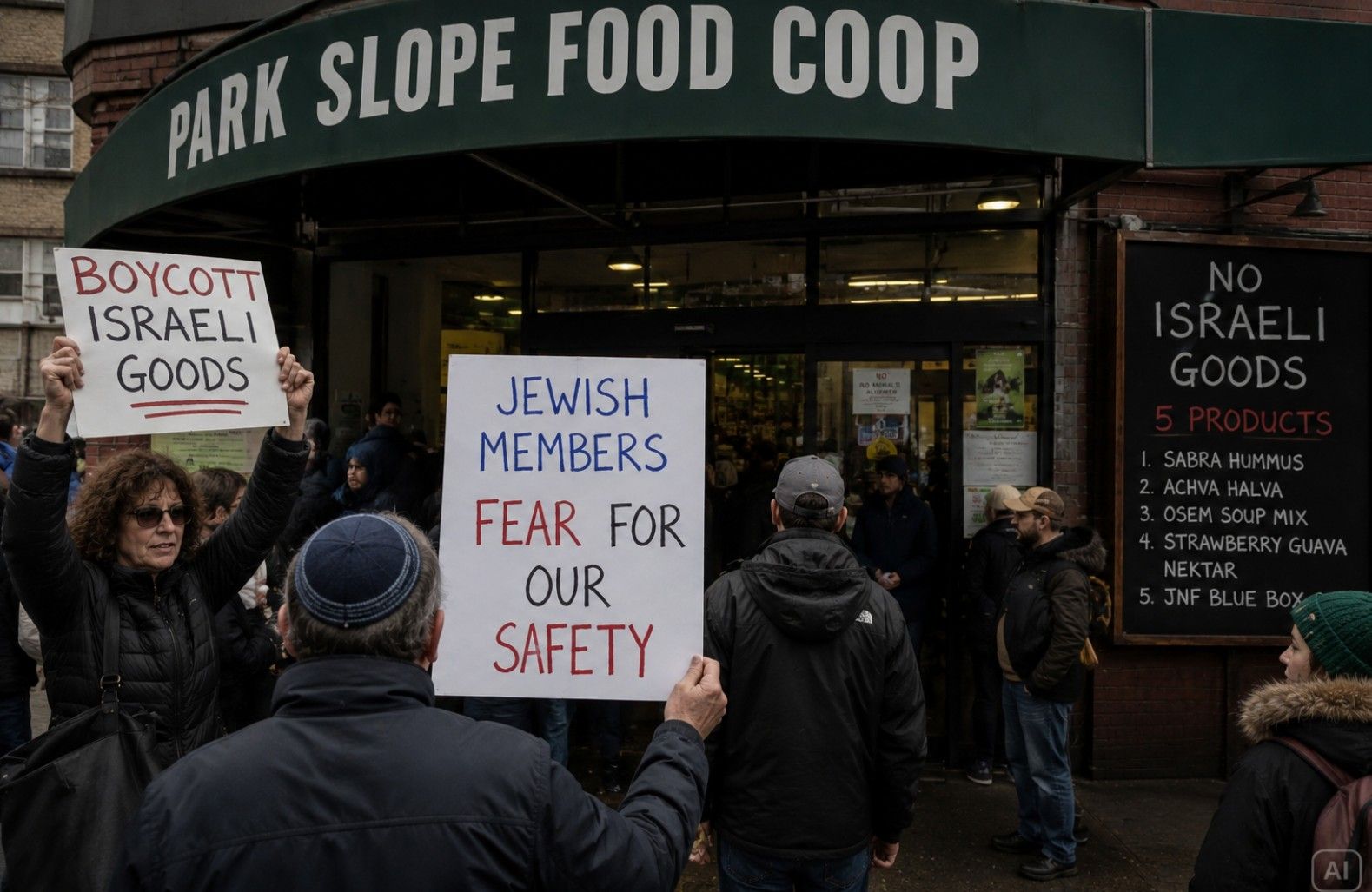
Inside Brooklyn’s famously left-leaning grocery experiment — the Park Slope Food Coop — a supposedly “routine” vote over whether to tighten rules around Israeli products has morphed into a full-blown ideological street brawl, with Jewish members now saying the atmosphere has become so hostile they fear for their safety.
What’s on the table sounds almost absurdly small-scale: just a handful of Israeli-linked items, including seasonal kosher matzo and some packaged hummus. But in Park Slope, nothing stays small for long once politics enters the produce aisle.
According to internal communications and members involved in the dispute, what should have been a procedural meeting has instead spiraled into accusations, intimidation claims, and enough bad blood to last a lifetime of grocery runs.
The New York Post reports that tensions inside the coop have reached such a fever pitch that leadership scrapped an in-person meeting at The Picnic House in Prospect Park and moved the vote entirely online after members raised what they described as “explicit concerns about their safety.”
One board member, Ramon Maislen, didn’t sugarcoat the mood. He told the Post that some members backing the boycott movement had become, in his view, “fairly violent,” with opponents allegedly feeling targeted simply for disagreeing with the push.
The dispute has been simmering for years, but it has exploded since the Oct. 7, 2023 Hamas terror attack on Israel and the subsequent war in Gaza, which supercharged activism and deepened divisions even inside this famously cooperative grocery collective.
What’s especially striking is how far the rhetoric has spilled over from policy debate into personal confrontation. One recent meeting reportedly included a member declaring that “Jewish supremacism is a problem in this country,” while comparing Jews to Nazis — comments that ignited immediate outrage inside the coop.
Even within Brooklyn’s progressive Jewish community, the fracture is becoming impossible to ignore. Rabbi Rachel Timoner — herself often aligned with progressive political causes — has publicly warned congregants that the boycott-divestment-sanctions movement, or BDS, is not about coexistence or peace but, in her view, about eliminating Israel altogether.
Outside the coop this week, pro-Palestinian activists staged demonstrations, chanting about genocide and apartheid while urging members to back the boycott. One protester even wore a shirt declaring, “I’m Jewish and I’m against genocide,” underscoring just how tangled and emotionally charged the issue has become.
For some longtime members, the scene feels like a takeover of what was once a community institution. One attorney who has belonged since 2012 told the Post that if the measure passes, it will effectively become “a scalp hanging from the belt” for the broader BDS movement — a symbolic win that turns a grocery store vote into political branding.
Others say the atmosphere has crossed a line from heated debate into intimidation. One member affiliated with an anti-boycott group said she witnessed a confrontation where a pro-boycott participant allegedly got physically aggressive with a flyer distributor, stepping in close and shouting about “genocide and apartheid” before staff intervened.
Even the logistics of attending meetings have become fraught. One longtime member described experiencing anxiety severe enough that she arrived hours early just to ensure she could get inside, fearing she might be blocked or intimidated.
In a formal complaint reviewed by the Post, another member described sleepless nights and physical distress ahead of meetings, writing that she had become increasingly distressed after emails referencing “Zionists” circulated among organizers. She said the experience left her feeling “utter disgust” toward what the coop had become.
The boycott effort itself is being pushed by members aligned with the group Members for Palestine, which has urged support for the measure while dismissing safety concerns as exaggerated. The group did not respond to requests for comment.
Meanwhile, estimates circulating among members suggest that if the boycott succeeds, as many as 1,000 people could walk away from the coop altogether — a potentially significant hit to a 53-year-old Brooklyn institution built on the idea of shared ownership and community cooperation.
Even some who have lived through earlier political fights inside the coop say this one feels different — more personal, more polarized, and far less likely to end when the votes are counted.
As one longtime member put it bluntly, most people “just want all of this to go away.” That wish, however, doesn’t appear to be on the ballot.