

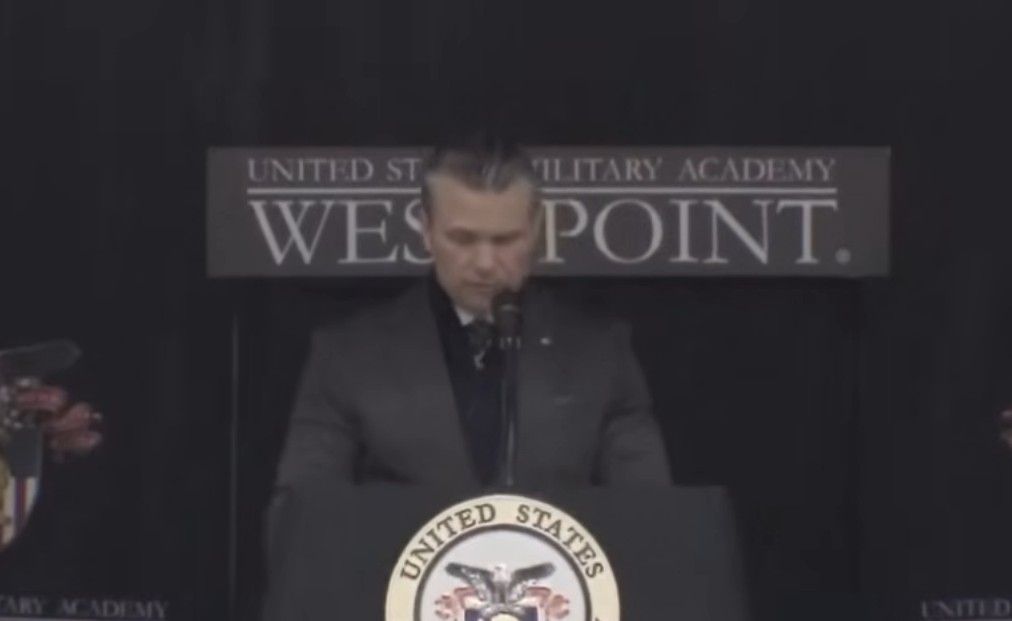
If you missed Secretary of War Pete Hegseth’s West Point commencement address, you might want to pull it up before someone tries to explain it away for you.
Because it wasn’t just another polite graduation speech with handshakes and platitudes. It was a verbal gut check aimed squarely at a military culture he says has been softened, politicized, and distracted at precisely the wrong time.
Fox News, in a recent opinion piece, describes how Hegseth used the platform to deliver a blunt message about readiness, standards, and what actually keeps soldiers alive when bullets start flying—not campus buzzwords or HR-approved talking points.
His core message was simple, and deliberately unvarnished: the battlefield does not care about social experiments.
As Hegseth put it: “The battlefield does not grade on a curve, and you can’t throw your pronouns at the enemy. Combat is the ultimate test, and our best Americans must ace it.”
Hegseth also trained his fire on what he described as ideological drift inside the U.S. Military Academy itself, warning that leadership had pushed the institution away from its mission and toward something closer to a progressive finishing school.
He called out what he described as “woke and weak leaders” who tried to reshape West Point into a “woke Princeton”—a comparison that, in military circles, lands somewhere between insult and alarm bell.
According to Hegseth, the problem wasn’t just tone, but training and priorities. He argued that leadership had allowed identity politics to seep into the core of military education.
“They embraced the DEI craze and tried to introduce diversity and inclusion studies. They hired professors who advocated for anti-American ideologies right here in these halls…”
In his framing, this wasn’t harmless academic drift—it was mission degradation dressed up as progress.
The op-ed recounts a personal anecdote from the author describing a visit to West Point in 2022, where a senior officer allegedly confided concerns that the institution was shifting “far left” and watering down long-standing standards and traditions.
While such accounts are anecdotal, they reflect a broader argument now echoing across parts of the military community: that merit-based systems have been increasingly replaced—or at least diluted—by ideological considerations.
Hegseth, a combat veteran himself, is presented as uniquely positioned to amplify those concerns from the top of the chain of command rather than from the sidelines.
Hegseth also told cadets they were not imagining what they’ve been witnessing in the field and in training environments. “Many of you, even in your short time in uniform have endured what I call the slow slide of the U.S. Army. You’ve seen standards lowered, you’ve seen an obsession with race and gender, you’ve seen the watering down of discipline, codes weakened and traditions tossed aside in the name of political correctness, statues taken down, paintings placed in the basement…”
The op-ed expands the critique beyond West Point, arguing that similar “DEI-driven” shifts have crept into other essential fields—law enforcement, firefighting, healthcare, aviation, and emergency response systems.
The underlying claim is that when critical institutions prioritize identity frameworks over competence, the risk is not theoretical—it is operational. And that, Hegseth argues, is where the stakes become existential.
Stripped of political framing, the central thesis is straightforward: life-and-death professions should be governed by performance, not ideology.
The piece argues that “identity politics” has no place in selecting those responsible for protecting the public, whether in uniform or in civilian critical infrastructure roles.
In that sense, Hegseth’s West Point message is less about campus politics and more about national security fundamentals.
The speech’s closing sentiment circles back to a basic premise that would have been uncontroversial for most of American history, and is increasingly controversial only in modern discourse: Regardless of race, religion, gender, or sexual orientation, the job is simple—find the best people for the hardest jobs, or accept the consequences when things go wrong.












I fully agree with Defense Secy Hegseth. He is absolutely right on.