

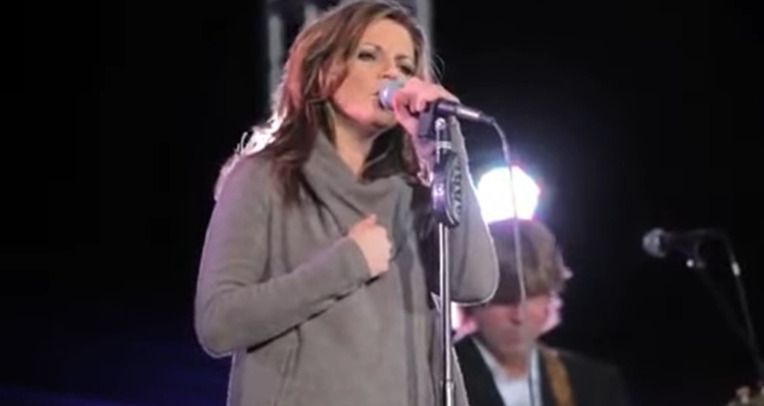
Well, here we go again—another celebrity suddenly discovering “principles” right when they become inconvenient.
Country star Martina McBride has backed out of performing at the so-called Great American State Fair tied to America’s 250th birthday celebration, claiming organizers didn’t fully disclose the event’s “nonpartisan” nature. And just like that, the curtain gets pulled back on yet another Hollywood-adjacent meltdown over anything that even sniffs of patriotism being, gasp, “controversial.”
The excuse might sound tidy on paper. In practice? It’s raising more than a few eyebrows.
— Martina McBride (@martinamcbride) May 29, 2026
Because McBride’s own public posting history—yes, the same social media trail celebrities seem to forget exists—has reignited scrutiny over what “nonpartisan” even means in entertainment circles anymore. Funny how that word suddenly becomes a red line only when the guest list doesn’t tilt the “right” way politically.
And that’s the part many Americans are rolling their eyes at: the selective outrage.
If an event celebrating 250 years of the United States is now treated like a political litmus test instead of a national milestone, what exactly does that say about where some entertainers are drawing their lines? For a growing number of observers, it looks less like a principled stand and more like political temperature-checking dressed up as moral clarity.
Meanwhile, critics of the decision argue the bigger issue isn’t just one singer stepping away—it’s the broader pattern of performers distancing themselves from anything framed as patriotic unless it’s pre-approved by the “right” cultural filter. To them, it’s not about Trump, not about organizers, but about whether America itself is now considered too politically risky to celebrate without disclaimers.
The right never bullied a performer for performing at the White House. This kind of ideological intimidation is almost exclusively a feature of the modern left.
What a cowardly choice to bow to the mob rather than proudly celebrate our great country on its 250th anniversary. https://t.co/iUjh5yzfzo
— Meaghan Mobbs (@mobbs_mentality) May 29, 2026
This you? https://t.co/S1KIcjsCwj
— Libs of TikTok (@libsoftiktok) May 29, 2026
Ma’am, bless your ever-lovin’ heart 😂
You wrote a whole novel about how you thought this was just a wholesome “nonpartisan” celebration of all 50 states… but now suddenly “what we were told is not what is happening” and you gotta bail on America’s 250th birthday bash?
You…
— Gunther Eagleman™ (@GuntherEagleman) May 29, 2026
Supporters of the event, particularly from a more conservative vantage point, see it differently: a straightforward celebration of the nation’s milestone anniversary being dragged into culture-war theater it never asked for. In that view, turning a 250-year national birthday into a partisan flashpoint says less about the event—and more about the industry reflexively politicizing anything remotely nationalistic.
Whether one agrees with McBride’s reasoning or not, the timing and framing have only fueled accusations of inconsistency—and in today’s climate, inconsistency gets noticed fast.
Because nothing travels quicker than a celebrity saying “nonpartisan”… followed immediately by behavior that makes people ask, “nonpartisan for who, exactly?”








Longtime fan of Martina McBride. I could cry over her now betrayal of America. Yes, that’s what it is. She had no problem performing at the White House for the very partisan Barack Obama. But cannot bring herself to participate in a celebration of America’s 250th anniversary? Because duly elected President Donald Trump’s name is associated with it? Give me a break.