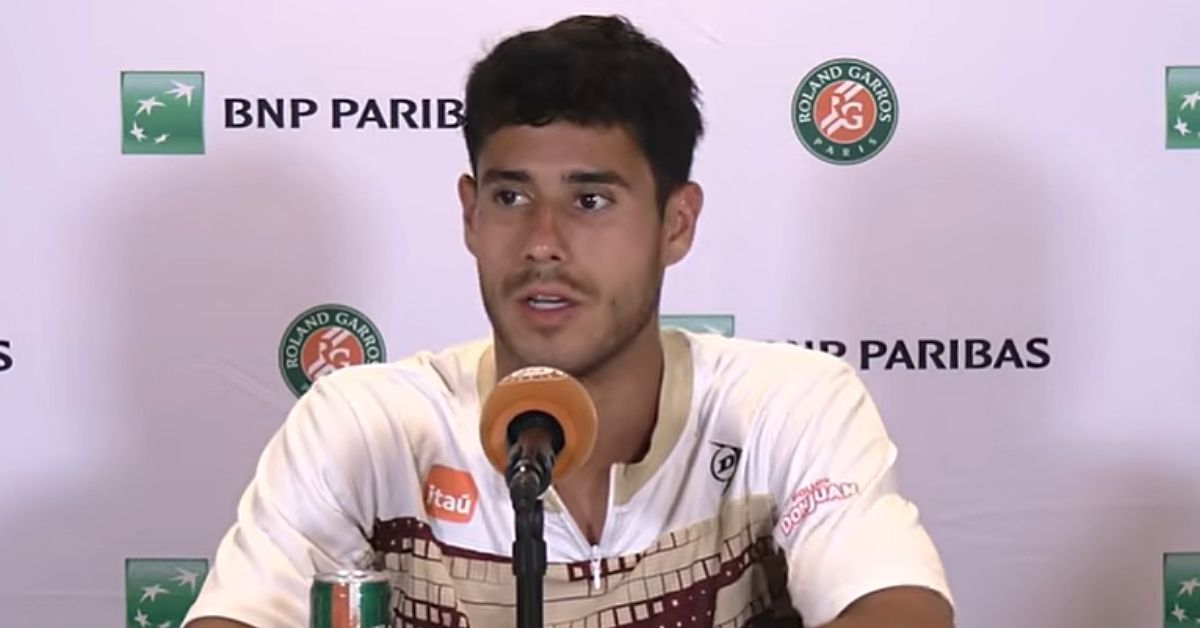
Paraguayan tennis player Adolfo Daniel Vallejo found himself at the center of a firestorm after a grueling, nearly five-hour French Open marathon against French teenager Moïse Kouamé. The 22-year-old battled through brutal Paris heat, a deafening pro-French crowd, and a dramatic fifth-set collapse before falling 6-3, 7-5, 3-6, 2-6, 7-6.
But it was what happened after the match that set off the real controversy.
Vallejo didn’t blame bad luck. He didn’t blame his racket. He didn’t blame the weather. Instead, he argued that the officiating crew failed to keep a wildly partisan French crowd under control — and he bluntly suggested the chair umpire lacked the authority needed for that assignment.
“This sort of match needs to be umpired by a man. It’s very difficult for a woman to do it,” Vallejo said after the loss.
He doubled down even further. “It has to be refereed by a man, because it’s a very demanding crowd and you need a lot of strength to go against the crowd.”
🚨 OFFICIEL ! Adolfo Daniel Vallejo va être SANCTIONNÉ d’une amende après avoir déclaré que son match contre Moïse Kouame n’aurait « pas dû être arbitré par une femme ». ❌
✍️ « Roland-Garros condamne fermement tout propos sexiste et apporte son soutien à l’arbitre concernée. » pic.twitter.com/8rRX7HyGok
— Univers Tennis 🎾 (@UniversTennis) May 29, 2026
French Open organizers and the French Tennis Federation immediately condemned the remarks as “unacceptable” and announced that Vallejo would face a significant fine. Tournament officials insisted that an umpire’s ability has nothing to do with gender and everything to do with professionalism.
But buried beneath the predictable social-media pile-on is a question that sports fans have been debating for decades: How much influence should rowdy home crowds be allowed to have over elite competition?
Vallejo argued that Kouamé benefited from extended breaks, lengthy crowd celebrations, and stoppages that disrupted the rhythm of the match.
“The crowd was very out of line, but I understand they’re supporting their compatriot,” Vallejo said. “It’s quite an intense crowd and that’s why I was prepared; I already knew it would be like that and, to be honest, it didn’t harm me, but rather strengthened him.”
Statement from the French Tennis Federation and the Roland-Garros tournament organisers#RolandGarroshttps://t.co/8fi84kTVui
— Roland-Garros (@rolandgarros) May 29, 2026
He continued: “I think he took up a lot of time on many occasions, lying on the floor or stalling. And it’s not normal for the crowd to be shouting for a full minute without any play. In a match where the physical aspect matters so much, if you give a player a lot of time, he’s obviously going to take advantage of it.”
Whether fans agree with his criticism or not, Vallejo clearly believes the issue wasn’t simply crowd noise — it was inconsistent enforcement of the rules during one of the most emotionally charged matches of the tournament.
Of course, in modern sports, criticizing officiating is one thing. Suggesting gender may have played a role is another matter entirely. That’s why the tennis establishment reacted with lightning speed, portraying the comments as sexism rather than engaging the broader complaint about crowd management and competitive fairness.
Meanwhile, Kouamé’s Cinderella run continues. The 17-year-old French sensation became the youngest man to reach the third round at Roland-Garros in decades, thrilling home fans who transformed Court Suzanne-Lenglen into something closer to a soccer stadium than a traditional tennis venue.