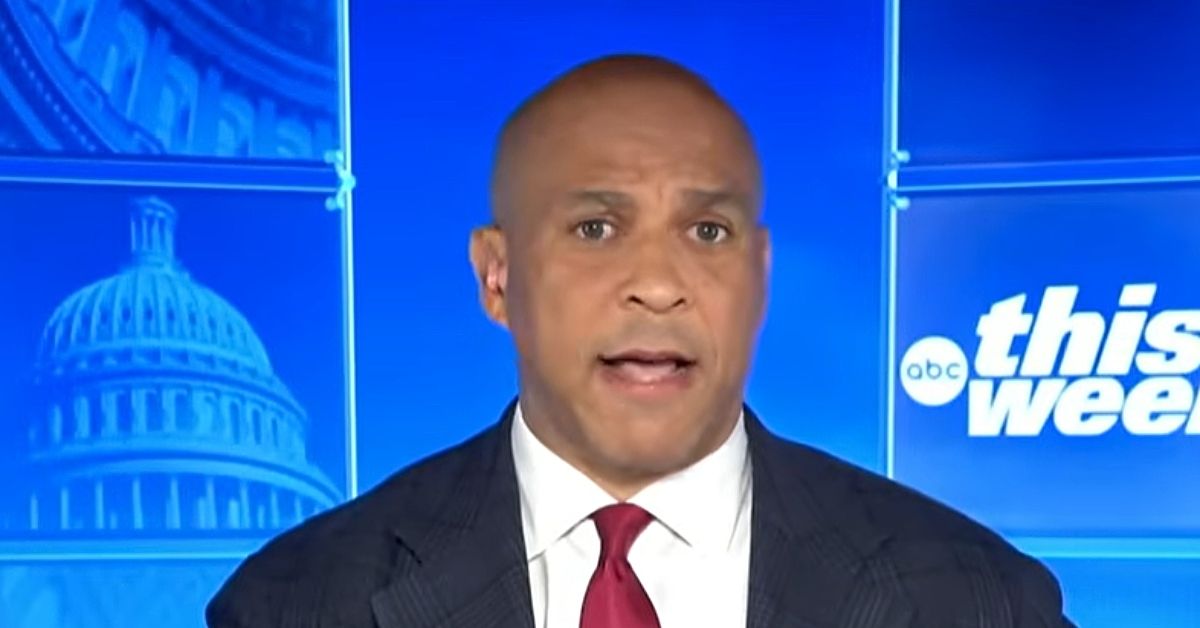
Sen. Cory Booker has officially entered the sacred Hall of Political Understatement, where “I have concerns” is doing Olympic-level gymnastics to avoid saying what every sentient adult can already see: the Maine Democratic Senate hopeful Graham Platner is dragging a full-blown, multi-alarm scandal parade behind him, and the party is pretending it’s just a light drizzle.
On ABC’s This Week, Jonathan Karl didn’t exactly tiptoe around it. He pressed Booker on whether Platner’s growing pile of controversies — including reports of sexually explicit messages to multiple women, a past tattoo that reportedly resembled a Nazi-associated symbol before being covered up, and a resurfaced trail of bizarre online posts — could sink Democrats’ hopes in a key Senate race.
Booker’s response? The political equivalent of shrugging while the kitchen is on fire: “Yes, I have concerns,” Booker told Karl. “That guy has questions to answer.”
And just like that, Washington’s favorite escape hatch was deployed. Not outrage. Not endorsement. Not condemnation. Just “concerns.” The word you use when you want to acknowledge the dumpster fire exists without actually admitting it’s a five-alarm inferno rolling downhill toward your party’s electoral chances.
ABC: Do you have concerns that Graham Platner may jeopardise Democratic hopes to get that Senate seat in Maine?
BOOKER: “Yeah, I have concerns. The guy has questions to answer…” pic.twitter.com/lVt3Chajfx
— RNC Research (@RNCResearch) May 31, 2026
Of course, Booker didn’t linger on the scandal. Why deal with that when you can pivot to the Democrats’ favorite talking point — the cosmic importance of winning the Senate? Suddenly it was all about health care costs, gas prices, and the looming apocalypse of “an out-of-control president.” Because nothing says accountability like changing the subject mid-sentence.
Meanwhile, the reporting behind the controversy gets messier by the day. According to reporting cited in multiple outlets, Platner’s wife reportedly discovered and flagged sexually explicit messages he sent to other women during the early phase of his campaign. The situation, naturally, has evolved into a full family-campaign-media spiral — complete with emotional statements, social media defenses, and the kind of “this is private but also very public” drama that always mysteriously lands in the news cycle right before an election.
Platner’s spouse has pushed back hard against the coverage, calling it “shameful” and insisting critics are focusing on gossip instead of policy. But in classic Washington fashion, the real story isn’t just the scandal — it’s the choreography of everyone trying not to step in it. Booker’s “concerns.” Other Democrats suddenly developing selective hearing. The universal political instinct to act like the elephant in the room is actually a tasteful houseplant.
And that’s where the absurdity peaks. Because “I have concerns” isn’t really a position — it’s a parking brake someone gently taps while the car is already rolling downhill. It signals awareness without responsibility, acknowledgment without consequence, and above all else, maximum distance from the mess.
The old “questions to answer” trick:
When everyone already has access to the proof, pretend it isn’t proof.
— David Steinberg (@realDSteinberg) May 31, 2026
Republican accused of anything: “Threat to democracy.”
Democrat with a Nazi linked tattoo controversy: “The guy has questions to answer.”
Amazing how careful they get when it is their team.
— The Double Standard Desk (@DSDdesk) May 31, 2026
At this point, voters are left decoding a familiar pattern: when Democrats think a candidate is radioactive, they don’t say so — they whisper “concerns” and hope the news cycle develops amnesia.
Platner, for his part, remains the presumptive nominee and continues campaigning while the story metastasizes around him. The Democratic establishment, meanwhile, appears stuck between two bad options: defend the candidate or admit the vetting process might have been about as sturdy as a screen door in a hurricane.
Either way, Booker’s carefully calibrated “concerns” won’t be mistaken for leadership. It’s the kind of statement designed to satisfy exactly no one — except, perhaps, the consultants who get paid per syllable of strategic vagueness.