

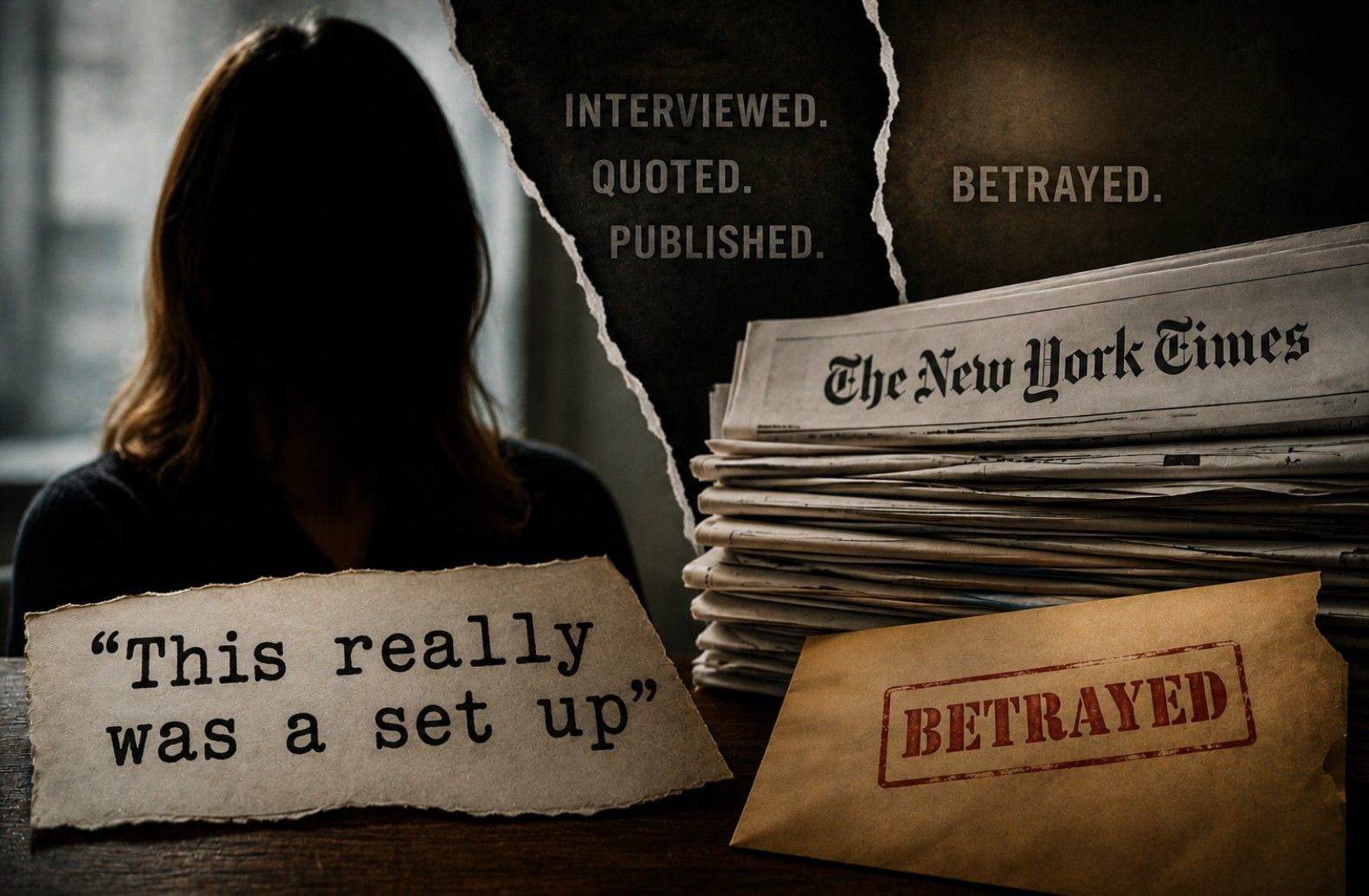
Lyndsey Fifield — the former girlfriend whose allegations helped fuel a fresh round of scrutiny surrounding the Maine Democrat — is now accusing The New York Times of turning her deeply personal story into what she calls “a gift” for the very politician she says mistreated her.
And her fury is aimed not at Platner, but at the journalists she says persuaded her to come forward.
In a blistering public statement, Fifield painted a picture of reporters who allegedly promised protection, solidarity and a platform for multiple women — only to publish a story that she believes watered down key claims, omitted supporting evidence and left her exposed while benefiting Platner politically.
“It dawned on me that this really was a set up all along,” Fifield wrote. Those are not the words of someone thrilled with her media coverage.
According to Fifield, she initially had no intention of speaking publicly. She says she wanted nothing to do with the controversy that erupted after questions resurfaced about Platner’s long-running Nazi-linked Totenkopf tattoo, a symbol associated with Hitler’s SS death squads. Platner has maintained that he did not understand the symbol’s meaning when he got the tattoo during his Marine Corps service, a claim Fifield has publicly disputed.
Fifield says Times reporters approached her and urged her to reconsider. They allegedly told her that other women also had stories to tell and suggested they could collectively expose troubling behavior. She says she eventually opened her home, shared diary entries, turned over messages and provided contacts who could corroborate portions of her account. What followed, according to her version of events, was months of requests for more material, more sourcing and more documentation.
She complied. Then the story appeared. And that’s when she says alarm bells started ringing.
Why, she wondered, were allegations from other women largely absent? Why did the article focus so heavily on her background? Why were screenshots omitted? Why did the story state that certain claims could not be corroborated when she says she provided sources who could do exactly that? And why, she asked, did the final product include details she viewed as irrelevant while excluding information she considered critical?
“The journalists I trusted,” she wrote, “methodically delayed and twisted this into a gift to the Platner campaign.”
Platner’s campaign has been staggering from one controversy to the next. Recent reports have detailed allegations involving explicit messages sent to women during his marriage, renewed scrutiny surrounding his tattoo, resurfaced online comments that critics have described as offensive and inflammatory, and accounts from former romantic partners describing volatile behavior. Platner has denied allegations of physical abuse and insists the most serious accusations are false and politically motivated.
The Times report itself included claims from Fifield that Platner sometimes grabbed her hard enough to leave marks, once pulled her from a cab by her wrist during an argument and, on another occasion, twisted her arm behind her back before confining her to a room until she calmed down. Fifield also alleged that Platner referred to his controversial tattoo as “my Totenkopf” and made disturbing comments about dominance and violence. Platner has disputed those allegations.
But now the controversy has expanded beyond the candidate.
For critics of legacy media, Fifield’s account lands like gasoline on a bonfire. Her complaint is not that reporters ignored her story. Her complaint is that they allegedly convinced her to tell it, gathered mountains of material and then produced something she believes softened the political fallout.
And perhaps the most devastating line in Fifield’s lengthy statement had nothing to do with Platner or the press.
After describing how she felt pressured, disappointed and ultimately betrayed, she reflected on her final conversation with the reporters.
She says she thanked them. “Still fawning after all these years,” she wrote.
HER FULL STATEMENT FROM X:
Anyone who has ever extracted themselves from a relationship with a narcissistic abuser knows it isn’t clean or easy.
I cringe remembering how many times I tried to play the “cool girl” or fawn in response to what was clearly abusive, coercively controlling behavior by Graham.
I also know how dangerous it is to become the target of a narcissist—so even long after our relationship ended I continued to be upbeat any time he reached out, while also immediately shutting down any attempts on his part to initiate flirting or romanticizing the past.
Yes, the day I saw him announce he was running I wanted to make sure people knew he had a Nazi tattoo—and I was terrified he would find out it was me. But of course he knew it was me.
What’s ironic is I absolutely never would have shared my story if he hadn’t been relentlessly attacking my character behind the scenes for months once the tattoo story came out. I tried to signal that I wasn’t the source and stayed completely silent about him on social media even as most of my friends posted regularly about what a bad person he is.
But then in early April the New York Times came to me. I asked how they got my number. I said I was not interested in sharing my story. They said but wait—there are other women. Women terrified to tell their stories too, and you need to band together. We will help you. We will protect you. Men can’t keep getting away with this.
Hours before their first call to me I saw Eric Swalwell’s name plate get removed from his office door in Cannon. It felt like fate.
I welcomed the two journalists into my home days later, nervous and overwhelmed. Justin Fairfax had just died the previous day, and even conservative pundits were suggesting that if only those women hadn’t accused him of abuse, this never would have happened.
But I told them my story. I let them take pictures of my diary pages, sent them screenshots of messages, and gave them phone numbers and contacts. It was excruciating. I was surprised by what details I remembered, and as I went through old messages I was horrified by how much I had forgotten.
I explained very clearly that, like many women abused by their partners, I had not told anyone about his violence at the time—I had covered for and defended it. I accepted his apologies. They said that was fine because the diary entries and my on-the-record account were enough.
They connected me to two of the other victims so we wouldn’t feel so alone. I insisted to each of them that I trusted the journalists and that we were doing the right thing, despite their (sadly very accurate) sense that something was wrong.
One of the victims and I realized our relationships with Graham overlapped completely—he had been cheating on both of us the entire time.
I should note here that my life is just… beautiful. These are the best years of my life. Raising two young girls in a safe, beautiful neighborhood where I work from home and shuttle my children from dance classes and soccer to church events. I am blessed far beyond what I deserve with wonderful friends, family, and the most loving, brilliant husband in the world. Why would I blow my life up like this? Why would I risk the psychotic doxxing from violent activists?
Because while I have been terrified to come forward I decided this was the “hard right thing” to do. The guilt of staying silent has nagged me.
Most therapists recommend a “gray rock” approach to extracting yourself from narcissistic abuse—it works really well, but it is a gift to the abuser, allowing them to persist in their delusion that they’ve done nothing wrong.
I couldn’t stay silent as he continued to lie and lie and lie. I want my daughters to boldly speak out if they’re ever abused as I was.
4:08 AM · Jun 5, 2026 · 197.9K Views
I bucked all advice from my friends (and resisted my conservative bias) and decided to fully trust the Times journalists.
As they left my home, they asked that I not talk to any other outlets, and I insisted then and repeatedly over the following weeks that I would keep my word and only share this story with them.
But then the weeks dragged on. They kept coming back saying the editors needed more. I needed to go on the record (okay). They needed more screenshots (okay). I met every benchmark they set, eager to provide more sources and evidence as needed.
After the story went up, I began to ask them: wait—where are the stories from the other women? Where are their accusations of sexual assault? Why am I the focus? Why are there 11 paragraphs dedicated to detailing my work history—more than has been published about Graham’s by far?
Why does it say “nobody could corroborate” when I offered them sources that could corroborate?
Why did they include an out-of-context quote from a friend joking “do not call Graham” after I called off my wedding (because she knew I would never)?
Where were the screenshots they said they would use? Or the mention that I had supported local Democrats and that most of my family (and husband) are liberal?
The editors said it was too much, they explained.
The Times also failed to include any mention that I did confide in multiple friends over the years that Graham had been abusive—long before he was running for office. Those friends confirm they told the Times so.
It dawned on me that this really was a setup all along. The journalists I trusted, who convinced me to share a story I never wanted to tell, methodically delayed and shaped it into something else entirely. Violating the trust of his victims and shattering the trust I placed in them with the most vulnerable story of my life.
And at the end of my call with them I reluctantly accepted their insistence that this was still a powerful story and that I had done a brave thing. And I thanked them for all the hard work they had put into it.
Still fawning after all these years.











“The journalists I trusted…”
There is your problem, Missy –