Former CBS star Scott Pelley appears determined to prove that nobody takes a firing harder than a network news celebrity.
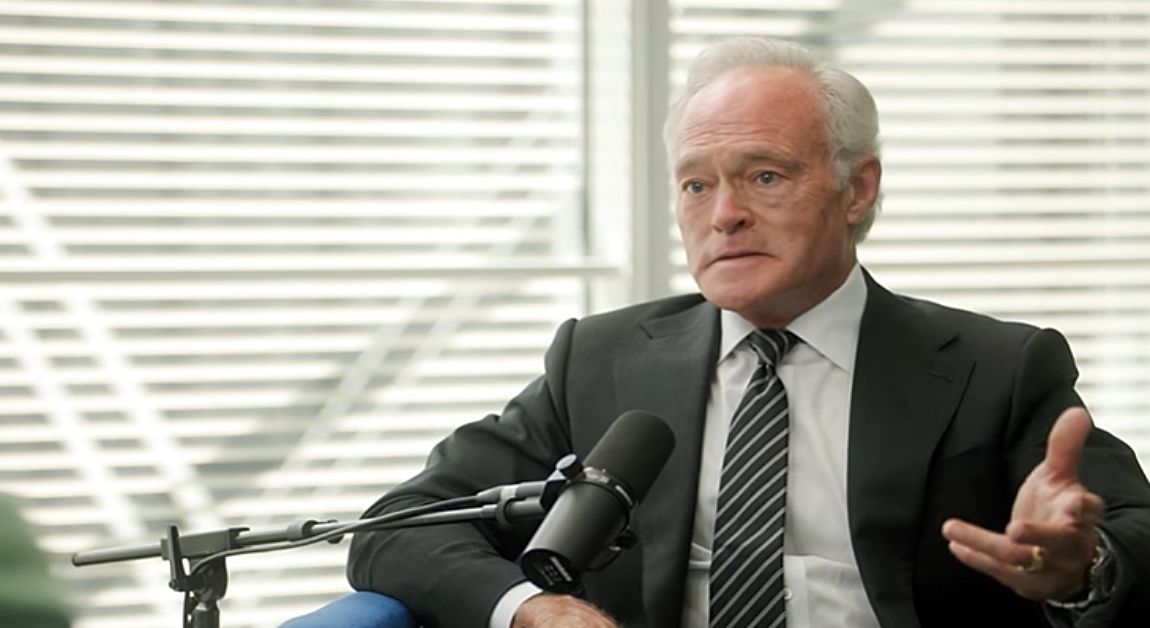
The veteran journalist, who spent nearly four decades at CBS before being shown the door following a fiery confrontation with management, delivered a tear-filled interview in which he compared a recent leadership overhaul at “60 Minutes” to the murder of family members.
Pelley, 68, sat down for an emotional discussion about the network’s dramatic restructuring and repeatedly struggled to contain his emotions while describing the departures of longtime colleagues. While acknowledging that his previous rhetoric may have been over the top, he somehow managed to escalate it even further.
At one point, Pelley compared the changes at the legendary newsmagazine to the killing of a spouse. “It’s like your spouse being murdered,” he said.
He also referred to the staff shakeup as a “Black Thursday massacre,” lamenting the sudden departures of several veteran figures associated with the broadcast. “No one saw the Black Thursday massacre coming,” Pelley said.
Memo to Scott Pelley:
I buried two children. They were not murdered.
That’s why I know the difference between grief and hyperbole.
Getting fired from a television job is painful. Losing colleagues is painful. But murder leaves empty chairs at family dinners, birthdays that… https://t.co/5SDfKHoEou
— Sam E. Antar (@SamAntar) June 7, 2026
The timing clearly still stings. Pelley noted that he and former executive producer Tanya Simon had attended the Emmy Awards the night before the cuts were announced, celebrating multiple wins. Within hours, several high-profile staffers were out.
“The night before, Tanya and I were at the Emmy Awards, and we won two Emmys. Within hours, all of those people have been wiped out, and one-third of our correspondents have been fired,” he said. Among those leaving were Simon, correspondents Sharyn Alfonsi and Cecilia Vega, senior executive producer Draggan Mihailovich, veteran producer Guy Campanile and staff member Matthew Polvoy.
For Pelley, however, this wasn’t merely a business decision. It was personal. “My colleagues and I have worked together 10, 20, 30 years. We travel together. We dine together. We go into literal combat together,” he said. He then doubled down on the family analogy. “So, these bonds are pretty tight, and when somebody wipes out, murders, a large number of your family members, people are desperate for some explanation, and as you and I sit here today, there still has been none.”
To most Americans who have watched entire factories close, industries disappear, and livelihoods evaporate without a television special dedicated to their suffering, comparing newsroom layoffs to homicide may seem just a touch melodramatic.
But Pelley insisted his tears weren’t about losing his own prestigious position. “I am not emotional about this because I have lost this job. I’ve done it for a long time. I’ve had the greatest experiences. But the people I leave behind, treated in this way? That breaks my heart, and it’s going to take me a long time to get over it.”
The controversy stems from a reportedly explosive meeting earlier this month after journalist and editor Bari Weiss took over as CBS News chief. According to multiple reports, Pelley unloaded on network leadership, accusing Weiss of being brought in to dismantle the culture of “60 Minutes.”
Sources familiar with the meeting said Pelley questioned Weiss’s qualifications and blasted the direction of the network. He also reportedly confronted newly installed executive producer Nick Bilton, a prominent technology journalist and author, telling him his credentials were insufficient for leading one of television’s most recognizable news programs.
According to accounts of the meeting, Pelley warned Bilton that he would “never be welcome here” and challenged him over accepting the position.
Bilton reportedly pushed back. “You are not going to intimidate me in front of this group of people. I want that to be clear.”
Across the industry, struggling news organizations have increasingly turned to outsiders, digital executives and nontraditional managers in an effort to adapt to shrinking audiences, collapsing trust and rapidly changing media habits.
Pelley acknowledged that he was furious during the meeting and claimed he initially intended to cool off before speaking. “I’m almost 69 years old, and if I’ve learned one thing in life, it is not to reflexively react when you feel that way. I thought, I’m going to give it a day. I’m too emotionally wrought up. I am going to say the wrong thing.”
That plan apparently didn’t last long. Shortly after the confrontation, CBS terminated his employment.
Looking back, Pelley admitted he never seriously considered that his outburst might cost him his job. “Some reporter I turned out to be. I just didn’t connect the dots.”
He also predicted the public reaction to his emotional interview with remarkable accuracy. “Headlines will focus on the parts where I’m crying and say I’m a lunatic.” On that point, at least, he may have been onto something.
Despite his criticism of management, Pelley reserved warm words for the journalists and producers he worked alongside over his 37 years at CBS. In his farewell statement, he wrote: “I depart after 37 years at CBS with one emotion — a heart brimming with gratitude for the men and women of CBS News who encouraged and enriched my work.”
Scott Pelley INSISTS “I’m fine” and this is “not about me,” but gets misty-eyed when saying being fired at CBS News is “like your spouse was murdered” and many times he “frankly fall[s] apart” because being married to someone is the same “depth” of “devotion” he gave to CBS….… pic.twitter.com/srOqyUZn6g
— Curtis Houck (@CurtisHouck) June 7, 2026