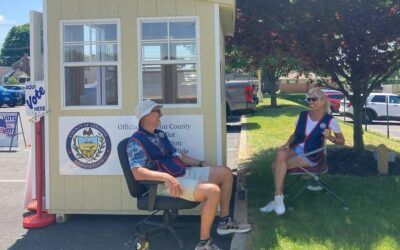
WASHINGTON — In most of America, Election Day is supposed to be exactly that: a day. In California, it often feels more like an election season.
As Los Angeles voters continue playing the waiting game while officials sort through piles of mail ballots days after polls close, a little-noticed Supreme Court case could soon deliver a political earthquake — one that conservatives hope will restore the idea that Election Day actually means something.
The case, Watson v. Republican National Committee, centers on a deceptively simple question: If Congress established a national Election Day, should ballots arriving after that day still count?
The answer could reshape election procedures in California, New York, Washington, Oregon, the District of Columbia and more than a dozen other jurisdictions that continue accepting certain ballots after polls close, provided they carry an Election Day postmark.
For years, critics have argued that extended ballot-counting periods undermine public confidence and leave voters wondering why Americans can put astronauts in space but apparently can’t count votes in a timely fashion.
The latest example comes straight from Los Angeles, where residents don’t have confidence in the accuracy of who will move forward in the mayoral contest. Weeks of campaign ads, millions of dollars spent and endless political drama — yet voters are left refreshing election websites like they’re tracking a delayed airline flight.
Republicans say the problem isn’t complicated.
“What’s happening in California is a Democrat failure on full display,” Republican National Committee Chairman Joe Gruters said. “Nearly a week after the primary, it is completely unacceptable ballots are still being counted. That’s why the RNC is aggressively fighting in the Supreme Court to stop ballots received after Election Day from being counted. Americans deserve timely election results they can trust.”
The legal fight has become one of the most significant election-law battles to reach the Supreme Court in years. At issue is whether federal statutes establishing a uniform Election Day preempt state laws that permit ballots to trickle in afterward. The justices heard arguments in March and are expected to issue a ruling before the court’s summer recess. The outcome could affect election administration nationwide.
During oral arguments, several conservative justices appeared skeptical of systems that leave ballot boxes effectively open after Election Day. Questions from members of the court’s conservative bloc focused heavily on whether prolonged counting periods erode confidence in election outcomes and conflict with federal law.
Even some of the toughest questioning highlighted a larger issue many voters have been asking for years: If states can set deadlines for voter registration, candidate filing and early voting, why should ballot receipt deadlines be treated differently?
Solicitor General John Sauer argued there is a clear distinction between casting ballots before Election Day and continuing to receive them afterward. When Justice Amy Coney Barrett pressed him on where that line should be drawn, the exchange underscored how consequential the court’s eventual decision may become.
Meanwhile, liberal justices warned that overturning long-standing mail-ballot practices could create disruption in states that have relied on such systems for years. Justice Elena Kagan suggested it would be extraordinary to invalidate procedures that have become common across much of the country.
Election-integrity advocates counter that popularity alone doesn’t settle legality.
And that’s the heart of the dispute.
Supporters of stricter deadlines argue that elections should produce clear, prompt results. Opponents warn that requiring ballots to arrive by Election Day could create problems for military personnel, overseas voters and others who rely on mail service delays outside their control. The competing arguments have transformed a technical election-administration dispute into a national showdown over how Americans vote and how quickly results should be known.
President Trump weighed in on the Los Angeles race this week, blasting the prolonged count on Truth Social and questioning how a candidate who held an early lead could still be waiting for final results days later.
His criticism tapped into a broader frustration that has lingered since the chaotic vote-counting battles of recent election cycles. While investigations and court challenges following the 2020 election failed to uncover evidence sufficient to overturn the presidential result, public skepticism about election administration has remained a major political issue. Delayed counts have done little to ease those concerns. Now the Supreme Court may be poised to decide whether America’s elections need a hard stop.