

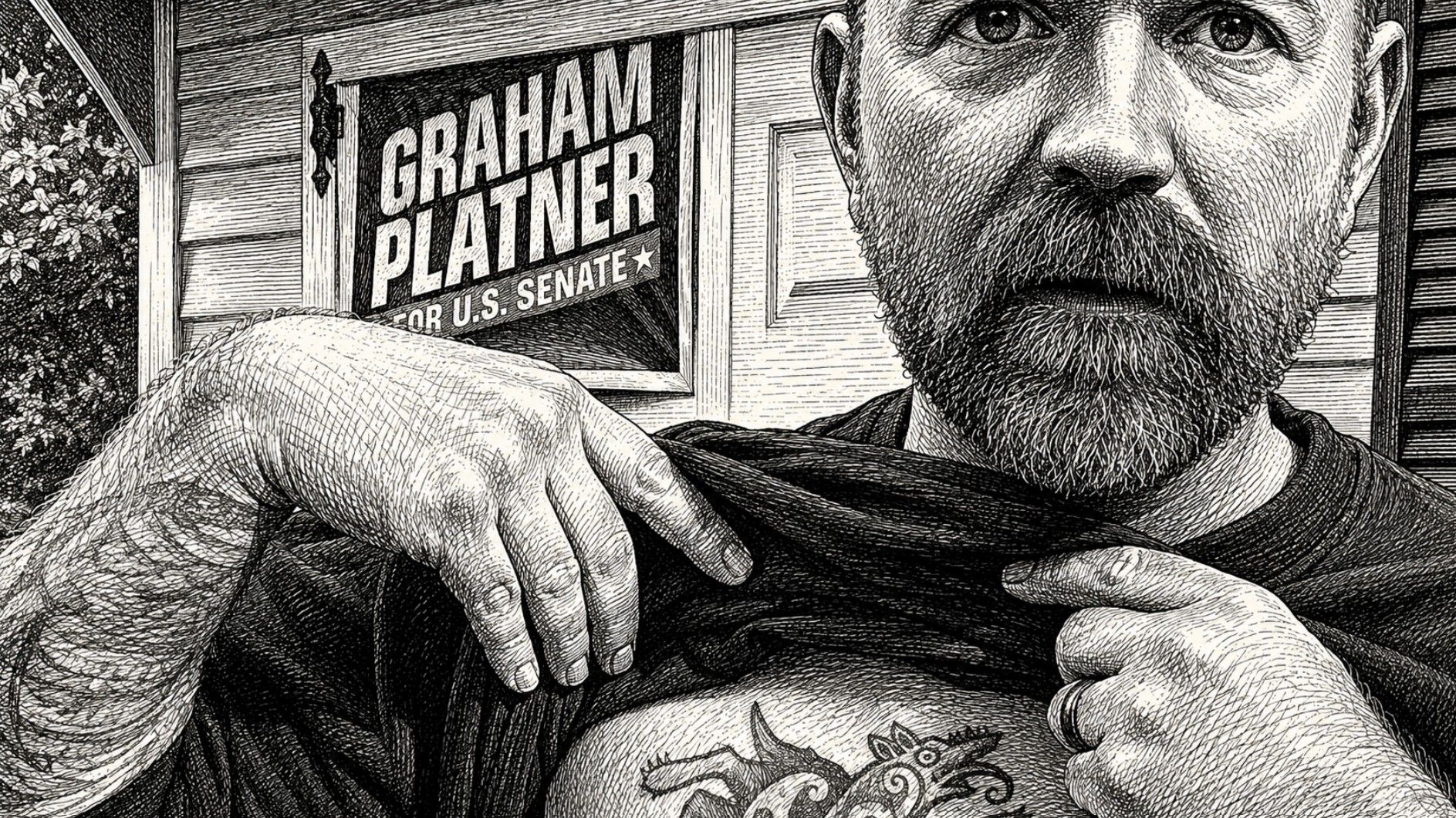
So much for the “I had no idea” defense.
Maine Democratic Senate nominee Graham Platner is now facing yet another round of uncomfortable questions about that infamous skull-and-crossbones tattoo — the one critics say looks an awful lot like a Totenkopf symbol tied to the Nazi SS.
And according to yet another former girlfriend, the story he’s been telling reporters doesn’t hold up.
The woman, who spoke on condition of anonymity, says Platner didn’t just know what the tattoo was — he allegedly had an entire ideological backstory ready to go for it.
She told the Post that when she first saw the ink, she immediately asked him whether it was a Totenkopf. His response, she claims, wasn’t confusion or shock — but a rehearsed, almost theatrical explanation about “carrying the weight” and how the tattoo was meant to symbolize the idea that “the United States was the evil bad guy overseas.”
In other words: not exactly the reaction of a man who supposedly thought he’d just picked a random “cool skull” in Croatia after a few drinks.
This isn’t coming out of nowhere, either. She says she later found messages she had sent to her mother in 2025 — before the tattoo became public controversy — already referring to it bluntly as a “Nazi tattoo.” She also shared screenshots she says back up that she was warning others about it long before the political blowback began.
She further alleges a broader pattern: cheating, overlapping relationships, and what she describes as Platner’s habit of tailoring stories depending on who he was talking to — especially women who shared his political leanings.
Platner’s camp, predictably, is sticking to the original version: that the ink was supposedly picked up in Croatia in 2007 during military-adjacent travel and had nothing to do with Nazi symbolism. His spokesperson insists he didn’t know the meaning at the time and has since covered it up. But the problem for the campaign is simple: he’s now dealing with multiple people who say otherwise.
Another former partner, Lyndsey Fifield, has already told the New York Times that Platner openly referred to the tattoo as his “Totenkopf” and even joked about its grim historical associations. She also claims she texted friends about it at the time, calling it exactly what critics now say it resembles.
That makes two exes, multiple screenshots, and a growing pile of private messages that predate the public controversy — all pointing in the same direction: this wasn’t some misunderstood souvenir gone wrong.
Meanwhile, Platner has gone on record insisting he “didn’t know” the symbol’s Nazi ties when he got it, and that nobody ever warned him. He’s also pointed to background checks and military-related screenings as proof nothing was flagged at the time.
But critics aren’t buying it — especially given that the tattoo was reportedly visible for years before he eventually covered it with a Celtic design.
Republicans, unsurprisingly, are having a field day with it, framing the issue as less about ink and more about judgment — or lack of it — for a candidate now asking voters to trust him with a U.S. Senate seat.
And while the campaign tries to dismiss the controversy as old news, the steady drip of exes, screenshots, and conflicting explanations suggests the story is far from settled. If anything, the more people speak, the harder it becomes to believe this was just an innocent misunderstanding etched in a fog of youthful bad decisions abroad.










Yes President Trump is a fake Nazi, and must be eliminated, but we, the holy then thou Democrats, are going to vote for a real Nazi, because we are real Nazi lovers, and we hate fake Nazis! What don’t you understand ?
Don’t you know we loved Trump before he ran for office, and we loved our heads being stuffed up his ass, because that’s who we are! Butt, ( oops!) after he became a fake Nazi we hate him! What don’t you understand?
We love everyone, but hate all you fake Nazi MAGA people! We hate fake Nazis! What don’t you understand?
It’s very simple, us Democrats hate everyone who disagrees with us, and that makes you a fake Nazi!We hate a fake Nazi! What don’t you understand?
We, the Democrats love real Nazis, because we are all fake! What don’t you understand?
What we , the Democrats, don’t understand is how you, the right, could love a fake Nazi? He’s not a real Nazi? What don’t you understand?
I have a headache trying to wake you people up! Ma! Where’s my crayons and my ham sandwich? I need to watch some Sesame Street to straighten my mind out. These stupid people on the right just don’t understand!
Ma! Is it nap time yet?