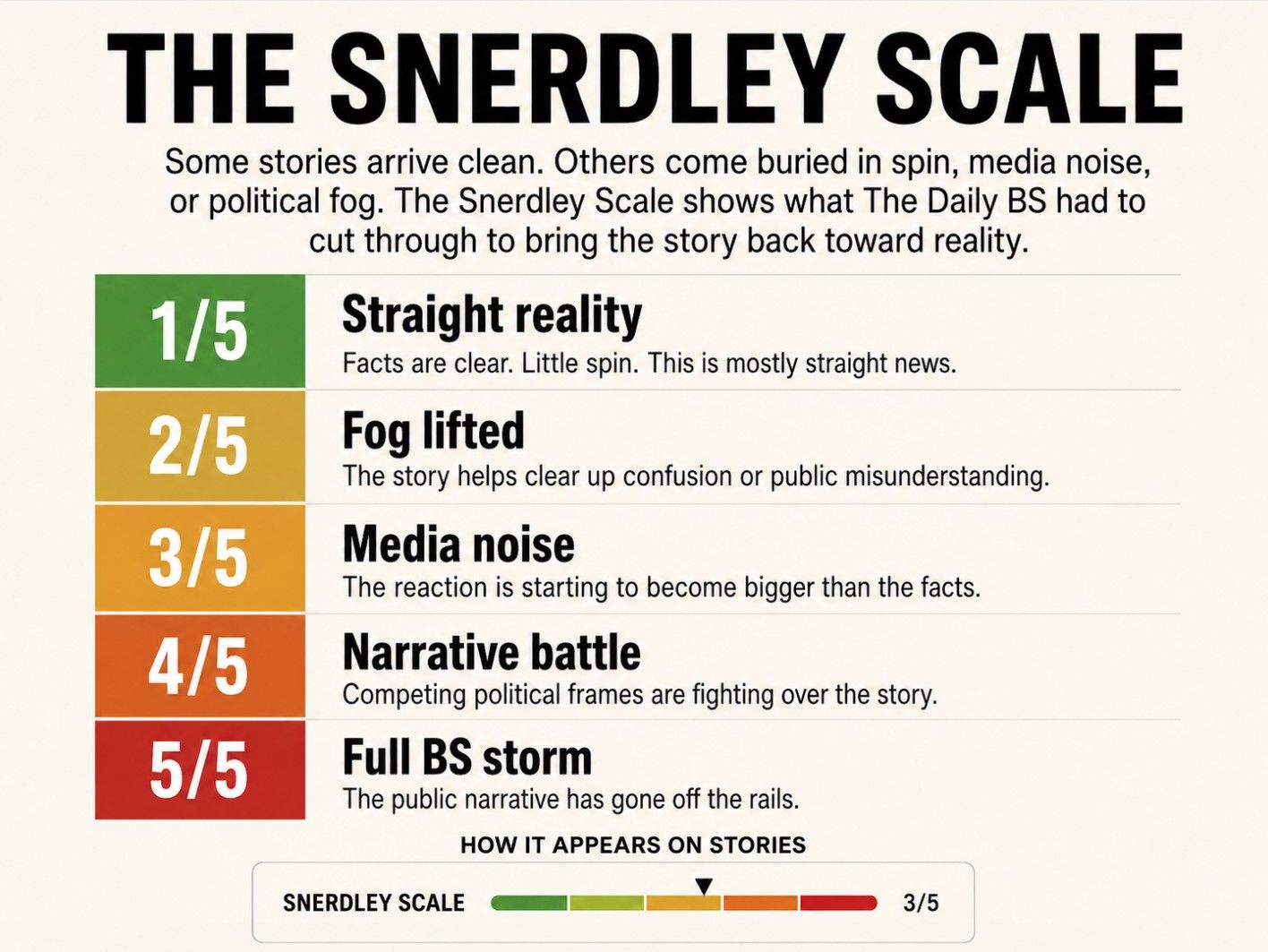
Snerdley score: 4/5 — Spin zone
Source headline: “Wrap your head around that”: Internet skewers $300B reconstruction fund in Iran deal
The moment a political reporter sees a number with eleven digits, all normal journalistic restraint apparently leaves the building. That’s the impression left by the latest round of coverage surrounding the reported $300 billion reconstruction fund tied to the Iran agreement. Readers are invited to “wrap your head around” a supposedly shocking arrangement while being treated to a parade of social media outrage, dramatic reactions, and worst-case assumptions. What readers are not encouraged to do is spend much time examining the distinction between what critics claim is happening and what the administration says is actually being proposed.
To be clear, a reported reconstruction fund of this magnitude is a legitimate news story. Three hundred billion dollars is an enormous figure by any standard. Any deal involving Iran deserves scrutiny. Any administration entering a major agreement with a hostile regime should expect tough questions. That’s the easy part. The harder part is resisting the temptation to transform every controversial proposal into a ready-made scandal before all the facts are known.
Instead, the story leans heavily on reactions that assume America is simply writing Iran a $300 billion check. One quoted critic declares, “We are going to pay Iran $300 billion to rebuild from the war we started. Wrap your head around that when they claim that Trump is a master negotiator.” It’s a sharp political line. It’s also not what the administration says is happening. Vice President JD Vance’s public explanation was that Iran could potentially gain access to reconstruction funding backed by Gulf nations if it fulfilled the obligations required under the agreement. Readers may dislike that arrangement. They may oppose it entirely. But a Gulf-funded reconstruction mechanism tied to compliance is not the same thing as American taxpayers being ordered to wire hundreds of billions directly to Tehran.
That distinction happens to be the entire debate, yet it receives remarkably little attention compared to the outrage. Instead, the article elevates claims like, “Can we talk about the scale of problems that are going to arise from spending 300 billion? This is 500%-600% larger than the entire annual budget of the Iranian govt. It is one year of Iranian GDP of the ENTIRE COUNTRY. This is insane.” Maybe it is. Maybe it isn’t. But before declaring something insane, reasonable people might want answers to a few basic questions. Who is providing the money? Over what timeframe? Is it aid, investment, loans, reconstruction contracts, infrastructure financing, or some combination of all of the above? What conditions must be met? What happens if Iran violates the agreement? Those questions are far less emotionally satisfying than posting a giant number on social media, but they happen to be the questions that determine whether the criticism is justified.
Perhaps the most revealing quote comes from another critic who scoffs, “Oh, look. Trump’s deal is explained as providing no money for Iran…unless they stick with the deal. Which means, of course: IRAN IS GETTING MONEY under the deal.” The statement is intended as a devastating contradiction. Instead, it accidentally describes how incentives work. Virtually every diplomatic agreement in modern history has involved benefits conditioned on compliance. If sanctions relief follows compliance, that’s an incentive. If investment follows compliance, that’s an incentive. If access to international markets follows compliance, that’s an incentive. The real argument isn’t whether incentives exist. The real argument is whether those incentives are worth the concessions being demanded in return. That’s a serious policy debate. The article seems far more interested in generating outrage than having one.
The headline itself tells the story. Notice that the focus is not the agreement. It’s not the funding structure. It’s not the conditions. It’s not the verification requirements. It’s not even whether the reported fund would ever fully materialize. The headline is about the internet “skewering” the proposal. Modern political journalism increasingly treats online reactions as evidence rather than reactions. A handful of angry posts become the story. The outrage becomes the proof. The pile-on becomes the headline. Before long, readers are no longer evaluating a policy proposal. They’re evaluating a social media mood.
That doesn’t mean the administration is automatically right. It doesn’t mean the agreement is automatically good. It doesn’t mean every criticism is unfair. There are legitimate concerns about Iran, legitimate questions about enforcement, legitimate concerns about regional stability, and legitimate skepticism toward any agreement involving a regime with a long history of deception. But those concerns deserve to be debated on their actual merits rather than through a haze of selective framing and emotional amplification.
The biggest tell is that the most explosive accusation in the entire story—that America is paying Iran $300 billion—is presented through critics’ reactions even though the administration’s own explanation directly disputes that characterization. That’s not straight reporting. That’s narrative construction. The outrage arrives first. The context arrives later, if at all.
Which is why this lands at a solid 4 out of 5 on the Snerdley Scale. There’s a real story underneath all the noise. There are important questions worth asking. But the presentation is driven less by informing readers than by steering them toward a predetermined emotional conclusion. The result is classic Spin Zone journalism: a giant number, a politically useful assumption, a stack of furious reactions, and just enough missing context to keep the outrage machine humming.