Democrats and their allies have found a new target for outrage: President Trump’s proposed triumphal arch honoring America’s 250th birthday.
A group of six lawmakers fired off a warning letter to Interior Secretary Doug Burgum, acting National Park Service chief Jessica Bowron and other federal officials, insisting the administration lacks the legal authority to move forward with the massive monument without first getting Congress to sign off.
The coalition — led by independent Sen. Angus King of Maine alongside Democratic Sens. Martin Heinrich of New Mexico and Jeff Merkley of Oregon, plus Democratic Reps. Jared Huffman of California, Maxine Dexter of Oregon and Yassamin Ansari of Arizona — blasted the proposal as unlawful and demanded the project be halted.
“We oppose this project in the strongest terms and object to execution of the draft Programmatic Agreement. The National Park Service (NPS) is assessing the effects of an undertaking that Congress has never authorized and that two federal statutes squarely prohibit,” the lawmakers wrote.
They argued that reviews being conducted under federal historic-preservation laws cannot magically create authority that Congress never granted.
“Section 106 consultation cannot supply that missing authority, and no programmatic agreement can resolve the adverse effects of a project the NPS has no power to build,” the letter continued.
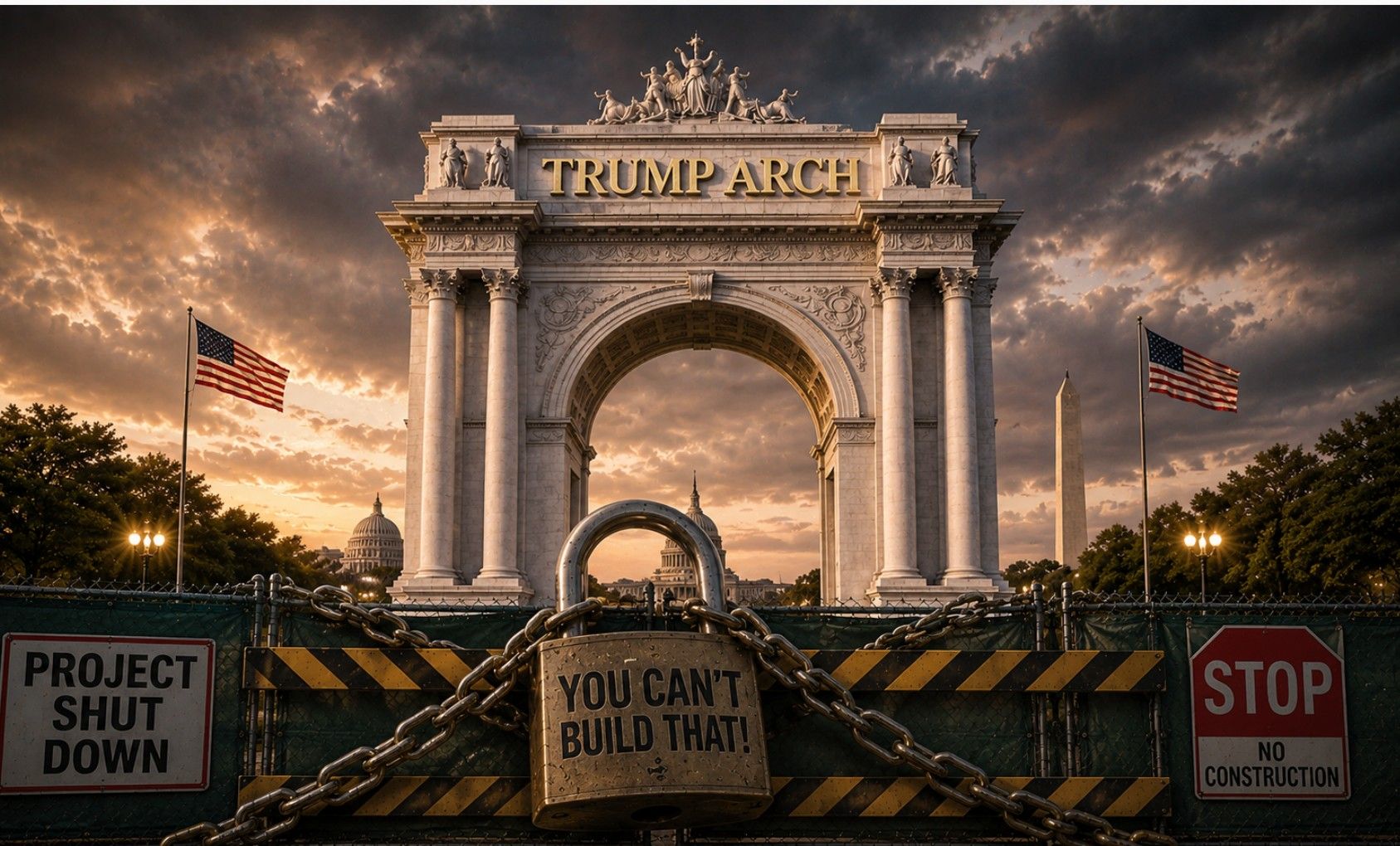
At the center of the dispute is a proposed 250-foot triumphal arch planned near Arlington National Cemetery and the Lincoln Memorial as part of the nation’s semiquincentennial celebrations. Supporters see it as a bold patriotic statement marking 250 years of American achievement. Critics see it as an oversized political monument.
The lawmakers claim the structure would run afoul of both the Height of Buildings Act and the Commemorative Works Act, the latter of which generally requires congressional approval before permanent memorials are placed on federal land in Washington. “A departure of this magnitude from the capital’s settled vertical order is precisely the kind of decision the law reserves to Congress,” the lawmakers wrote.
They also complained that the monument would disrupt one of Washington’s most recognizable visual corridors. “Beyond its illegality, the Arch would deface one of the most deliberate and historic sightlines in America,” they argued.
The latest political clash comes as opponents have opened multiple fronts against the project. Vietnam War veterans have challenged the plan in court, raising many of the same legal objections. Meanwhile, House Democrats have introduced legislation aimed at stopping the project altogether.
Yet despite the resistance, the proposal has continued advancing through portions of the federal review process. Earlier this year, the U.S. Commission of Fine Arts approved a revised version of the design slated for Memorial Circle on Columbia Island.
The Trump administration has remained unapologetic, arguing that the project is both lawful and fitting for the nation’s milestone anniversary. “In America’s 250th year, President Trump wants to fulfill this vision and build the Triumphal Arch to celebrate the triumphs of the American people, inspires patriotism and love of country, and beautify our nation’s capital,” an Interior Department spokesperson said.
The administration also pitched the monument as a tribute to America’s veterans and military families. “The arch will also enhance the visitor experience at Arlington National Cemetery for veterans, the families of the fallen, and all Americans alike, serving as a visual reminder of the noble sacrifices borne by so many American heroes throughout our 250-year history so we can enjoy our freedoms today,” the spokesperson added.
Democrats, however, are signaling they may not stop at strongly worded letters. Their message extended beyond administration officials to contractors and firms that could participate in the project. “No valid authority has been conferred here. Every official who directs this work, and every firm that performs it, proceeds at their own peril,” the lawmakers warned.
As the lawmakers themselves acknowledged, if the administration wants a permanent commemorative structure, Congress remains an available route. “If the Administration believes the semiquincentennial warrants a permanent commemorative work in the capital, the path is open and well worn; it runs through Congress, as it has for every memorial since the Continental Congress approved the first, an equestrian statue of George Washington, in 1783.”