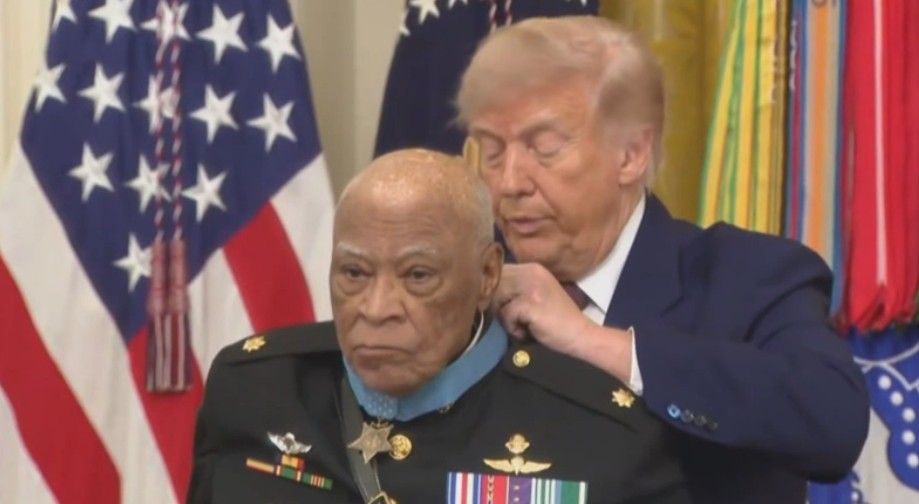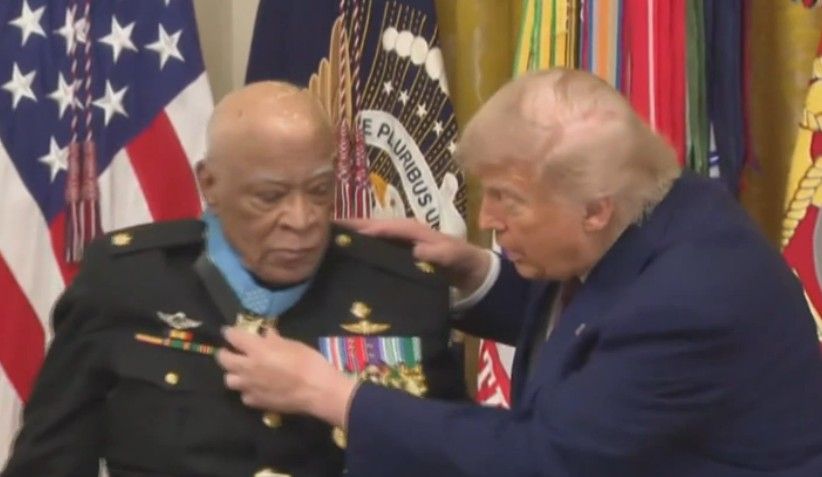
Retired Marine Corps Major James Capers Jr., widely regarded as the father of Marine Special Operations, finally received the Medal of Honor nearly 60 years after displaying extraordinary heroism in the jungles of Vietnam.
And yet his reaction wasn’t celebration.
It was grief. It was gratitude. And it was a sobering reminder that the true cost of war never disappears.
Capers, now 88 years old, could have spent the day basking in praise. Instead, he immediately shifted attention away from himself and toward the Marines who never came home.
“I can’t say I’m happy to be here, because this award belongs to a lot of young men who followed me and died in battlefields around this world for a country that we honor this flag.”
That’s not the language of a celebrity. It’s not the language of someone chasing recognition. That’s the language of a warrior carrying memories most Americans can barely imagine.
The ceremony also recognized retired Army Major Nicholas Dockery and posthumously awarded Marine Colonel John W. Ripley, one of the most legendary combat leaders in Marine Corps history. But Capers’ story stood out because of how long the nation waited to recognize it.
Back in 1967, Capers was leading a reconnaissance team deep in Vietnam when his unit was ambushed.
The situation quickly turned catastrophic. Men were wounded. The enemy closed in. Capers himself suffered devastating injuries. He was shot in the stomach, suffered a broken leg and lost massive amounts of blood.
Most men would have focused on survival. Capers focused on his Marines. Explaining what drove him during those horrific moments, he said:
“When your men [are] in peril, and you have an opportunity to save your men, then that’s what I chose to do, to get off the helicopter, to lighten the load so that my men can survive.”
That’s leadership in its purest form. No consultants. No PowerPoints. No social media strategy. Just a commander deciding that his men mattered more than he did.
Capers would become a trailblazer throughout his military career. He was the first African American to command a Marine reconnaissance company and the first to receive a battlefield commission in that role. His accomplishments helped shape the elite special operations culture that would eventually evolve into today’s Marine Raiders.
But what struck me most wasn’t the battlefield heroism. It was the survivor’s guilt.
Even after receiving America’s highest military decoration and being inducted into the Pentagon’s Hall of Heroes, Capers still struggled with the idea that he deserved the attention.
“It was a difficult time for me because I felt a little guilty because I didn’t really [feel] like I deserved it. But all of the men and women that served, and I get to do something like this, it’s a wonderful day, and I’m honored.”
That humility seems almost foreign in modern America, where too many people believe every achievement deserves a standing ovation.
Capers spent decades carrying wounds that never fully healed. And not just physical wounds. The Marine veteran revealed that his losses extended far beyond Vietnam.
“I lost a lot of good men in battlefields and I fought two wars and suffered 19 bullet holes and along the way out of the battle zones. My son died in my arms of appendicitis and my wife of 50 years died of cancer.”
Then came the line that silenced any temptation to romanticize military service.
“So I had to survive that on top of losing wonderful Marines, Special Operations Marines, in combat. So there’s no real satisfaction in getting a medal when I’ve lost so much.”
Nineteen bullet wounds. The loss of fellow Marines. The loss of a son. The loss of a wife of half a century. And yet he kept moving forward. Capers credits the military brotherhood for helping him survive those darkest moments.
“Well, that’s what the military does. We’re one unit, and when one falls, somebody else has to replace that person who fell.”
“So I feel honored to have the support that I find today. I’m honored, and I give gratitude to the ones who made this happen.”
President Trump acknowledged the extraordinary sacrifices made by Capers and the other recipients during the White House ceremony, promising:
“We will never, ever forget you.”
America shouldn’t. The Medal of Honor is often described as the nation’s highest military award. That’s true. But for men like James Capers Jr., the medal isn’t really about glory. It’s about remembering those who never got the chance to grow old. It’s about honoring sacrifices that can never be repaid. And it’s about recognizing that some heroes spend a lifetime carrying burdens no ceremony can ever fully lift.
Still, the nation finally placed the medal around Major Capers’ neck.