Source: Wire
You can tell a lot about a project by what the people behind it call it.
If somebody spends years telling the public they’re building a library and then opens something that looks like a political campus, an activist training ground, a conference center, a youth sports complex, and the headquarters of a private foundation all rolled into one — people are going to ask questions. And frankly, they should. Because this isn’t really a debate about Barack Obama. It’s a debate about institutions.
For decades, Americans have understood what a presidential library is supposed to be. Maybe you visit once. Maybe you never go. But the concept is pretty straightforward. A museum. Historical archives. Documents. Artifacts. A place to preserve a presidency for future generations.
Instead, what has emerged on Chicago’s South Side appears to be something entirely different.
The most interesting part isn’t that critics are saying it. It’s that the center itself seems to be saying it. When you see slogans like “Bring Change Home” and “A Home For Action,” nobody immediately thinks, “Ah yes, a quiet archive where historians examine old presidential papers.” They think movement. They think organizing. They think activism.
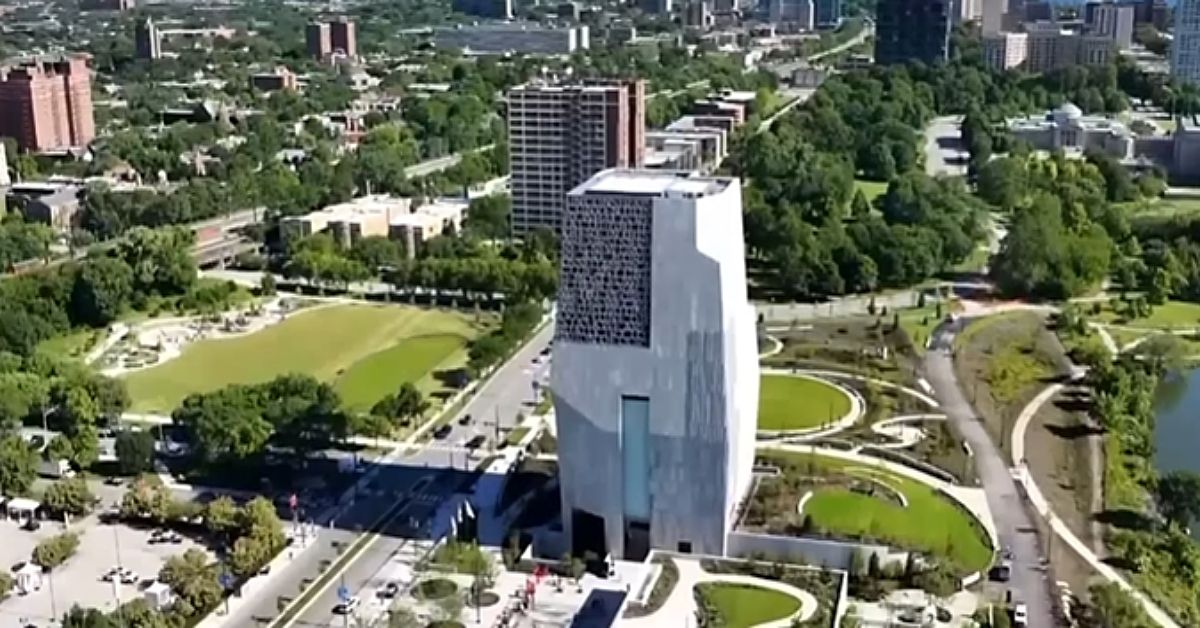
The newly opened Obama Presidential Center is generating controversy as critics argue the sprawling billion-dollar campus bears little resemblance to what Americans traditionally think of as a presidential library.
The massive complex, situated on nearly 20 acres near Lake Michigan, opened with considerable fanfare and celebration. Supporters describe it as a dynamic institution designed to inspire future generations and encourage civic engagement.
The Obama Presidential Center might be named for the Obamas, but it is built for you. It’s a vibrant, living celebration of community. A monument to unshakable values: equality, empathy, and inclusion. A beacon of hope.
It’s a place we hope you’re going to come back to again… pic.twitter.com/mNNrFchWKm
— The Obama Foundation (@ObamaFoundation) June 22, 2026
Critics see something else entirely.
Unlike modern presidential libraries operated within the federal presidential library system, the Obama Center does not house President Obama’s official records. Those documents are being maintained elsewhere, with digital access potentially available in the future.
Instead, the centerpiece serves as a combination museum, foundation headquarters, leadership-training hub, conference venue, community center, and gathering place for programs associated with the Obama Foundation.
The distinction has become the central focus of the controversy.
Presidential historian Tevi Troy, who has studied presidential libraries extensively, suggested the project appears to be pursuing a broader mission than simply preserving history.
“Usually, these libraries are a monument to a presidency and the presidency is in the past, it’s in the rear-view mirror.”
He added:
“It looks like Obama wants to use it as some kind of activism center, something that continues to promote his ideas and his political views.”
The center itself appears to embrace an active future-focused mission. According to foundation materials: “We are building more than a campus. We are creating a living institution that will inspire, empower, and connect the next generation of leaders.”
During the dedication ceremony, Obama himself emphasized that vision. “We designed the center not to be some lifeless mausoleum.” Later, he expanded on the mission: “This center is devoted to lifting up their stories, giving them the tools and support they need to expand their impact.”
Perhaps the most revealing line came when Obama openly acknowledged the center’s philosophical perspective. “While we are non-partisan, we are not value-neutral. We have a point of view.”
The center represents an evolution of the presidential library concept, moving beyond static exhibits toward active civic participation and leadership development.
Critics argue that confirmation raises even more questions. One major concern involves the land itself. The center occupies approximately 19 acres within Chicago’s historic Jackson Park under a highly controversial agreement that transferred public parkland for the project. Opponents spent years fighting the development in court, arguing that public assets were being handed over to a private organization.
Although legal challenges ultimately failed, critics maintain that many of the underlying public trust concerns were never fully examined. Law professor Richard Epstein, who represented opponents of the project, remains unconvinced the public received adequate protections.
“When we were defeated, we weren’t told that we were wrong on the merits.” He continued: “We were told that we had no right to bring the complaint at all.”
Questions have also surfaced regarding taxpayer-funded infrastructure improvements surrounding the campus and concerns about long-term financial obligations associated with maintaining the site.
Meanwhile, some Illinois Republicans argue the project evolved far beyond what many residents originally believed they were supporting. Illinois Republican Party Chairman Bob Grogan characterized the project as a classic political transformation. “This isn’t a presidential library. It’s a Democratic headquarters on the South Side.”
Grogan went further: “They go and sell it with the most palatable thing. Then they just incrementally, drip by drip, make it worse until they get back to the reality.
“It’s not just a museum. It’s the home base for the foundation and everything it does.”
To be fair, even some critics acknowledge that former presidents have broad latitude when designing their post-presidential institutions. After all, Obama raised the money. The foundation operates the center. The federal government does not control its exhibits, programming, or mission. That’s his right. But the debate now unfolding isn’t really about legality.
It’s about expectations. Americans hear the phrase “presidential library” and imagine archives, exhibits, and history.
When they see leadership incubators, activist programming, athletic facilities, conference centers, organizing spaces, and a private foundation headquarters wrapped together under one roof, some naturally conclude they’re looking at something entirely different.