
For years, Democrats dreamed of a Republican civil war.
Now they’re sitting back with popcorn while some of the biggest names in the MAGA universe are openly questioning whether the Republican Party still deserves their support.
Former Congresswoman Marjorie Taylor Greene just threw another log on that fire.
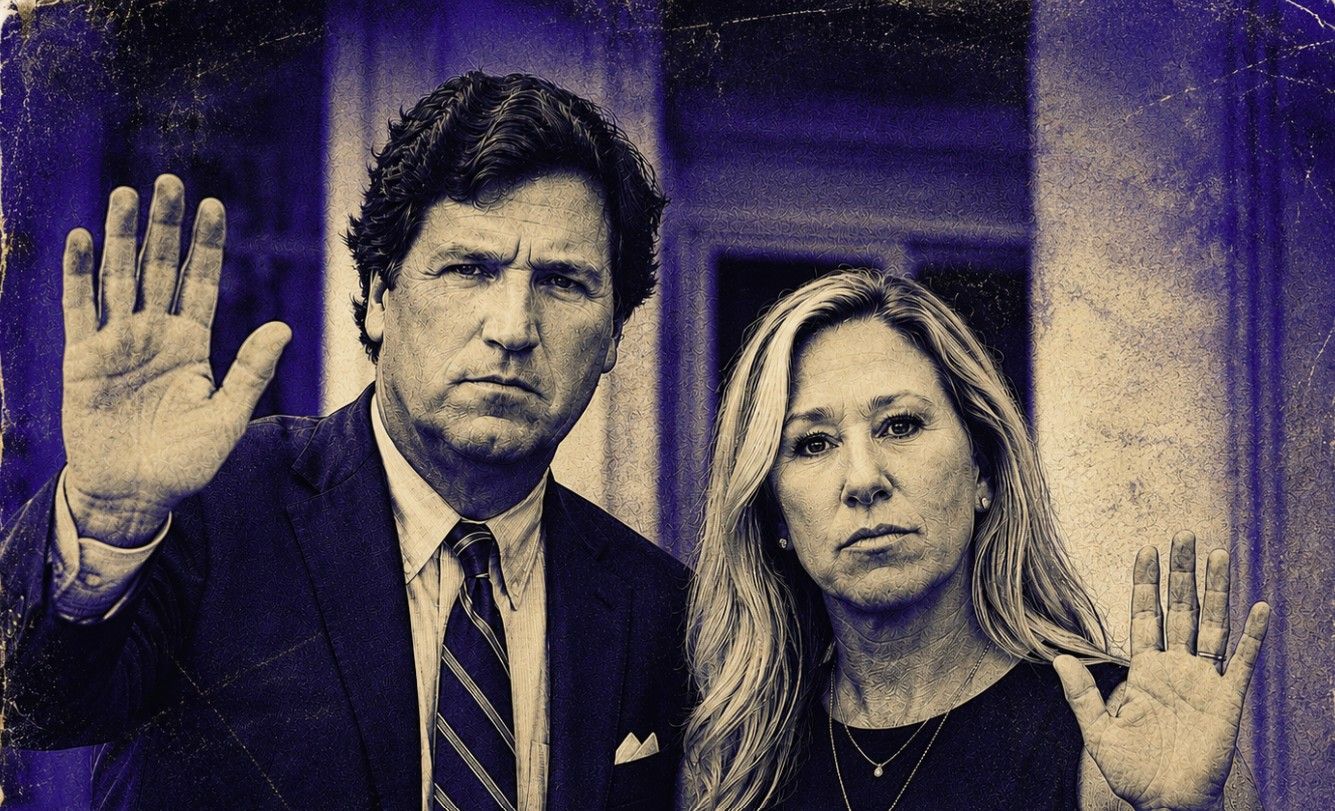
Greene announced this week that she’s finished backing what she calls the “America LAST Republican Party,” aligning herself with media personality Tucker Carlson, who recently declared that he could no longer support the GOP either.
And if you’re keeping score at home, this isn’t some Never Trump crowd gathering at a wine-and-cheese fundraiser. These are figures who helped shape modern populist conservatism.
That’s what makes this story interesting.
Greene posted on X:
“Tucker is not the only one who is done supporting the Republican Party.
There is A LOT of us that are absolutely fed up and will not support a party that betrays its voters and country.
That does not mean we are turning into Democrats either. But we are DONE with the America LAST Republican Party.”
Carlson recently delivered a similar message, saying:
“I would not support the Republican Party. There’s no chance I would support the Republican Party. I’m not going to support the Democratic Party — I’m not sure what I’m going to do.”
Now, before anyone starts writing the obituary for the GOP, let’s remember something. Conservatives have been fighting among themselves since the movement existed. Reagan conservatives fought moderates. Tea Party activists fought establishment Republicans. Trump supporters fought everybody.
What makes this round different is that the argument isn’t primarily about taxes, spending, or immigration. It’s about foreign policy.
Carlson has spent months arguing that Washington’s political class is placing the interests of foreign governments ahead of American voters. His sharpest criticism has focused on U.S. policy toward Israel and the growing conflict involving Iran.
Carlson argued:
“How could I or any American voter support a political party that’s not loyal to the United States. That puts the interests of a foreign country above those of its own citizens. It’s not possible to vote for people like that, and I’m not going to.”
He went even further, claiming:
“What we know for certain is that the United States went to war with Iran — a war we are losing, that we’ve effectively lost already — because of pressure from the prime minister of Israel, Benjamin Netanyahu.”
Those comments have sparked fierce backlash from many Republicans who reject Carlson’s assessment and continue to strongly support America’s alliance with Israel.
President Trump has publicly dismissed suggestions that foreign leaders are directing American policy. At various points, Trump has insisted that he—not foreign governments—is making the decisions.
And that’s where this entire debate gets complicated.
Many conservatives who agree with Tucker on spending, immigration, censorship, and the administrative state sharply disagree with him on Israel and Iran. Others believe the Republican Party has drifted too far toward intervention abroad and not far enough toward an America First approach at home.
Meanwhile, Greene has increasingly found herself at odds with Trump-world.
Their relationship deteriorated over disagreements involving the handling of Jeffrey Epstein-related files and broader foreign policy issues. The split eventually became so severe that Greene exited Congress after what became an increasingly hostile political battle.
Since then, she has continued criticizing both the administration and Republican leadership.
Every political movement eventually reaches the point where the family starts arguing around the dinner table.
The media loves portraying every Republican disagreement as the collapse of Western civilization. In reality, this looks more like a battle over what “America First” actually means in 2026.
The Democrats have their progressive wing, their moderate wing, and about seventeen different activist factions all fighting each other daily. Republicans are hardly unique in that regard.
Still, when two of the most recognizable populist voices in America start publicly questioning the party itself, it’s no longer just another social media spat.
Whether voters see this as a healthy debate or a warning sign may determine where the conservative movement heads next.