


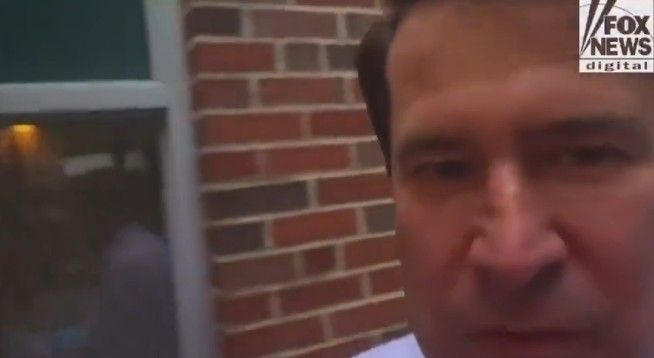
A brief encounter quickly turned into one of Wednesday’s most talked-about political moments after Rep. Seth Moulton, D-Mass., reacted angrily to questions about a controversial Democratic Senate nominee.
Video circulating online shows Moulton walking toward an office when he is approached by a man asking whether he supports Maine Democratic Senate candidate Graham Platner.
Rather than answering, Moulton immediately questioned the reporter’s identity.
“Who are you?”
The reporter repeated his question.
“Do you endorse Graham Platner in Maine?”
At that point, Moulton walked directly toward the camera and again challenged the individual.
“Who are you to be asking this question?”
Moments later, the congressman appeared to grab or knock the phone from the reporter’s hand while saying:
“You gotta do a better job of hanging onto your phone.”
The video ends with the camera tumbling toward the ground.
Moulton later addressed the incident on X, arguing that the individual questioning him was not an independent journalist but a political tracker working for America Rising, a Republican opposition research organization.
The Massachusetts congressman made no apology for his reaction.
“I’m not going to apologize for how much MAGA pisses me off. I’ll take them on anywhere, anytime, and I won’t back down. If this tracker can’t handle a reality check or hold onto his own equipment, that’s on him.”
He also criticized Fox News, writing:
“If Fox News wants me back on their airwaves so badly, they should stop ghosting my team.”
BREAKING: Democrat MA Senate Candidate Seth Moulton appeared to ASSAULT a FOX reporter for asking if he endorses nazi-tattooed Graham Platner pic.twitter.com/6lftkZ1MAc
— Libs of TikTok (@libsoftiktok) June 24, 2026
Now, Moulton insists the man wasn’t a reporter but a Republican opposition tracker. Fair enough. Political trackers are nothing new. Republicans and Democrats have both used them for years. But here’s the funny part, if the question wasn’t worth answering, why get so worked up over it? Usually when politicians are completely comfortable with a question, they don’t end up batting cameras like they’re trying out for the Boston Red Sox.
Then came the social media response.
Instead of cooling things down, Moulton doubled down.
“I’m not going to apologize for how much MAGA pisses me off. I’ll take them on anywhere, anytime, and I won’t back down. If this tracker can’t handle a reality check or hold onto his own equipment, that’s on him.”
That’s certainly one way to handle a public relations problem.
Washington politicians love talking about protecting democracy, defending free speech, and respecting a free press—at least until someone asks an uncomfortable question. Suddenly, curiosity becomes harassment, cameras become enemies, and accountability is apparently optional.
Maybe Moulton genuinely believed he was dealing with a partisan operative rather than a journalist. That distinction may matter to some people. But it doesn’t explain why answering—or declining to answer—a straightforward political question required a confrontation that became the story itself.
In politics, composure matters. Ronald Reagan had it. Donald Trump, for all his counterpunching, has stood in front of hostile reporters for years and sparred verbally with them. That’s part of the job. If every uncomfortable question turns into a wrestling match with someone’s phone, Congress may want to add “camera handling” to freshman orientation.
Sometimes the biggest political own goal isn’t the question.
It’s the reaction.









This guy has anger issues..Perhaps should not be in a position making decisions affecting the public