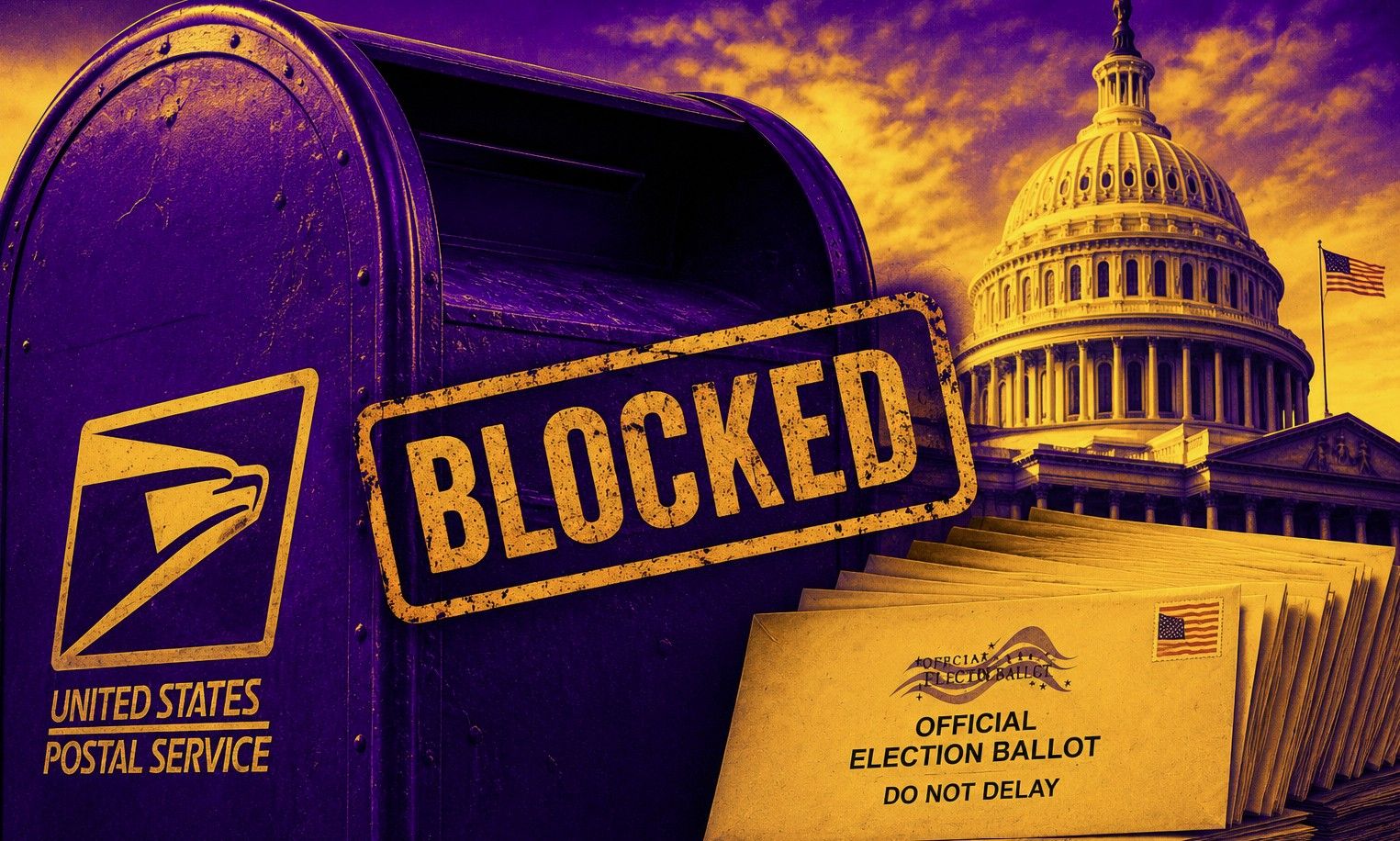
The Trump administration’s push to strengthen election integrity has reached another major institution, with the U.S. Postal Service signaling it is prepared to enforce new requirements tied to mail-in voting.
Appearing before the Senate Homeland Security and Governmental Affairs Committee on Wednesday, Postmaster General David Steiner confirmed that, under a proposed federal regulation, the Postal Service would not deliver absentee ballots for states that decline to provide voter eligibility information requested by the federal government.
The proposal stems from President Donald Trump’s executive order issued earlier this year, which directed the Postal Service to develop regulations requiring states to submit lists of eligible absentee voters at least 60 days before federal elections. Administration officials argue the goal is straightforward, verify that ballots are being mailed only to legally eligible voters and improve confidence in the mail voting process.
During the hearing, Sen. Gary Peters, D-Mich., pressed Steiner on how the policy would work in practice.
“If a state refuses to turn their absentee voter list over to the federal government, will the Postal Service still mail their ballots under this proposal rule?”
Steiner’s answer was brief.
“Under our proposed regulation, no.”
Republicans have long argued that maintaining accurate voter rolls is one of the most basic safeguards for election integrity. Supporters of the proposal say requiring updated voter information before ballots enter the mail stream is a commonsense administrative step rather than a change to who may vote.
Steiner defended the proposal on those grounds, explaining that the Postal Service is focused on ensuring election mail reaches the proper recipients.
“I would think that states would want the information to ensure that the ballots that they think they’re sending out are the ballots that are actually getting sent out.”
At the same time, Steiner acknowledged an important constitutional distinction. He emphasized that the Postal Service is not attempting to administer elections—a responsibility that remains with the states—but rather to establish procedures governing the handling of election mail.
He also made clear that the agency would comply with any court orders affecting mail-in voting should legal challenges arise.
Democrats sharply criticized the proposal during the hearing, arguing it represents an inappropriate expansion of federal influence over elections.
Sen. Elissa Slotkin, D-Mich., urged Steiner to reject the administration’s approach.
“Please push back on being a pawn in this authoritarian playbook. The Postal Service is one of the most important institutions in our country. Don’t taint it with the obsession of this one man.”
The proposed regulation is currently in a 30-day public comment period. Under President Trump’s executive order, the Postal Service is expected to issue a final rule by the end of July.
If adopted, the policy could become one of the administration’s most significant election-integrity initiatives heading into future federal elections, while almost certainly setting the stage for additional legal and political battles over the balance between state authority and federal oversight in administering mail ballots.
Every election season we’re told that asking for secure elections is somehow an attack on democracy. Funny how the people who insist you need an ID to board an airplane, cash a check, or buy certain cold medicine suddenly become constitutional scholars the minute someone suggests verifying who gets an absentee ballot.
The Postal Service’s proposal isn’t saying people can’t vote. It’s saying, “Show us the list of eligible absentee voters so we’re delivering ballots to the right people.” That sounds less like authoritarianism and more like how every competent business in America operates before it mails out something important. Imagine Amazon saying, “Nah, let’s just ship these packages to whoever used to live there.”
Then came the predictable script. Instead of debating whether accurate voter rolls are a good idea, critics jumped straight to calling President Trump an authoritarian. That’s become Washington’s version of pulling the fire alarm. Someone proposes a safeguard? Cue the dramatic music, accuse Trump of ending democracy, and hope nobody notices we’re still talking about something as basic as confirming who’s eligible to receive a ballot.
Even Postmaster General David Steiner pointed out that states still run elections. The Postal Service isn’t counting votes or certifying winners. It’s talking about the rules for handling election mail. There’s a difference, but nuance has become an endangered species in today’s political debate.
Here’s the question nobody seems eager to answer: if voter rolls are already accurate, why object to verifying them before millions of ballots are sent through the mail? Election integrity shouldn’t be a partisan slogan. It should be the one issue where every American—Republican, Democrat, or independent—expects the government to get it right. Unless, of course, some folks have become more comfortable defending the process than defending confidence in the outcome.
Maybe that’s why this debate keeps happening. One side keeps asking for transparency. The other side keeps acting like transparency is the real threat.