


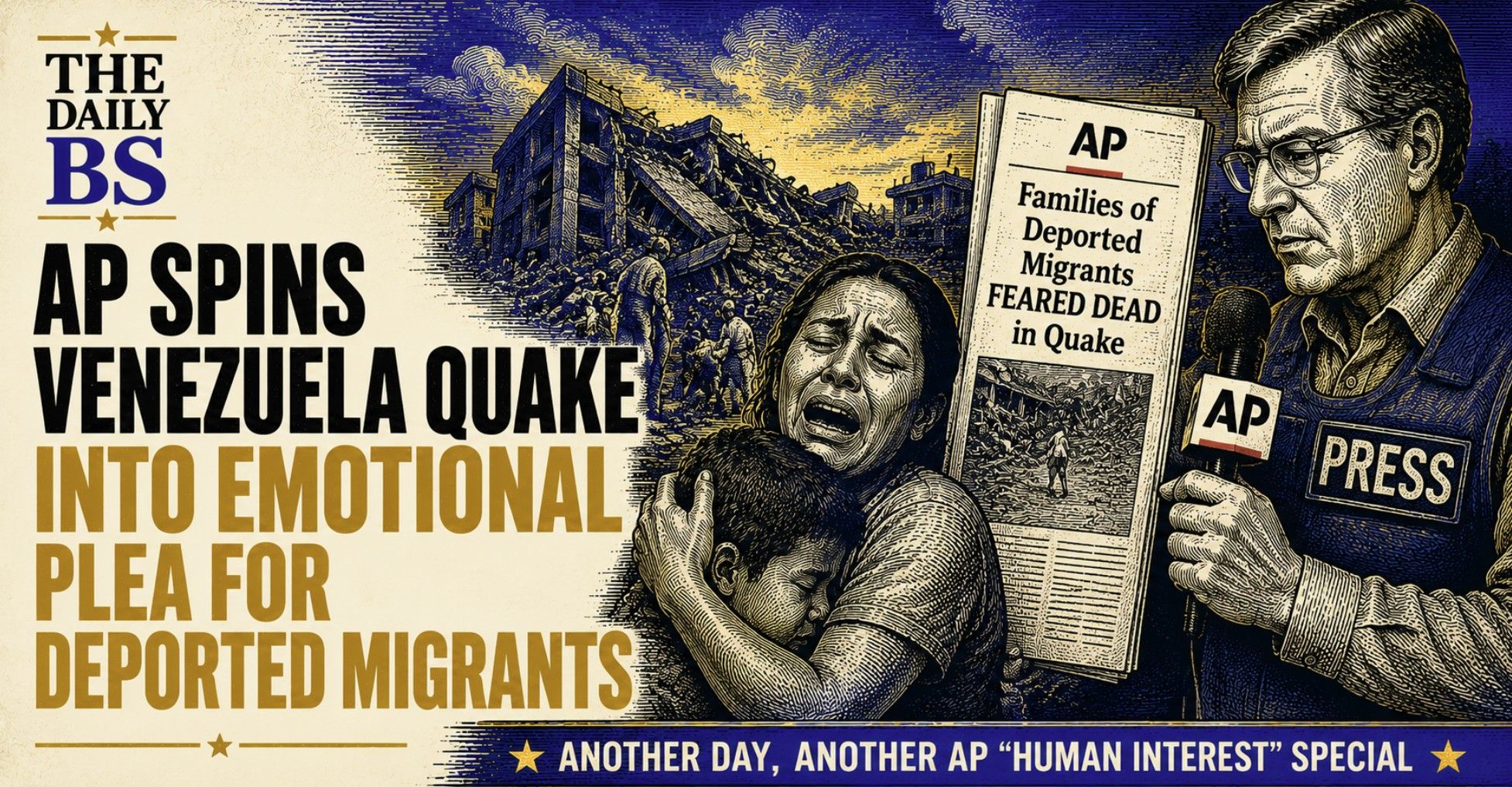
There is a heartbreaking human story buried inside the latest Venezuela earthquake coverage: people survived a devastating disaster, families were terrified, and survivors crawled out of wreckage not knowing who was alive or dead.
That should have been the whole story.
Instead, the Associated Press chose to frame the event through the familiar lens of one of today’s biggest political fights: immigration and the Trump administration’s deportation policies.
A deportation flight carrying Venezuelan nationals arrived in Venezuela before major earthquakes struck. The group was taken to a hotel in La Guaira, where survivors said they were caught in the collapse and chaos when the buildings shook.
Lisbeth Portillo, a survivor, described the terrifying moments. “I started hearing ‘papa, papa papapa,’ and I saw the women next to me start to fall,” she said. “They were all screaming for help.”
Portillo said she became trapped under debris but managed to escape. “I fall and end up buried and covered by a beam, but the shaking shifted everything where I was buried and I was able to get out,” she said.
She and other survivors then walked through the devastation looking for assistance. “We walked about five kilometers, and I cried and cried … there was no communication,” Portillo said.
Another survivor, Jenny Rodriguez, described being buried under rubble. “I was trapped under the rubble,” Rodriguez said. “A colleague who had been on the same flight came by; I managed to free my hand from the debris, grabbed him by the trousers, and begged for help.”
“Thanks to God — and to him — I was able to get out of there,” she added.
Those are powerful words. Those are human stories.
But the article quickly moved from the disaster itself into a broader political narrative, repeatedly highlighting the Trump administration’s deportation efforts and immigration enforcement policies.
The piece noted that deportation flights to Venezuela resumed in 2025 and cited broader deportation numbers. It also emphasized that Portillo had previously crossed the border and had an asylum claim pending.
Those details are obviously not relevant context. Because there is a difference between reporting what happened and constructing a story designed to make readers view every event through a predetermined political filter.
I can’t believe they didn’t check the earthquake forecast or even have a structural analysis of the Venezuelan hotel done before sending them back. Basically murder.
The disaster raised legitimate questions: How were the deportees accounted for? What communication existed between governments? Were families given timely information? What happened to those still missing?
Those questions deserve answers. But a tragedy involving people caught in an earthquake should not automatically become a political cudgel.
You can almost hear the newsroom meeting:
“Okay, terrible earthquake. Horrible human suffering. Now how do we make sure everybody knows this is somehow about Donald Trump?”
It’s the same old trick: take a complicated situation, grab the political angle, and turn the entire event into a morality play.
The problem with that approach is that real life is messier than a headline.
A country has a right to enforce its borders. Every nation on earth has immigration laws. A government can decide who enters, who stays, and who leaves.
At the same time, people caught in a disaster are still people. Their suffering is not a political prop.
The survivors quoted in the article didn’t talk about campaign slogans. They talked about fear. They talked about rescue. They talked about calling their families and hearing voices they thought they might never hear again.
“I’m alive, I made it out of the rubble, I’m alive,” Portillo told her husband.
That’s the story.
Not the endless political theater. The media can keep trying to turn every event into another chapter in the anti-Trump screenplay. But sometimes the facts are stubborn things. Sometimes the human story refuses to fit the preferred narrative.
BREAKING: More than 100 Venezuelans who were deported from the U.S. hours before the earthquakes are missing after their hotel collapsed. https://t.co/v6BOQVLRnx
— The Associated Press (@AP) June 29, 2026











Everything that happens here, or anywhere around the globe, is Trump’s fault. That’s a fact! The guy has supernatural powers that he uses to destroy people’s lives.
Want proof? Why just ask any Democrat!