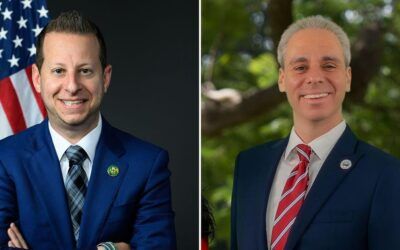
WASHINGTON — A House Republican is moving quickly to test the limits of congressional authority over citizenship policy following a major Supreme Court decision on birthright citizenship.
Rep. Andy Ogles (R-Tenn.) announced plans to introduce legislation called the “Anchors Away Act,” which would seek to prevent pregnant foreign nationals from entering the United States for the purpose of giving birth and obtaining U.S. citizenship for their children.
Today’s United States Supreme Court decision is not only a betrayal of American sovereignty, but a direct attack on our national security.
Because of birthright citizenship, foreigners are being born on our soil, groomed by communists and globalists, and embedded into our… pic.twitter.com/j5x9vwMalq
— Rep. Andy Ogles (@RepOgles) June 30, 2026
Ogles outlined the proposal during an appearance on Fox News, arguing that Congress should act after the Supreme Court rejected President Donald Trump’s executive order targeting birthright citizenship.
“We are literally going to be dropping Anchors Away, which really pushes back against the Supreme Court, this idea that if you are pregnant and you are from a foreign nation, you know what, it is time for Congress to pass a law that says you cannot come here. You cannot have a baby on U.S. soil and exploit this loophole,” Ogles said.
The proposal follows a closely watched Supreme Court ruling that reaffirmed birthright citizenship protections under the 14th Amendment. In a 5-4 decision, the Court concluded that the Trump administration’s executive order restricting automatic citizenship for certain children born in the United States was inconsistent with constitutional protections.
SCOTUS betrayed America.
It’s time to bar pregnant foreigners from coming to this country. We are being colonized.
Anchors Away! pic.twitter.com/uBQ0Tduy7A
— Rep. Andy Ogles (@RepOgles) June 30, 2026
Chief Justice John Roberts authored the majority opinion. Justice Brett Kavanaugh, writing in dissent, argued that while the executive order conflicted with existing federal law, Congress could potentially address the issue through legislation.
“In my view, the Executive Order does not violate the Fourteenth Amendment. But the Order does contravene a federal statute,” Kavanaugh wrote. He added that Congress could “enact new legislation establishing exceptions to birthright citizenship for children born to foreign citizens unlawfully or temporarily in the country.”
The dissent immediately drew attention from lawmakers seeking legislative alternatives after the Court’s decision.
President Trump responded by urging Congress to act.
“The Supreme Court upheld Birthright Citizenship, which is too bad for our Country,” Trump wrote on Truth Social. “Congress should start TODAY to work on ending expensive and unfair to our Country, Birthright Citizenship. They will have my Complete and Total Support!”
House Speaker Mike Johnson (R-La.) indicated that Republican leadership is reviewing possible legislative options. “We’re looking at that,” Johnson told reporters when asked about Ogles’s proposal. “We need to address the issue as quickly and as efficiently as we can.” Johnson acknowledged that some legal experts believe a constitutional amendment would ultimately be required to make significant changes to birthright citizenship but argued that lawmakers should explore available legislative avenues. “We need to address the issue as quickly and as efficiently as we can,” he said. “Clearly, birthright citizenship has been abused.”
The interesting part of this story isn’t merely Andy Ogles introducing a bill. Members of Congress introduce bills every day that never go anywhere. The bigger story is that Republicans are treating the Court’s ruling not as the end of the debate but as the starting gun for a legislative battle.
What caught Washington’s attention was Justice Kavanaugh’s dissent. His argument wasn’t simply that Congress lost. It was that Congress might have tools available that lawmakers have never fully tested.
That observation immediately gave immigration hawks a new path forward.
Ogles’s bill would almost certainly face immediate legal challenges. But politically, it signals that birthright citizenship remains one of the defining immigration issues heading into the next legislative fights.
The question now is whether Congress is prepared to tackle one of the most contentious constitutional debates in American politics—or whether this becomes yet another high-profile proposal that generates headlines but never reaches the president’s desk.