Disney’s remake factory is headed back into dangerous waters.
The entertainment giant’s live-action version of “Moana” arrives in theaters this weekend facing a wave of brutal reviews, sluggish box office projections, and growing questions about whether Disney has finally exhausted the public’s appetite for endlessly recycling its animated classics.
Industry tracking cited by multiple entertainment outlets projects an opening weekend somewhere between $40 million and $60 million domestically—a concerning number for a film reportedly carrying a production budget of roughly $250 million before marketing costs are added.
If those projections hold, Disney could be staring at yet another expensive disappointment only a year after the studio’s much-maligned “Snow White” remake became a symbol of Hollywood excess, political distractions, and audience fatigue.
The criticism has been unusually sharp. The live-action “Moana” opened with a dismal Rotten Tomatoes critics score that initially landed in the low 30s before climbing slightly, still leaving it among the lowest-rated Disney remake efforts of the modern era.
Reviewers have repeatedly asked the same question: Why remake a movie that wasn’t even old enough to need nostalgia?
The original animated “Moana” premiered in 2016 and remains one of Disney’s most popular streaming titles. A sequel followed in 2024 and became a major box office success. Yet Disney decided to revisit the exact same story almost immediately.
The result, according to critics, feels less like a celebration of a beloved classic and more like a corporate boardroom exercise. The San Francisco Chronicle described the film as a “money grab” and questioned how a production with real actors could somehow feel less alive than the animated version. “What’s a real head-scratcher is how it can feel so lifeless with real people as compared to the animated original,” the review stated.
Britain’s Daily Telegraph was even harsher, comparing the finished product to something generated by artificial intelligence. “This was, by all appearances, an incredibly costly and labour-intensive production, yet there is barely a moment in it which feels as if it couldn’t have been achieved by typing: ‘What if this scene from Moana was remade in live action?’ into a video generator’s prompt box.”
Another reviewer argued the movie may not be Disney’s worst remake but instead serves as the perfect example of a deeper problem. “[Moana] isn’t necessarily the worst of these remakes the studio has churned out, but somehow feels most representative of the rot at the core of this artistic project.”
The criticism comes as Disney continues struggling to rebuild audience trust after several years of culture-war controversies, uneven box office performance, and increasing complaints that the company has prioritized corporate messaging over original storytelling.
To be fair, not every remake has failed.
Last year’s live-action “Lilo & Stitch” became a massive global success, surpassing $1 billion worldwide and proving audiences will still show up when they believe Disney is offering something fresh and entertaining.
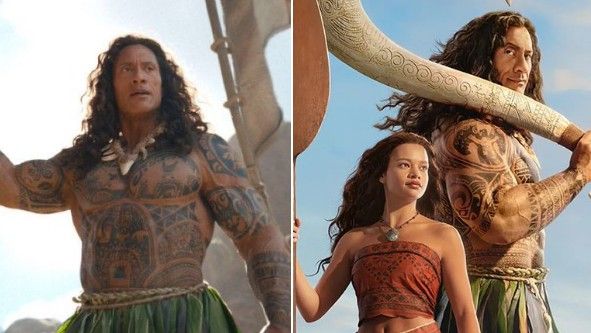
But “Moana” appears to be running into a different problem entirely. Even many fans of the original film seem unconvinced that this version offers anything new. Dwayne Johnson returns as Maui, the wisecracking demigod he voiced in the animated film. Newcomer Catherine Laga’aia takes over the title role. Yet much of the movie reportedly follows the original scene-for-scene, beat-for-beat, song-for-song.
That strategy may be colliding with a harsh reality; audiences increasingly have instant access to the original films through streaming services and are asking why they should pay theater prices to watch a nearly identical version.
For Disney, the stakes extend beyond one opening weekend. The company has spent years mining its animation vault instead of creating the next generation of classics. While that strategy once looked like easy money, a string of underperforming releases has raised concerns that the formula is losing steam.
There was a time when Disney made movies people remembered for generations. Now they remake movies people still remember from last Tuesday.
Think about this for a second. The original “Moana” came out in 2016. That’s not a beloved artifact from ancient Hollywood history. That’s practically yesterday. Some of the kids who watched the original are still borrowing money from their parents.
Disney’s executives looked at a wildly successful animated movie, looked at a successful sequel, looked at hundreds of millions of dollars already invested in the franchise and apparently concluded, “You know what America really needs? The exact same thing again.”
This is what happens when creativity gets replaced by spreadsheets.
Hollywood keeps lecturing audiences about diversity, representation, inclusion, sustainability, equity, climate change, emotional wellness, and whatever else is trending on social media this week. Yet nobody in the executive suite seems interested in representing one increasingly marginalized group, paying customers.
Americans aren’t rejecting Disney because they’re mean. They’re rejecting Disney because they’re bored. The audience isn’t asking for more remakes. They’re asking for more imagination.
And if Disney keeps treating its greatest hits catalog like an ATM machine, it may discover something unpleasant: eventually the machine runs out of cash.