

BS BRIEF:
- President Donald Trump signed a new executive order Friday directing the Interior Department to install temporary signs near the National Museum of American History alerting visitors to the White House’s findings of ideological bias and directing them to what the administration calls more accurate accounts of the nation’s past. The order also calls for temporary outdoor exhibits or signs correcting information inside the museum.
- The order followed a contentious House hearing where museum director Anthea Hartig rejected the White House report, insisting it did not “fairly or accurately characterize” the institution. Republicans countered that the Smithsonian has turned the national story into a narrative of oppression while placing America’s Founders and founding principles somewhere between the gift shop and the emergency exit.
- The White House’s 162-page report recommended a warning at museum entrances declaring that the exhibits were prepared by people who do not want visitors to love their country. The Smithsonian declined to comment on Trump’s new order, while outside historians and progressive critics accused the administration of political interference.
TRUMP ORDERS WARNING SIGNS OUTSIDE SMITHSONIAN AS BATTLE OVER AMERICA’S HISTORY EXPLODES
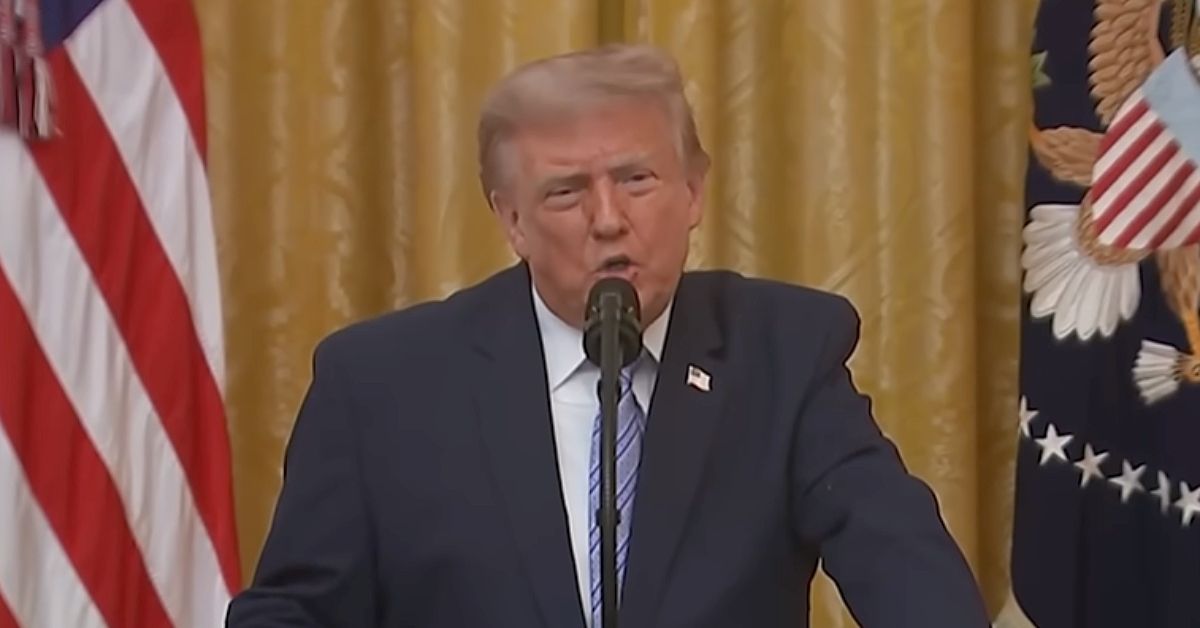
President Donald Trump is taking his fight with the Smithsonian directly to the museum’s front door.
Trump signed an executive order Friday directing the Interior Department to install temporary signs near the National Museum of American History informing visitors that the White House believes portions of the museum’s presentation are inaccurate, politically slanted and hostile to the country whose history it was created to preserve.
The order also directs federal officials to establish temporary displays or additional signage on property controlled by the National Park Service. Those materials are intended to challenge disputed museum content and give greater prominence to the Founders during America’s 250th-anniversary celebration.
PRESIDENTIAL ACTION, EXECUTIVE ORDER
Restoring Trust in the Smithsonian InstitutionExecutive Order 14254 addresses concerns about the Smithsonian Institution’s National Museum of American History, stating that the museum presents American history through a lens of social…
— whitehouse.gov News (@whgovnews) July 25, 2026
Because the Smithsonian operates independently of the executive branch, Trump cannot simply walk into the museum with a Sharpie and begin rewriting exhibit cards. The administration instead targeted the sidewalks and surrounding federal property maintained by the Park Service, where the president’s authority is considerably clearer.
The White House said the action was necessary because the institution’s current leadership “cannot be trusted” to tell the country’s story with sufficient honesty or gratitude.
Trump’s order builds on the Domestic Policy Council’s July 4 report, Saving America’s Story, which accused the National Museum of American History of replacing a coherent national narrative with what it called “thinly veiled anti-Americanism” and “extreme political activism.”
Doing research on various federal cultural agencies, including the Smithsonian Institution. Here’s the results for a generic Google search for exhibits at the Museum of American History.
It’s all like this. It’s 100% DEI-core. It has to go. We have to start over. pic.twitter.com/lPEpcoUClP
— Lomez (@L0m3z) March 2, 2025
The administration’s report argued that the museum repeatedly emphasizes slavery, conquest, exclusion and systemic injustice while minimizing the Founders, the Revolution, Christianity’s historical influence and America’s constitutional development.
It claimed visitors could walk through the country’s flagship history museum without encountering a clear, prominent account of Washington, Jefferson, the Continental Congress or the struggle for independence. The museum disputes that characterization and points to artifacts including Jefferson’s writing desk, a Revolutionary War gunboat and the original Star-Spangled Banner.
The report’s most memorable recommendation was considerably less diplomatic.
It suggested placing a notice at every entrance stating:
“Warning: the exhibits in this museum were prepared by people who don’t want you to love your country.”
The new executive order does not specify that the administration must reproduce those exact words. It does, however, direct officials to notify visitors of the report’s conclusions and steer them toward alternative historical material.
The order arrived only days after National Museum of American History Director Anthea Hartig defended the institution during a heated House Oversight hearing. “As we continue to fact check the report, we unwaveringly attest that it does not fairly or accurately characterize the full body of work at the museum,” Hartig told lawmakers. “There is always room for improvement,” she added, while defending what she called the museum’s “beauty,” “inspiration” and professional expertise.
Hartig insisted the museum does not take political sides and said its historians were attempting to broaden the national story rather than erase traditional history. “When historians talk about reframing a traditional narrative, we don’t mean erasing it,” she testified. “We mean adding the evidence, the voices, the objects, that earlier tellings left out.” She also argued that patriotism is most powerful when it is inspired rather than imposed from above.
Republican lawmakers were not persuaded.
Rep. Michael Cloud of Texas acknowledged that founding-era material existed but said it was difficult for visitors to locate. “I’m not saying it’s not there,” Cloud said, “but it’s hard to find.”
House investigators also questioned Hartig about past exhibits and educational initiatives involving gender identity, abortion, racial politics and training materials that associated ordinary professional behaviors—including politeness—with “white supremacy culture.”
Heritage Foundation senior fellow Mike Gonzalez testified that museum officials had adopted a mission of teaching visitors about “American wickedness” rather than presenting the broad sweep of the national experience.
Hillsdale College professor Matthew Spalding offered a more measured standard, arguing that the museum should tell the country’s story “warts and all” while avoiding the use of public history as a tool for social transformation. “Americans’ history belongs neither to liberals nor conservatives,” Spalding testified. “It belongs … to the American people.”
The administration has focused particular attention on the museum’s Entertainment Nation exhibit, arguing that even displays about popular culture are filtered through progressive theories of race, imperialism, gender and oppression.
The White House report objected to a display describing Alexander Hamilton mainly as an “influential and flawed founding father,” arguing that the label neglected his central role in building the country’s political and financial systems. It also criticized language connecting circus imagery, musical instruments and American entertainment to white supremacy and imperialism.
Ever wish that pop culture featured more prominently in museums? Look no further than the new “Entertainment Nation” exhibit at the National Museum of American History, where everything from Dizzy Gillespie’s trumpet to Muhammad Ali’s robe to @steveaoki‘ mixer surfaces. pic.twitter.com/d5LI3kUXwE
— Andrew Simon (@simongandrew) January 8, 2024
The report went further, accusing museum officials of placing sexually explicit or ideologically charged content in exhibits frequented by families and young children.
The museum has defended its scholarship and said some exhibits singled out by Republicans were temporary, provided appropriate context or clearly advised parents about subject matter. The Smithsonian previously said it was conducting a review of museum content and remained committed to “continuous and rigorous scholarship and research” along with an unbiased presentation of facts.
It offered no immediate comment on Friday’s executive order.
The Smithsonian is not simply a private collection with no obligation to answer questions from the public. It receives a substantial majority of its roughly $1 billion annual budget from federal appropriations and is governed by a Board of Regents that includes Vice President JD Vance, Chief Justice John Roberts and members of Congress.
That unusual structure gives the Smithsonian operational independence while leaving it dependent upon taxpayers and subject to congressional oversight.
Trump’s order directs the Interior Department, Office of Management and Budget, General Services Administration and Domestic Policy Council to use existing legal and financial authorities to pressure the institution to address the report’s findings and comply with federal funding requirements.
Critics accused Trump of trying to sanitize difficult chapters of American history and impose a government-approved version of patriotism. The Organization of American Historians rejected the White House report, while other opponents described the signs as political propaganda outside a scholarly institution.
The administration argues it is not demanding that slavery, segregation or injustice be hidden. The report explicitly states that those subjects should be taught, but says they should not become the central lens through which every American achievement, institution and historical figure is viewed.
DBS WIRE SOURCES:
- The White House: Restoring trust in the Smithsonian Institution
- The White House: Fact sheet: President Donald J. Trump restores trust in the Smithsonian Institution
- The White House Domestic Policy Council: Saving America’s Story: How ideological capture at the Smithsonian Institution’s National Museum of American History erases our heritage
- House Committee on Oversight and Government Reform: Hearing wrap-up: Smithsonian National Museum of American History’s radical agenda to reshape the past
- Associated Press: Trump orders new signs outside Smithsonian saying some exhibits are inaccurate
- Associated Press: Smithsonian history museum chief rejects White House criticism of its leaders as radical activists
- Reuters: Trump orders signs outside Smithsonian history museum to correct what he calls ‘inaccurate information’
- New York Post: Trump orders signs outside Smithsonian museum amid row over its depiction of American history










Good!
Calling out truth vs “disinformation” — or shutoff we just say LIES