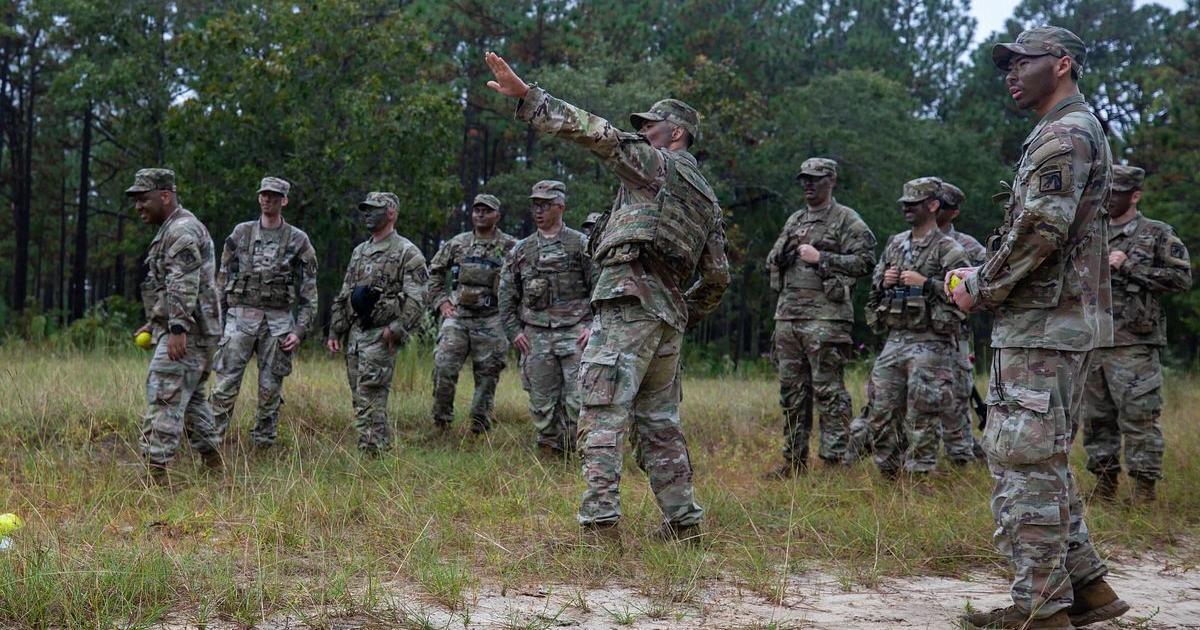
(The Center Square) – Military installations pivotal to national security, including Marine bases and the Army’s Fort Bragg in North Carolina, are ticketed for millions of the $1.15 trillion authorized in national defense discretionary spending within the U.S. House of Representatives’ passage of the fiscal year 2027 National Defense Authorization Act.
Included in the bill is second-term Republican President Donald Trump’s initiative to formally name the Department of War, changing from the Department of Defense. The department’s name carried the War Department moniker until two-term Democratic President Harry Truman signed the National Security Act of 1947.
The package is 27.7% higher than a year ago. War Department Secretary Pete Hegseth last week said the conflict with Israel against Iran has cost $37.5 billion to date; he’s requested $67.1 billion for that and other expenses.
Passage was 216-212, with North Carolina Democratic Reps. Deborah Ross, Valerie Foushee and Alma Adams all opposed.
Democratic Rep. Don Davis, in a tight midterm election race with Republican challenger Laurie Buckhout in the northeastern part of the state, sided with Republicans. The Air Force veteran’s vote was alongside Reps. Dr. Greg Murphy, Virginia Foxx, Addison McDowell, David Rouzer, Rev. Mark Harris, Richard Hudson, Pat Harrigan, Chuck Edwards, Brad Knott and Tim Moore.
Davis was one of six Democrats favoring what is also known as House Resolution 8800; seven Republicans, notably Rep. Thomas Massie, R-Ky., were against it.
The resolution has stalled in the Senate. It includes the SAVE Act, known also as Safeguard American Voter Eligibility Act. A cloture vote failed to advance the bill.
As it relates to the 2026 midterms, Democrats don’t have the votes for their version, which would drop the SAVE Act, and Republicans are at risk of blame on military readiness and defense authorization. For the past 50 years, average delay has been 45 days after the Oct. 1 fiscal year begins for defense authorization. Yet, it has become law 65 straight years.
The next step would be another cloture vote or negotiations.
“Through this year’s NDAA, I was able to deliver critical funding for facility maintenance upgrades, promote statewide innovation, and enhance the safety and wellbeing of my soldiers and their families at Fort Bragg,” Hudson said. “I urge my colleagues in the Senate to take up this legislation quickly and look forward to the president signing this bill into law.”
North Carolina is home to an estimated 615,000 vets, roughly 90,000 active-duty military, and about 43,000 National Guard and reservists. Texas, Florida, California and Pennsylvania rank with North Carolina in the top five of states home to veterans. California, Texas and Virginia are the only states with more active-duty military.
North Carolina’s six major military bases include the U.S. Army’s Fort Bragg and Pope Air Force Base, both in the southeastern part of the state; Seymour Johnson Air Force Base in eastern North Carolina; and U.S. Marine Corps Air Station Camp Lejeune and MCAS New River along the coast, not more than an hour’s drive from the more inland MCAS Cherry Point in Havelock. There are also two U.S. Coast Guard bases along the northern coast at Elizabeth City; and the Military Ocean Terminal Sunny Point on the southern coast in Brunswick County.
“By investing in our military installations, strengthening American manufacturing, and modernizing our military,” Davis said, “this legislation helps ensure our servicemembers remain ready to meet evolving global security challenges.”
Authorized for appropriation are raises of 7% for junior enlisted personnel, meaning E-5 and below; 6% for mid-level enlisted and junior officers, meaning E-6 to O-3; and 5% for senior officers and higher, meaning O-4 and above.
More than $800 million is authorized for appropriation to the bases in North Carolina. This includes:
• At Camp Lejeune, the Marine Raider Battalion Operations Facility, $80 million, and the Marine Raider Operational Support Facility, $72 million; Combat Water Survival Training Facility, $141.9 million; 10th Marines Operational Complex, $77.5 million; amphibious combat vehicle shelters, $24.1 million; and ammunition supply point upgrade, $15.4 million.
• At MCAS Cherry Point, the F-35 Sustainment Center, $89.1 million; maintenance facility and Marine air group headquarters, $62.6 million; aircraft maintenance hangar, $47.6 million; CH-53K gearbox repair and test facility, $17.9 million; 2D Low Altitude Air Defense maintenance and operations facilities design, $19.4 million.
• At Fort Bragg, the aircraft maintenance hangar addition and alteration for the North Carolina National Guard, $69 million; Special Operations Forces ammunition supply point, $65 million; and Special Operations Forces battalion operations facility $6.4 million.