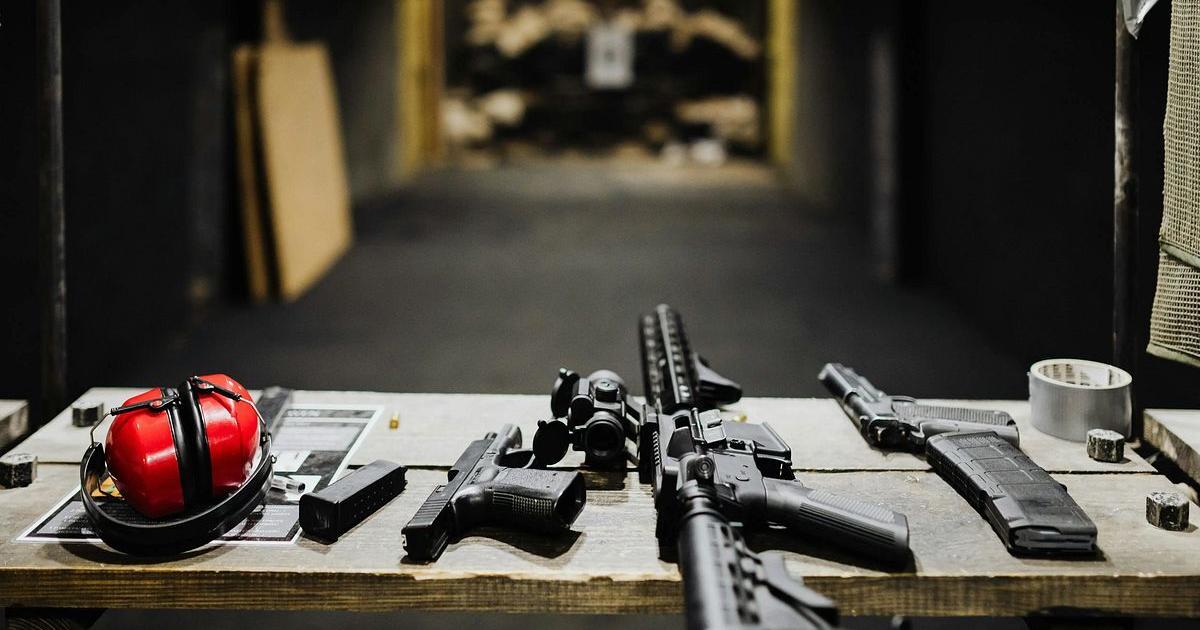
A handgun, rifle, magazines, and protective earmuffs are laid out on a table at an indoor shooting range. Photo: Kaboompics.com / Pexels
(The Center Square) – The U.S. Supreme Court is set to revisit its gun law precedent in the upcoming term as it deals with cases on assault weapons bans.
The nation’s highest court took up Viramontes v. Cook County and Grant v. Higgins, cases out of Illinois and Connecticut, respectively, that deal with challenges to assault weapons bans.
Gun law analysts said the court will have the opportunity to address how its 2022 decision in Bruen v. New York Rifle and Pistol Association will play out in states that propose bans on gun possession.
In Bruen, the high court ruled in favor of two concealed carry permit holders to maintain their weapons. The case overturned a New York law that required individuals to show a special need of self-protection to possess a firearm in public.
In the Bruen case, the court ruled governments must produce historical analogues on firearm place restrictions to justify depriving individuals of Second Amendment rights.
The 2022 decision was seen as extending the historical analogue test in order to restrict an individual’s Second Amendment rights.
“Courts should neither uphold every modern law that remotely resembles a historical analogue, nor require the government to produce a historical twin or dead ringer for the modern law,” said Amy Swearer, senior legal fellow at Advancing American Freedom.
However, analysts pointed out that recent Supreme Court precedent also appeared to contradict the Bruen case. In the 2024 case Rahimi v. United States, the high court upheld a federal law that prevents individuals under domestic violence restraining orders from obtaining firearms.
“I think that led many people to misread Rahimi as yet another course correction as the court backing away from the Bruen test in favor of a somewhat flexible principles-based approach to the Second Amendment,” said Haley Proctor, a law professor at Notre Dame.
Over the last term, though, the high court took up two cases directly addressing the Bruen test: U.S. v. Hemani and Wolford v. Lopez. In U.S. v. Hemani, the high court struck down a law that prohibits controlled substance users from possessing firearms.
Justices on the high court rejected laws prohibiting public drunkards from participating in civic life as historic analogues against habitual drug users from possessing firearms.
“Their ‘why’ was different: protecting the assets of historical drunkards from dissipation of assets instead of protecting the community from violence,” Proctor said.
Michael Williams, general counsel at the American Suppressor Association, said the courts decision in U.S. v. Hemani showed that judges are not able to define who is included in a group that is denied Second Amendment protection.
“When the grouping is this broad, it’s a no-go for the court,” Williams said. “If Congress were allowed to create out-groups that had no real relationship to whether an individualized finding that a person is or could be violent, that’s a pretty bad slippery slope.”
Williams said the court now has an opportunity to clarify what kinds of firearms operate under the Bruen test in Viramontes v. Cook County and Grant v. Higgins. Connecticut lists 70 firearms it bans under its assault weapons prohibition and Illinois lists 100 firearms, including semi-automatic weapons with a detachable magazine.
He said justices on the nation’s highest court will need to clarify whether assault weapons bans are determined based on magazine capacity, kinds of gun stocks or automatic weapons altogether.
Swearer pointed out that the Second Amendment’s basis in maintaining a “well-armed militia” could come up as a defense against the assault weapons ban. She pointed out that advanced weaponry would allow for a court to uphold the assault weapons ban.
“It’s tough to predict how the Supreme Court would take that, but so far the court has been pretty serious about insisting through its opinions that it was serious about Bruen,” Williams said.
Justices on the high court will either hear the assault weapons ban case in late 2026 or early 2027.