

YouTube
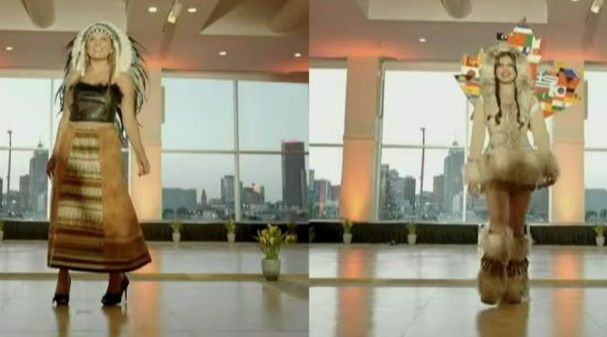
Miss Universe Canada is scrambling to rewrite its costume rules after two contestants walked the stage in Indigenous-inspired outfits that left former titleholder Ashley Callingbull asking the question, who approved this?
Callingbull, the first First Nations woman to win Miss Universe Canada, interrupted Saturday night’s finals to criticize the pageant for allowing what she called “cultural appropriation” during its national costume competition.
The latest fallout includes apologies from both contestants, a public mea culpa from pageant director Sonny Borrelli and plans for a “comprehensive costume guide.” Organizers have also asked Callingbull to serve as a cultural liaison for next year’s competition.
In other words, the pageant has gone from evening gowns and swimsuits to launching its own Department of Costume Compliance.
Callingbull, a member of Alberta’s Enoch Cree Nation, said she was stunned when Karisa Haverkamp appeared wearing a large multicolored feathered headdress and a red handprint painted on her cheek.
The red hand is associated with the Missing and Murdered Indigenous Women and Girls movement, a serious campaign drawing attention to violence and disappearances involving Indigenous women. Haverkamp apparently intended her costume as a show of solidarity—but intention and permission are not necessarily the same thing when sacred regalia is involved.
A second contestant, Jasleen Kaily, wore an Arctic-themed fur-and-fringe outfit resembling Inuit clothing, complete with a large maple leaf.
“My jaw just dropped to the floor,” Callingbull told CBC. “This cannot be real,” she recalled thinking. “Who allowed this on stage? Who approved this? Anything traditional or sacred should not be allowed.”
Callingbull took her objections directly to Borrelli before addressing the audience during the final portion of the competition.
“Me being the first Indigenous First Nations Miss Universe Canada, that was such a huge honor,” she said from the stage. “But sometimes there are mistakes that are made.”
“During this week, during the national costume competition, there was cultural appropriation done toward Indigenous people.”
Callingbull said the controversy should have been avoidable. “It’s 2026. We should know better,” she told the crowd. “A part of reconciliation is that we educate and learn and understand and move on from these things in a good way.”
Haverkamp subsequently apologized, acknowledging that her costume “caused hurt and offense” to members of the Indigenous community.
“I appreciate what I have learned from this experience,” she wrote, while reaffirming her commitment to speaking for women affected by “violence, trauma and oppression.”
Kaily also apologized, saying her intention “was never to disrespect or misrepresent Indigenous culture.” She said she had hoped “to recognize and celebrate one of the First Peoples of Canada.”
Borrelli joined the apology parade from the stage.
“It was never our intention to offend anybody,” the pageant director said. “If we did, we take full responsibility. We will learn from it, we will make it better, we will make it right.”
Miss Universe Canada has since announced it will produce a detailed costume guide and promised to improve its approval process. The organization said it remains committed to creating an “inclusive, respectful platform.”
The pageant’s own 2026 contestant packet describes the national costume category as a celebration of Canadian “culture and heritage” and says entries should be evaluated partly on “cultural authenticity.”
Therein lies the problem. Canada’s heritage includes Indigenous history—but that does not automatically make every piece of First Nations or Inuit culture communal property for a beauty contestant to strap on beneath the spotlight.
Callingbull has actually been warning the pageant world about this issue for years. After a previous Miss Canada contestant appeared in a notorious totem-pole costume, Callingbull said organizers needed a cultural adviser when contestants portrayed traditions outside their own backgrounds. She also warned that pageants encourage increasingly extreme designs because “the more extreme, the better it is” for ratings and votes, according to Global News.
Apparently, that memo got lost somewhere between hair, makeup and the feather department.
Callingbull said confronting organizers was emotionally difficult but necessary. “I felt like I was educating them and giving them hell at the same time,” she told CTV News.
“I’m glad I got the message across, but it was heavy on me. It was really heavy on my heart.”
DBS WIRE SOURCES
- Daily Mail: Miss Universe Canada winner slams “hurtful” Indigenous costumes
- CBC News: Costumes spark response from former Miss Universe Canada winner
- CTV News: Callingbull confronts pageant over First Nations regalia
- Miss Universe Canada: Official 2026 contestant and costume guidelines
- Global News: Callingbull previously urged pageants to use cultural advisers










What is it they say? Getting an apology is easier than getting an approval. They knew what they were doing.