BS BULLETIN
- CNN’s Jake Tapper said the White House “took the bait” after Sen. Jon Ossoff’s suggestive reference to Trump aide Natalie Harp — and laughed that CNN was now sending cameras to Georgia for Ossoff’s reaction.
- The controversy began after Ossoff attacked Trump’s conduct in office and referenced his traveling with Harp, prompting CNN reporter Kristen Holmes to ask Trump about it.
- During Tuesday’s discussion, Tapper joined Jonah Goldberg’s “fighting with pigs” analogy with the punchline: “And the pig likes it.”
(Video Credit: CNN)
Every once in a while, somebody on cable television accidentally explains how the sausage gets made.
Jake Tapper may have just given viewers one of those moments.
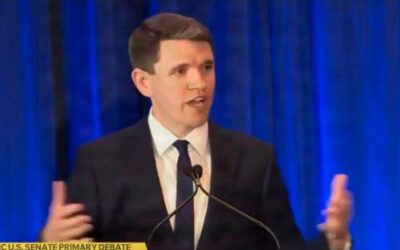
The latest Washington media feeding frenzy began with Democratic Georgia Sen. Jon Ossoff attacking President Donald Trump during a campaign appearance. Ossoff accused Trump of neglecting his presidential duties during the Iran conflict and tossed Trump executive assistant Natalie Harp into the attack.
“He wants to build his ballroom and travel with Natalie on their apparently defenseless flying palace, gifted by the Emir of Qatar,” Ossoff said.
The Harp reference immediately attracted attention because she is an unusually close and constantly present Trump aide. She travels with the president, handles information and social-media material for him and has become a familiar figure at his side. Recent reporting has also revisited highly personal letters Harp reportedly wrote to Trump before joining his staff.
But Ossoff didn’t explicitly accuse Trump and Harp of having an affair. The insinuation was left hanging there. And Washington’s media machine took care of the rest.
CNN senior White House correspondent Kristen Holmes raised Ossoff’s comments with Trump during an Oval Office appearance Monday. Trump erupted, dismissing CNN as “fake news” and attacking Holmes before later telling her to be quiet when she attempted to ask about North Korean leader Kim Jong Un. The White House subsequently escalated the fight online, including personal criticism referencing Holmes’ children. CNN defended its reporter.
By Tuesday, the controversy had become exactly what cable news controversies tend to become: A story about the reaction to the reaction to the reaction. And that’s when Tapper said something rather revealing.
“I mean, I think the White House really took the bait here,” Tapper said on The Lead.
Bait. Interesting choice of words.
Tapper explained that he had tried to tell someone at the White House that going “nuclear” against reporters asking about Harp would only guarantee more coverage.
“And now we’re sending cameras to Georgia to see what Jon Ossoff has to say.”
Well, thank you for clearing that up.
Ossoff throws out the bait. A reporter asks Trump about the bait. Trump gets angry about being asked about the bait. Trump’s anger becomes news. And because Trump’s anger became news, CNN dispatches cameras to Georgia to ask Ossoff what he thinks about Trump reacting to the bait Ossoff originally threw out.
Ladies and gentlemen, behold the perpetual-motion machine of political journalism. No fossil fuels required.
Ossoff, meanwhile, has since backed away from any overtly salacious interpretation of his remarks.
Appearing with Jen Psaki, he described Harp as one of Trump’s aides who doesn’t tell the president what he “needs to hear,” but rather what he “wants to hear.” His criticism, he suggested, was about Trump’s reliance on aides and his handling of presidential responsibilities rather than an allegation of sexual impropriety.
That’s an interesting retreat considering how quickly the original line generated precisely that kind of speculation. But the political strategy itself is becoming clearer.
Axios reports that Democrats are openly debating whether Ossoff’s aggressive approach offers a model for confronting Trump — essentially whether Democratic candidates should go lower and harder rather than continuing to complain that Trump does. Democratic strategist David Axelrod praised Ossoff as an effective Trump antagonist, while others within the party remain wary of trying to beat Trump at his own rhetorical game.
And that question came up directly during Tapper’s discussion. Jonah Goldberg warned that politicians attempting to imitate Trump’s insult-heavy style often discover that voters judge them differently.
Trump, Goldberg argued, has already had his behavior “priced in” by voters. “He got the White House to take the bait,” Goldberg said, before reaching for an old expression about fighting with pigs: you get dirty, too.
Tapper supplied the ending: “And the pig likes it.” And laughed.
Now, Tapper can reasonably say he was completing a familiar aphorism, not spontaneously announcing that Donald Trump is a farm animal.
Fine.
But imagine — just for sport — a Fox News anchor chuckling through a segment about Barack Obama and finishing an analogy by referring to “the pig.”
How many milliseconds before Media Matters issued the emergency bulletin? How many CNN panels? How many professors of political rhetoric? How many solemn discussions about “dangerous dehumanizing language”? We’d need a second internet. Yet the more revealing part of this episode isn’t even the pig line. It’s the bait.
Because Tapper described exactly what many Americans have complained about for years: political media doesn’t merely observe controversies. Sometimes it helps create the feedback loop that turns them into national stories. CNN didn’t invent Ossoff’s words. Trump genuinely did react angrily. The White House genuinely did escalate matters with its attacks on Holmes. Those are facts.
But when the network’s own anchor can laugh that the White House “took the bait” and then explain that CNN is consequently sending cameras to Georgia to keep the story going, viewers are entitled to notice something. The news cycle isn’t merely happening. People are making choices about what to amplify. And sometimes you can actually hear them describing the process on television.