BS BULLETIN
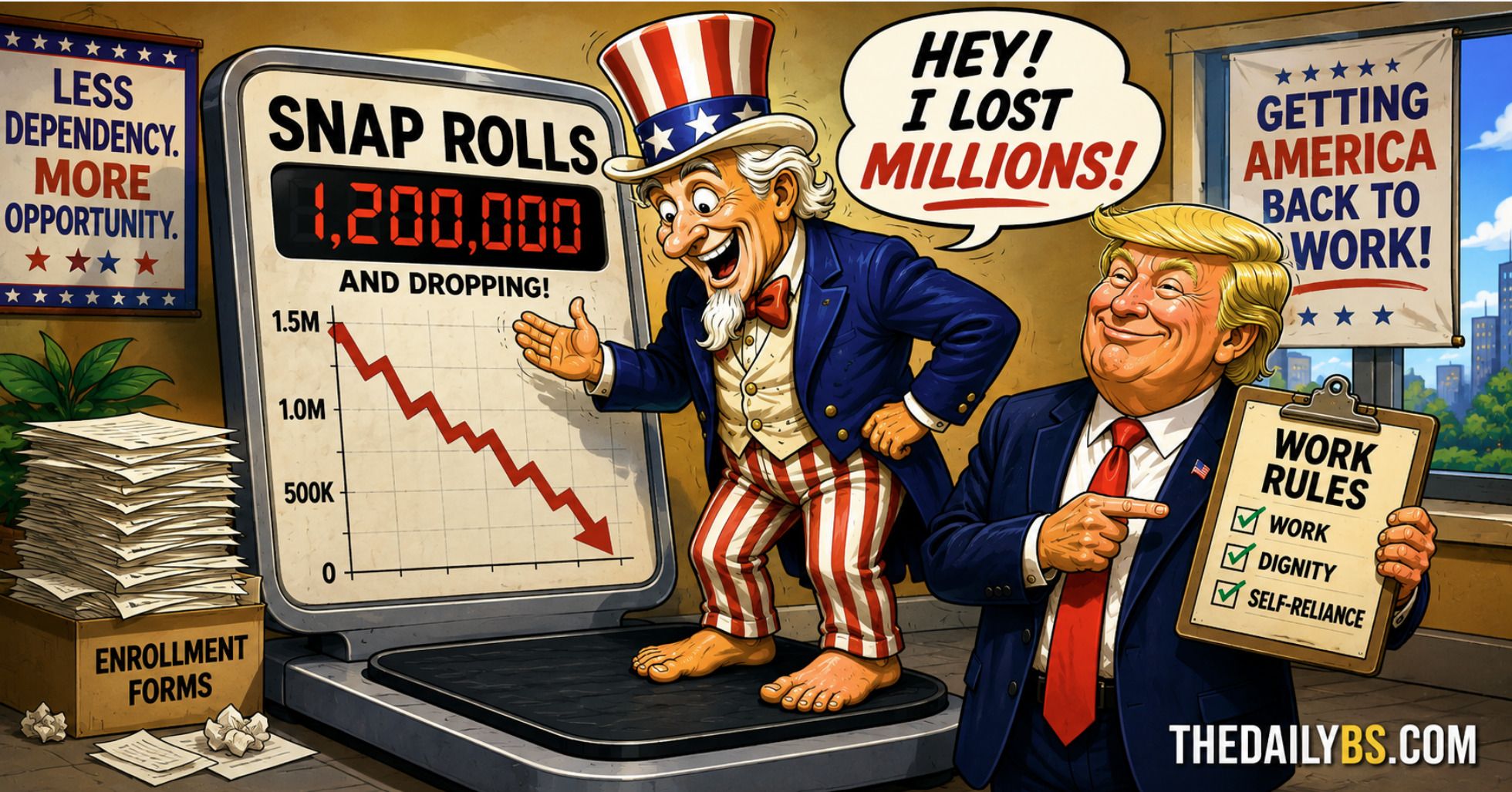
- SNAP enrollment fell from 42.2 million to 36.6 million between May 2025 and May 2026 — a drop of more than 13%.
- Trump’s welfare overhaul expanded work requirements and narrowed exemptions.
- The decline is substantially faster than analysts initially expected — and critics say paperwork problems are contributing too.
Something rather remarkable is happening to America’s food stamp rolls.
They’re shrinking. Fast.
New figures show enrollment in the Supplemental Nutrition Assistance Program — SNAP — plunged more than 13% in just one year, falling from roughly 42.2 million recipients in May 2025 to 36.6 million in May 2026. That’s about 5.6 million fewer Americans receiving benefits.
And this isn’t simply the usual slow decline that accompanies a booming economy. President Donald Trump’s welfare overhaul is changing who must work to continue receiving benefits.
The One Big Beautiful Bill expanded SNAP’s time-limited work requirement to more recipients, including adults through age 64 and parents whose youngest child is 14 or older. It also eliminated exemptions previously available to some homeless people, veterans and former foster youth. In general, affected adults must work, volunteer or participate in qualifying programs for at least 80 hours per month or face a three-month limit on benefits during a three-year period.
The result has been one of the sharpest contractions in SNAP participation in decades.
Between July 2025, when Trump’s bill became law, and January 2026 alone, participation dropped by more than 3 million people. Analysts at the liberal Center on Budget and Policy Priorities say the last comparable decline over such a short period — outside temporary disaster-related fluctuations — followed the 1996 welfare reforms.
The administration isn’t exactly mourning the disappearing caseload.
Agriculture Secretary Brooke Rollins has repeatedly argued that welfare programs should provide a temporary hand up rather than permanent dependency and has touted falling enrollment as evidence that Trump’s reforms are moving able-bodied Americans toward work.
But critics say there’s another side to those impressive numbers. They argue some people aren’t leaving SNAP because they suddenly landed great jobs. They’re disappearing because they failed to navigate new paperwork, reporting requirements and deadlines.
Arizona provides the most dramatic example. SNAP enrollment there has fallen by roughly 55%, the largest decline in the nation, and advocates say administrative difficulties implementing the new rules have contributed to eligible recipients losing benefits.
Meanwhile, food banks in several parts of the country report increased demand. In the Houston area, for example, SNAP enrollment fell about 18% over a year while the Houston Food Bank reported a 24% increase in clients between March and April.
And the next fight is already coming. Beginning in 2027, states with sufficiently high SNAP payment-error rates will have to shoulder part of the actual cost of benefits — a major departure from the federal government’s traditional financing of the program. States with error rates above 6% could eventually be responsible for between 5% and 15% of benefit costs, creating a powerful new incentive to police eligibility and payment accuracy.
So the numbers tell us something important: The days when the SNAP rolls seemed to move primarily in one direction may be over.
MY QUICK TAKE
For years, Washington had an interesting definition of success for government programs: More customers.
More people receiving benefits? Obviously the program is working!
So, I’m perfectly comfortable with the radical proposition that an able-bodied adult who can work should work. Call me old-fashioned.
But we should be just as interested in making sure the government gets the right people off SNAP. The objective shouldn’t be fewer people on SNAP at any cost. It should be fewer Americans needing SNAP in the first place.
Now that would be a number worth bragging about.
DBS WIRE SOURCES:
- The Hill — Tightening rules drive sharp SNAP enrollment dip
- Associated Press — Enrollment in SNAP grocery aid is dropping faster than expected
- USDA — SNAP work requirements
- USDA — SNAP monthly participation and benefit data
- Center on Budget and Policy Priorities — SNAP participation drop is steepest in decades
- Reuters — Massachusetts anti-hunger advocate protests Trump food stamp cuts