BS BULLETIN:
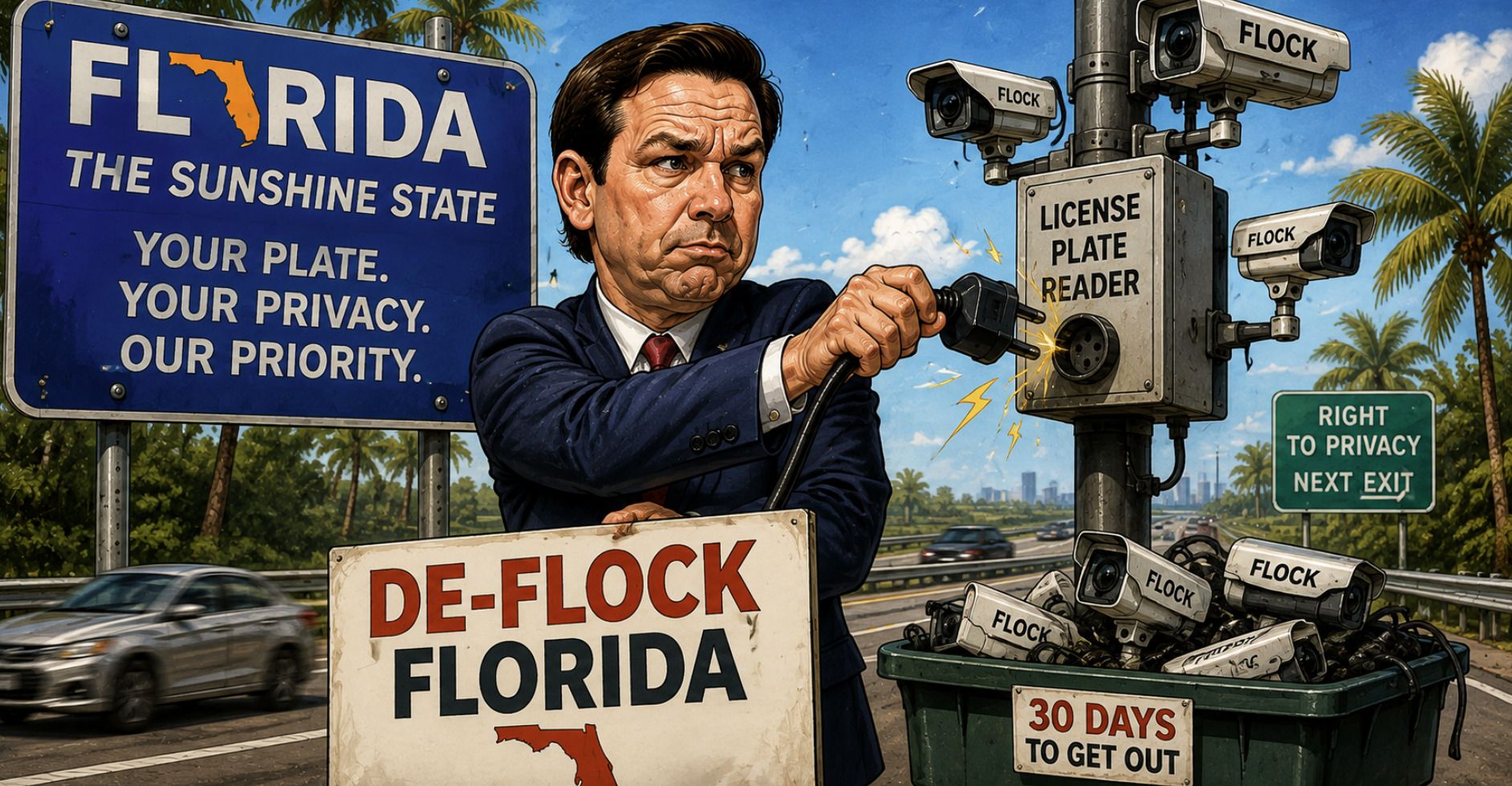
- Florida’s Department of Transportation has revoked existing permits for automated license-plate readers installed within state-highway rights-of-way and ordered local law enforcement agencies to remove the devices within 30 days.
- FDOT cited an “exponential increase” in the cameras along with reports of misuse, privacy concerns and “surveillance schemes,” while Gov. Ron DeSantis says law enforcement should be targeting criminals — not tracking ordinary Floridians.
- The backlash isn’t theoretical: A Florida police officer was arrested this summer after investigators alleged he made 717 searches of his estranged wife’s vehicle using the Flock camera system.
Florida has apparently decided that Big Brother has enough hobbies already.
The Florida Department of Transportation on Monday revoked approvals allowing local law enforcement agencies to install automated license-plate readers within the rights-of-way of roads on the State Highway System.
Agencies have 30 days to get them out.
If they don’t, FDOT says it will.
The department is also shutting the door on new applications to install the cameras in those locations, citing their rapid proliferation and growing concerns over what happens to all that information once your license plate gets sucked into the system.
FDOT Chief Operating Officer Will Watts said in the department’s memorandum that the “recent exponential increase in deployments along our roadways,” combined with reports of misuse, privacy concerns and surveillance schemes, warranted immediate action to protect Floridians’ sovereignty and quality of life.
The state has the authority to do it. Florida law gives FDOT discretion over automated license-plate recognition systems installed within state-highway rights-of-way and specifically allows the department to order their removal.
Gov. Ron DeSantis had already made clear where this was headed.
“No one’s more law and order than me, and I want to give law enforcement tools to target criminals, not to surveil innocent people in the public,” DeSantis said during a Real America’s Voice appearance last week.
“I don’t want to live in a state where we’re surveilled every time we take a breath.”
That’s the argument at the heart of the exploding fight over Flock Safety cameras and similar automated license-plate readers.
The technology can be enormously useful to police. Cameras automatically capture license plates, allowing investigators to search for vehicles connected to crimes, missing people and other investigations.
But they also create something considerably more powerful than the neighborhood cop remembering which car drove past.
They can create a searchable record of where vehicles have been.
And once thousands of cameras start talking to one another, the difference between finding a suspect and constructing a map of an innocent citizen’s movements gets uncomfortable very quickly.
DeSantis put it more colorfully during an Aug. 26 news conference.
“Go after criminals? Great, let’s do all that,” he said. “But surveilling just regular Floridians’ movements and how that data is used? That’s a bird of a different feather.”
One recent Florida case provided a particularly ugly demonstration of what can happen when the technology is abused.
Haines City police officer Christopher Goodson was arrested after authorities alleged he used the Flock system to track his estranged wife’s vehicle. According to his arrest affidavit, Goodson made 717 inquiries involving her car between September 2024 and June 2026. He was charged with offenses involving computer systems and official misconduct.
DeSantis specifically referenced that case while questioning how the technology was being used.
“When I see a police officer using it to track an ex-girlfriend, I’m like, ‘What’s going on with this?’” he said.
And Florida’s order is already having consequences beyond the state highways themselves.
Jacksonville Sheriff T.K. Waters announced Monday that his department would comply with FDOT’s directive — and then went considerably further.
Waters said the Jacksonville Sheriff’s Office will discontinue license-plate-reader technology throughout Duval County effective immediately.
He acknowledged that the cameras had been “an enormously valuable investigative tool” for solving serious crimes and locating missing and vulnerable people, but said community concerns and the state’s decision convinced him that ending their use was appropriate.
That’s an important distinction because Florida has not imposed a blanket statewide ban on every license-plate reader.
FDOT’s order deals with cameras installed in state-highway rights-of-way. Cameras elsewhere, including some on local or private property, aren’t automatically swept away by Monday’s directive.
DeSantis is signaling that the debate may not end there.
He has suggested Florida lawmakers consider broader legislation modeled on New Hampshire’s restrictions, arguing Monday that he doesn’t want private companies assembling detailed records of people’s movements and potentially turning that information into a commodity.
There was a time when being followed everywhere you drove required an actual guy in an unmarked car.
Technology has made things much more efficient.
- DBS WIRE SOURCES
- Florida pulls the plug on license-plate surveillance cameras across state highways
- FDOT pulls the plug on Flock cameras after public outcry, denunciation from Gov. DeSantis
- Florida bans automated license plate readers on state highways, orders removal within 30 days
- FDOT revokes permits for ‘Flock cameras’ installed on state land next to roads
- JSO Discontinues Use of License Plate Readers