BS BULLETIN:
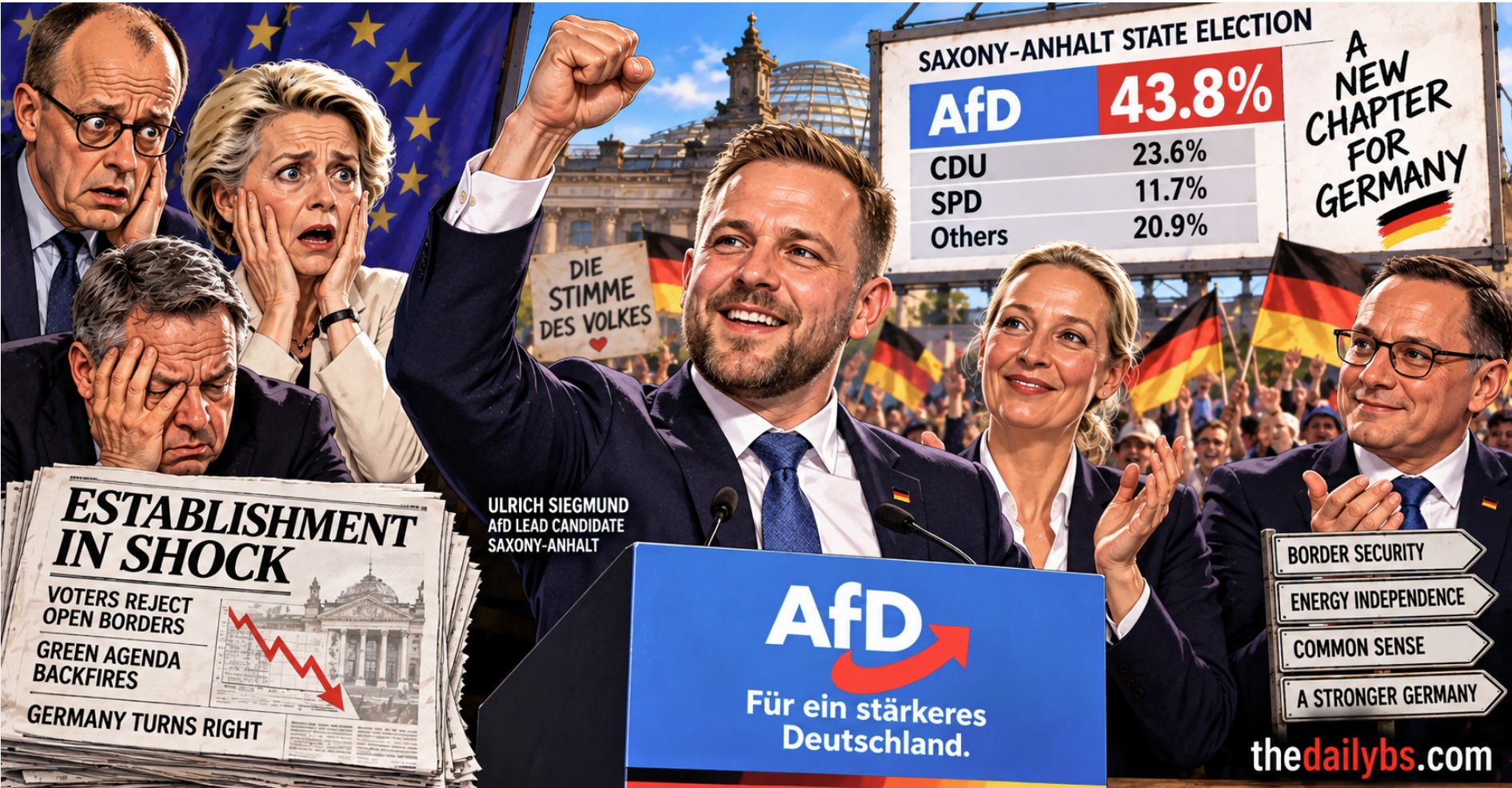
- Alternative for Germany won a stunning 43.8% of Sunday’s vote in Saxony-Anhalt, more than doubling its support from the previous state election.
- Chancellor Friedrich Merz’s center-right CDU finished a distant second at just 17.2%, losing roughly half its previous support.
- AfD fell only three seats short of an outright parliamentary majority, leaving Germany’s other parties scrambling to figure out whether they can keep it out of government.
Germany just got a political earthquake.
Alternative for Germany scored a landslide victory Sunday in the eastern state of Saxony-Anhalt, crushing Chancellor Friedrich Merz’s Christian Democrats and coming tantalizingly close to something once considered almost unimaginable in modern German politics:
Governing a state outright.
Final results gave the AfD 43.8% of the vote.
Merz’s CDU?
Just 17.2%.
The AfD more than doubled the 23.7% it received in the state’s previous election, while the CDU lost roughly half its support.
“We have written history,” AfD gubernatorial candidate Ulrich Siegmund declared.
That’s difficult to dispute.
AfD won 39 seats in the 83-member state parliament — just three shy of the 42 needed for an outright majority.
The result doesn’t guarantee the party will govern.
Germany’s mainstream political parties maintain what is known as the “firewall,” refusing to form coalitions with AfD.
The CDU reiterated Sunday that it has no intention of abandoning that position.
But the numbers have created an extraordinary problem.
AfD is now by far the largest political force in the state, while the remaining seats are fragmented among five other parties.
The Social Democrats won 9.3% of the vote, followed by the Greens with 8.9%, the Left Party at 8.6% and BSW at 5.3%.
That means AfD’s opponents may need an unwieldy multiparty arrangement — potentially requiring cooperation across enormous ideological differences — simply to prevent the election winner from taking power.
Siegmund says voters have delivered a clear mandate. “Things cannot carry on like this,” he told German broadcaster ARD.
He also couldn’t resist twisting the knife into Merz. “A very good campaigner for us in this election campaign was Friedrich Merz,” Siegmund said.
The result is especially damaging for Germany’s chancellor.
Merz came into office promising to reverse AfD’s rise. Instead, the party has continued gaining strength and is now Germany’s largest opposition party nationally.
Sunday’s result demonstrates just how formidable AfD has become in the formerly communist eastern states.
Immigration was once again central to its campaign. Siegmund has promised what he calls a “deportation offensive,” tighter restrictions on migration and an end to incentives he says encourage migrants to exploit Germany’s welfare system.
The party’s state platform also calls for banning rainbow flags from being officially flown at schools, expanding homeschooling and emphasizing German national identity in education.
AfD’s Saxony-Anhalt branch has been classified as right-wing extremist by the state’s domestic intelligence authorities. The party rejects accusations that it is extremist and says such designations are politically motivated.
Its Russia-friendly positions have also generated intense criticism, particularly as the war in Ukraine continues.
But whatever Germany’s political establishment thinks of AfD, nearly 44% of Saxony-Anhalt’s voters just delivered an unmistakable message.
And they turned out in enormous numbers.
Participation reached 77.8%, with AfD apparently attracting substantial support from people who hadn’t voted in the previous election.
The result immediately reverberated outside Germany.
Right-wing political leaders elsewhere in Europe celebrated it, while critics warned about the implications of AfD’s growing power. President Donald Trump posted a screenshot of the election projection on Truth Social without adding commentary.
The biggest question now is whether AfD can translate its historic victory into actual control of the state government. Its opponents still have enough seats collectively to stop that. But doing so may require virtually everyone else to cooperate with virtually everyone else.
AfD didn’t win Germany on Sunday. It didn’t even win an outright majority in Saxony-Anhalt. But it came within three seats. And for Germany’s political establishment, that may be frightening enough.
MY QUICK TAKE
Here’s the number that matters:
43.8%. At some point, endlessly calling voters extreme stops being a strategy for persuading them not to vote for the “extreme” party.
Germany’s establishment built a firewall around AfD.
The voters just walked around it.
DBS WIRE SOURCES:
- Associated Press — AfD wins landslide in Saxony-Anhalt as Merz faces pressure
- Washington Post — Alternative for Germany scores first-place finish in key regional election
- The Guardian — AfD wins key German state election but falls just short of majority
- CBS News — AfD wins big but falls short of outright majority
- Euronews — AfD landslide reshapes Saxony-Anhalt political landscape