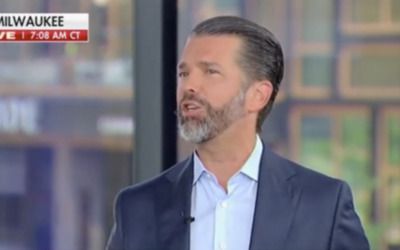
Hey folks—I know not everyone gets a chance to catch Rush Hour live, so I’m going to start including a link to each episode right here in the blast. That way, if you missed the show or just want to hear it again, it’s only a click away – or check out my thoughts below.
VIEW HERE:

Look out for the Rush Hour link Tuesday – Saturday in your Daily BS email blast.
There are days when you have to appreciate the little miracles. Tuesday gave us one: CNN defended Donald Trump.
Okay, “defended” may be too strong. But CNN fact-checker Daniel Dale did something increasingly unusual in political journalism: He listened to what Trump was actually talking about before deciding what Trump meant. And what a difference that made.
It started with comments Trump made while discussing Iran, the war and the economic consequences Americans are enduring — particularly higher oil and gasoline prices. Trump said those costs were a “small price to pay” for keeping America and the world safe. Then came the Trumpian sentence fragment heard round the media world: “Let them take out Los Angeles. Let them take out San Diego.”
Off to the races. The New York Times reported “fury” in California. Gavin Newsom declared Trump “deranged and dangerous.” San Diego Mayor Todd Gloria said his city wasn’t “collateral damage.” Los Angeles Mayor Karen Bass called the remarks dangerous. Apparently the president of the United States had just invited Iran to vaporize two American cities.
There was only one little problem: That’s not what he was saying.
Listen to the entire exchange and Trump was talking about the price Americans were paying as a result of the conflict. His point — delivered in his characteristically unfinished, jump-around-the-sentence Trump style — was that Americans might view that price differently if Iran actually attacked an American city.
You don’t have to like how he said it. You don’t have to think it was eloquent. You don’t even have to think it was smart. But you should probably report what he meant before announcing that the president wants Los Angeles blown off the map.
And then Daniel Dale showed up. On CNN.
Dale examined a social-media post portraying Trump as saying Iran should “take out Los Angeles and San Diego” and concluded that it wasn’t a direct quote and, more importantly, wasn’t a correct paraphrase. Somewhere, a pig just requested clearance from air-traffic control.
CNN’s fact-checker essentially agreed with the interpretation we were giving you on Rush Hour and that The Daily BS was reporting: Trump has repeatedly argued that Americans are temporarily enduring higher costs because preventing Iran from posing a greater threat is worth the price.
That’s the story, and it raises the question I’ve been asking for years. After all this time, does the political press genuinely still not understand how Donald Trump talks? Or do they understand perfectly?
Trump has been speaking this way publicly for decades. He starts sentences, interrupts himself, jumps ahead, circles back and frequently leaves the connecting words sitting somewhere alongside the highway. Everybody knows this.
Yet every few weeks, somebody grabs six words, removes the surrounding thought and announces that Trump has confessed to wanting to destroy democracy, invade Cleveland or possibly sell Nebraska to Vladimir Putin. This time even CNN said: Hold on a minute.
When CNN is telling you that you’re being unfair to Trump, perhaps it’s time to reconsider your Trump interpretation.
Tuesday’s show provided an interesting bridge from media hysteria into one of my favorite words from the left: intersectionality. They love that word, so I borrowed it, because a lot of stories really did intersect Tuesday.
DHS Secretary Markwayne Mullin was discussing illegal immigration with Laura Ingraham and estimated that the number of people living illegally in the United States could be dramatically higher than the figures Americans have traditionally heard. Then Mullin said something that really got my attention.
He mentioned asking ChatGPT how a red state becomes a blue state and said the answer began with changing voting demographics. Now, I don’t base public policy on what somebody says ChatGPT told him, but Mullin’s larger argument was political: He believes Democrats understand that demographic change can eventually produce political change.
That took us straight to Randi Weingarten. The head of the American Federation of Teachers blasted the Trump administration’s deportation policies and described immigrants facing detention and removal as people who “work hard” and “play by the rules.”
That’s where I have a problem. If we’re talking about legal immigrants, absolutely. They played by the rules. Millions of people have waited, applied, filled out forms, endured bureaucracy and followed American immigration law because they wanted to come here legally. But somebody who entered the country illegally did not, by definition, play by the rules. You cannot make the rule disappear because acknowledging it makes the argument inconvenient.
And then our intersectionality tour arrived in Michigan.
Abdulrahman Mohamed El-Sayed was confronted by Martha MacCallum with a brutal statistic: Only about one-quarter of Michigan fourth-graders are proficient readers. His answer? The public schools are “deeply underfunded.”
There it is. The answer is always more money. Only one-quarter of fourth-graders can read proficiently? More money. Schools fail? More money. Scores collapse? More money. At some point, taxpayers ought to be allowed to ask what they’re purchasing.
El-Sayed argued that historic redlining and property-tax-based school funding left some communities without sufficient resources. That’s an argument worth discussing. But money cannot be the only measurement of commitment to education. The objective isn’t to fund a school. The objective is to educate a child.
If three out of four fourth-graders aren’t reading proficiently, something has gone terribly wrong. And before anybody demands another mountain of money, perhaps somebody should explain what happened to the mountain we’ve already spent.
That’s where all these things intersect: immigration, schools, union membership, government spending, political power and demographics. The argument is always presented as though each exists in a separate little box. It doesn’t.
An enormous influx of people affects schools. It affects housing, hospitals, government budgets, wages and politics. You can support generous immigration policies and still acknowledge that. You can oppose illegal immigration without opposing immigrants. And you can demand that American schools actually teach children to read without being accused of attacking public education.
In fact, I’d suggest that insisting children learn to read is a reasonably pro-education position.
Tuesday’s Rush Hour wandered through plenty more — the gigantic Paramount-Skydance/Warner Bros. Discovery media deal, memories of Eddie Van Halen, Ginger Baker and Johnny Nash, and enough political insanity to keep the fastest hour in American media moving at its usual dangerous speed.
But the moment I’ll remember is still CNN. Donald Trump says something, the political world explodes, California politicians race toward the cameras, the headlines practically write themselves — and then a CNN fact-checker wanders into the room and says, guys, that’s not what he meant.
What a time to be alive.
~Bo
Rush Hour airs Monday through Friday and moves quickly through the day’s hottest political stories, breaking developments and media absurdities. It is the fastest hour in American media because there is always more happening than the legacy media has time—or desire—to explain.
And if you want my daily stack of news and commentary delivered directly to you, sign up for The Daily BS here. It is free, arrives daily and, unlike a New York Democratic event, questions are not removed for exceeding ideological capacity.