BS BULLETIN:
- Gov. Gavin Newsom signed a first-in-the-nation California law requiring certain large companies to search historical records for slavery-related transactions and publicly disclose what they find.
- The law applies to companies doing business in California with more than $100 million in annual worldwide receipts whose businesses or predecessors existed by the end of 1964.
- The measure does not order companies to pay reparations, but its legislative findings explicitly call on corporations to recognize historical connections and engage in “redress efforts.”
California businesses already have taxes, regulations and paperwork to worry about.
Now some of the biggest ones can add this to the compliance department’s to-do list:
Check the family tree.
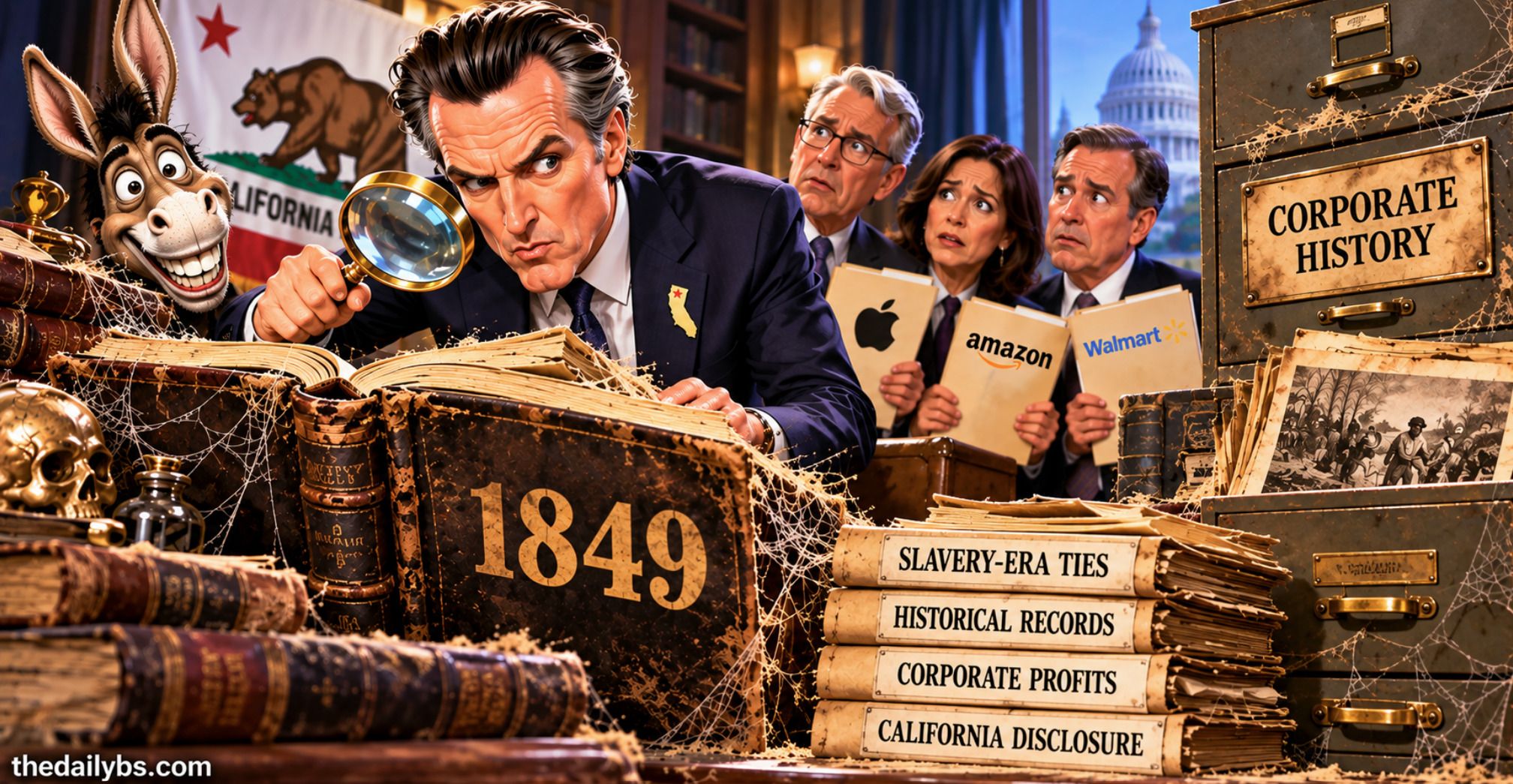
Gov. Gavin Newsom has signed AB 2599, dubbed the Truth in Disclosure Act, requiring certain large companies doing business in California to search records for historical connections to slavery and report what they find under penalty of perjury.
Newsom explained the idea while signing the legislation during an interview with civil rights attorney Bryan Stevenson:
“This is a bill that requires large companies that operated before 1965 to search their records for ties to slavery going back to 1849 and then we make it public. These are insurance policies on enslaved people. Human beings used as collateral, quite literally as collateral for loans. Accountability, as Bryan said, starts with the truth.”
The law covers businesses with more than $100 million in annual worldwide gross receipts that do business in California and either existed themselves or had a predecessor company in existence on or before Dec. 31, 1964.
And this isn’t a request to take a casual peek through the corporate archives.
Covered companies must submit affidavits under penalty of perjury verifying that they searched records in their possession, control and knowledge — including those of related entities — for evidence involving slavery-era transactions.
That includes records showing companies or their predecessors bought or sold enslaved people, used enslaved people as collateral, financed their purchase, insured enslaved people or transactions involving them, or provided services facilitating those transactions.
The resulting information is supposed to become publicly accessible through a searchable digital platform maintained by California’s Civil Rights Department. For businesses operating in California as of Jan. 1, 2028, the first affidavits are generally due Jan. 15, 2029, provided the state has funded and established the system.
Democratic Assemblyman Isaac Bryan, who authored the measure, described his rationale during a legislative hearing:
“For centuries, private corporations across the country benefited from chattel slavery. They benefited from the economic wealth transfer of free labor.”
The actual legislation goes even further in describing its purpose.
Its findings say corporations should “recognize their historical connections to the enslavement era” and “take responsibility for any past actions.” The Legislature also declares that by “actively engaging in redress efforts,” companies can demonstrate a commitment to a more just society.
Important distinction: AB 2599 itself does not establish corporate reparations payments.
It establishes disclosure requirements.
But it unquestionably sits inside California’s larger reparations debate. The state’s Reparations Task Force previously issued more than 100 recommendations addressing the legacy of slavery and racial discrimination, including proposals involving housing, education, health, policing and potential monetary compensation.
Newsom has previously stopped short of embracing direct cash payments. “Dealing with that legacy is about much more than cash payments,” he said in 2023.
There is also precedent for at least some of what California is doing. The state has required insurers to research and disclose slavery-era insurance policies since 2000. Insurance industry groups opposed AB 2599 in part because they argued the new requirements duplicate work insurers have already been required to perform.
Their objection, as summarized in the legislative process, was straightforward: “AB 2599 appears to require reporting that substantially overlaps with the work already completed pursuant to SB 2199 and codified in CA INS 13810.”
Republicans, meanwhile, are attacking Newsom’s priorities.
RNC Press Secretary Natalie Baldassarre told Fox News: “California is already ranked the least affordable state in the nation, yet instead of cutting costs, Gavin Newsom is more worried about his future failed presidential run and placating to his far-left base. He’s focused on literally anything but making California a safer, cleaner, and more affordable place to live.”
Supporters see something very different: a historical record that has never been assembled in one publicly searchable place.
CalMatters reports that advocates believe the database could give researchers, journalists and descendants a new way to examine connections between modern corporate wealth and participation by predecessor companies in the slave economy.
So this law isn’t a reparations check. It’s a giant corporate-history excavation project.
And California wants the results online for everybody to see.
MY QUICK TAKE:
Imagine being the poor compliance officer who walks into work one morning and gets this assignment:
“Bob, we’re going to need you to find out what the company that eventually became the company that eventually became our company was doing in 1852.”
That’s going to be one heck of a Zoom meeting.
There is nothing wrong with uncovering history. Slavery was an abomination, and the historical record showing human beings being bought, sold, insured and literally pledged as collateral deserves to be known.
The policy argument here is about what government should require present-day businesses to do with that history — and how far those obligations should reach through predecessor companies and generations of corporate mergers.
Newsom says, “Make it public.”
California lawmakers explicitly talk about corporate “redress efforts.”
And anyone who has watched California’s reparations debate knows why people will be watching very carefully to see where “disclosure” goes next.
For now, however, the assignment is simple: Grab the corporate genealogy chart. We’re going back to 1849.
DBS WIRE SOURCES:
- Fox News — Newsom signs first-in-nation law forcing major companies to reveal slavery-era ties
- California AB 2599 — Chaptered bill text
- CalMatters — New California law requires companies to disclose slavery profits