TOTAL BS!
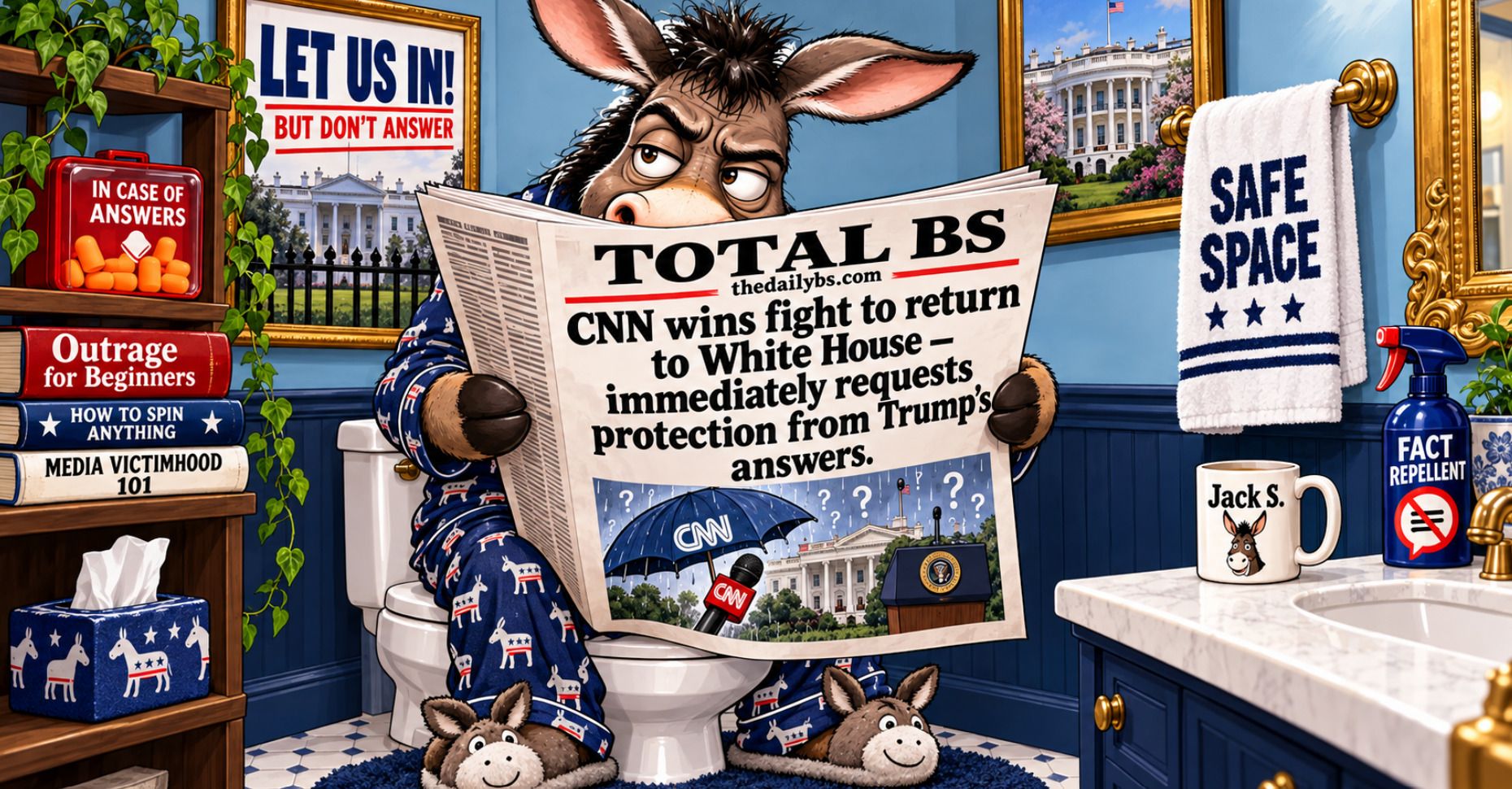
WASHINGTON — CNN won its fight to regain White House access Tuesday, but the network’s legal team is reportedly preparing a second lawsuit after discovering that the ruling allows President Donald Trump to answer reporters’ questions without first obtaining CNN’s approval.
The complication surfaced after U.S. District Judge Timothy Kelly granted a preliminary injunction protecting White House access for CNN, MS NOW and Politico while their legal challenge proceeds.
The ruling was celebrated as a major victory for press freedom until network attorneys discovered that the First Amendment also applies to the president.
“We fought for the right to question the president,” explained CNN legal adviser Richard P. Selective. “We never imagined he’d be permitted to question us back.”
CNN has reportedly retained the Washington law firm of Dewey, Dodge & Deflect, which specializes in First Amendment litigation, selective outrage and obtaining restraining orders against inconvenient facts.
Managing partner Arthur N. Denial said the firm is seeking an injunction requiring Trump to submit all answers 24 hours before reporters ask their questions.
“Journalists have a constitutional right to hold the powerful accountable,” Denial said. “There is simply no precedent for the powerful demanding the same thing from journalists.”
The proposed filing seeks protection from presidential responses containing the phrases “fake news,” “your ratings” and “that’s not what happened.”
CNN executives are particularly concerned about Trump’s habit of answering questions by referring to something the network previously reported.
“That creates an extremely hostile work environment,” said media psychologist Dr. Claire N. Presentdanger, director of the Center for Broadcast Emotional Resilience.
“Imagine spending an entire morning preparing to accuse someone of dishonesty, only to have that person bring up your own reporting. The psychological consequences can be devastating.”
Presentdanger recommends issuing CNN correspondents noise-canceling headphones and emergency cue cards reading THAT’S NOT THE POINT.
The network has also reportedly hired Context Optional Strategies to develop a presidential-answer screening system.
Under the proposal, Trump’s responses would pass through a seven-second delay, allowing CNN producers to decide whether to broadcast them, fact-check them or replace them with a discussion about threats to democracy.
“Anything that takes longer than seven seconds to verify can simply be labeled misinformation until further notice,” explained company president Neil B. Fair.
The proposal has received enthusiastic support from Rep. Warren T. Narrative, a Democrat who chairs the Congressional Working Group on Questions That Shouldn’t Have Answers.
“Americans deserve a free press,” Narrative said. “But freedom without editorial supervision is just people saying things.”
Not everyone agrees.
Constitutional scholar Professor Frank L. Speaking noted that the First Amendment protects journalists from government censorship, not criticism.
“The Constitution protects the press,” Speaking explained. “It does not protect CNN from finding out what the president thinks of CNN.”
Network attorneys dismissed that interpretation as dangerously literal.
Meanwhile, several CNN correspondents are reportedly demanding hazard pay for assignments requiring them to stand within hearing distance of Trump.
“We spent weeks fighting to get back into the White House,” one producer complained. “Now we’ve got to figure out how to cover the president without giving him a platform.”
CNN’s legal team is considering a compromise under which reporters could attend White House briefings, ask questions and immediately leave before the answers began.
The network called the proposal a historic step toward restoring responsible journalism. The White House declined to comment. CNN was still deciding what it wanted Trump to say.
TOTAL BS is SATIRE. The news is real. The BS is intentional.
READ the real story here: Trump-appointed judge blocks White House media ban — but says Trump’s complaints about the press may have merit