THE DAILY BS: HOW MUCH CAN YOU HANDLE?
SPARE ME THE BS (I’ve got things to do).
- A ProPublica investigation reveals that FBI agents examined allegations involving Lindsey Graham, Democrat James Clyburn and Republican Joe Wilson in a suspected defense-contract bribery scheme.
- Former defense contractor CEO Martin Kao told investigators that politicians sought $100,000 campaign commitments in return for supporting federal contracts. Company emails and campaign records corroborated portions of his account.
- The investigation stalled after the Trump administration dismantled federal public-corruption teams and removed investigators working on the case. The lawmakers were never charged or formally designated subjects of the probe.
LAY IT ON ME (I’ve got time).
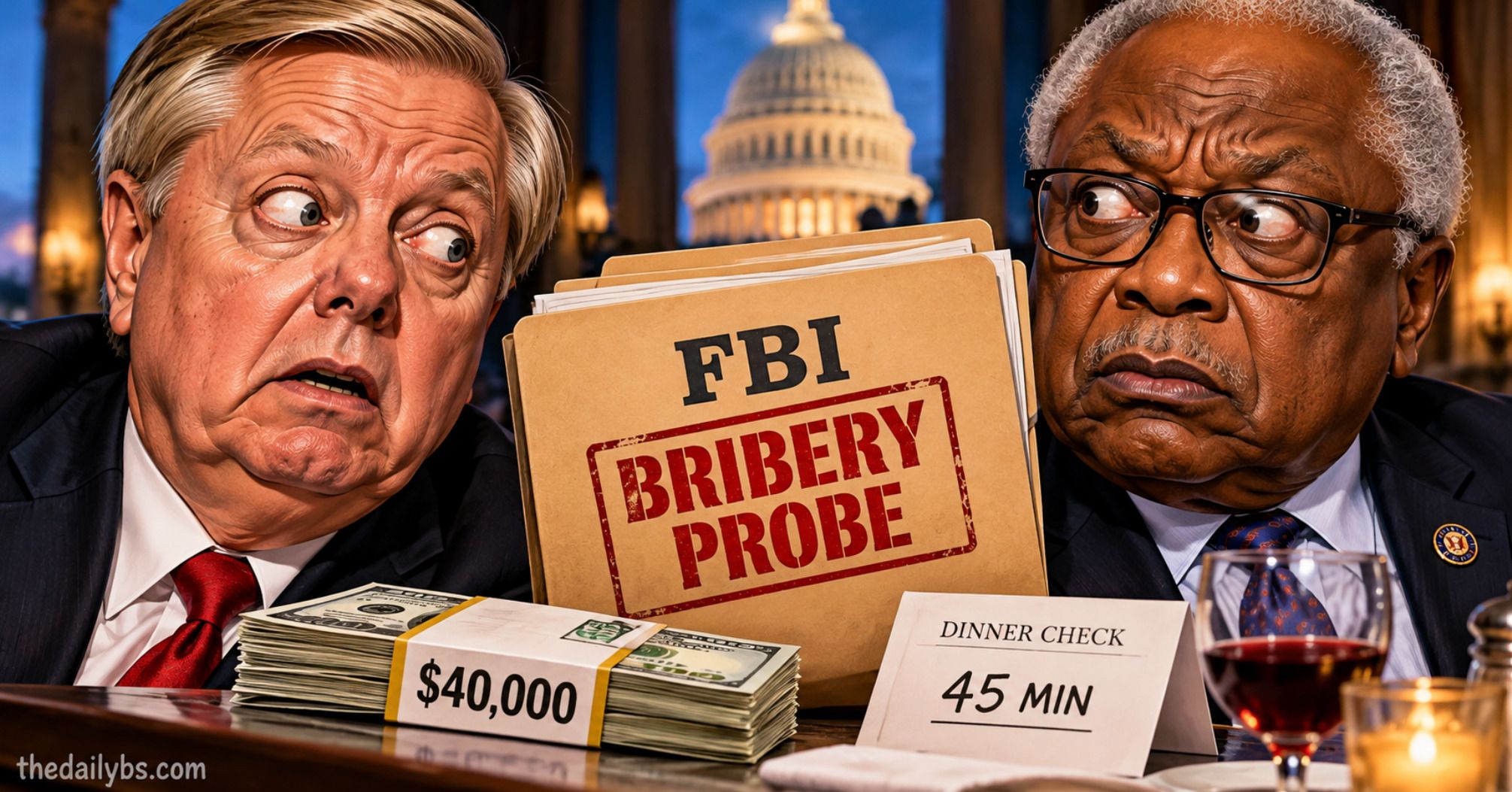
Forty thousand dollars for 45 minutes.
That’s not the price of a private jet, an exotic vacation or even a particularly enthusiastic Washington lobbyist.
According to a newly uncovered FBI investigation, it was the campaign fundraising commitment needed to arrange a private steakhouse dinner with the late Republican Sen. Lindsey Graham.
And the businessman who wanted the meeting wasn’t particularly interested in the steak.
He wanted millions in government contracts.
A sweeping investigation published Tuesday by ProPublica reveals how Martin Kao, the former CEO of Hawaiian defense contractor Navatek, cultivated some of South Carolina’s most powerful politicians while pursuing federal research funding.
The cast included Graham, Democratic Rep. James Clyburn and Republican Rep. Joe Wilson.
For those keeping score, that’s a Republican, a Democrat and another Republican. Apparently, the pursuit of federal dollars can occasionally produce the bipartisan cooperation Washington keeps promising us.
The centerpiece was a March 3, 2020, meeting at Charlie Palmer Steak in Washington, D.C.
According to company emails reviewed by ProPublica, Graham’s political operation required a commitment of $40,000 in campaign contributions to secure a brief private dinner with the senator.
Kao, eager to discuss federal contracts, reportedly saw no reason to waste time pretending the gathering was a social occasion.
In an email before the dinner, he explained that all Graham needed to do was agree to support the company’s request.
The evening was short. The ambitions were considerably larger.
Kao later told FBI investigators that Graham agreed to help steer approximately $10 million in federal funding toward Navatek’s South Carolina operations and requested a total commitment of $100,000 in campaign donations.
That’s Kao’s account, and Graham’s representatives emphatically deny any improper exchange.
But investigators weren’t relying solely on the recollections of a disgraced businessman.
ProPublica reviewed internal company correspondence, financial records, congressional spending documents and materials used by the FBI to evaluate Kao’s allegations.
The resulting paper trail showed Navatek cultivating powerful congressional offices while pursuing research contracts in their states.
The company’s business strategy was remarkably straightforward.
Establish a relationship with a university. Develop a proposal for military research. Hire lobbyists with access to influential lawmakers. Seek federal appropriations. Repeat in another state.
For an outfit supposedly devoted to cutting-edge naval technology, its most important equipment may have been a spreadsheet and a reliable supply of campaign contribution checks.
The arrangement eventually expanded into South Carolina, where Navatek partnered with the University of South Carolina on research involving power systems for Navy ships.
Congress approved $9.5 million for the project in December 2019.
Internal communications reviewed by ProPublica showed Graham’s office helping ensure that the Navy directed the funding toward the Navatek partnership.
Graham’s representatives say the research was supported by the Navy, benefited South Carolina and had nothing to do with campaign contributions.
They also maintain that fundraising requirements for private political dinners were ordinary campaign practice.
Then there’s James Clyburn.
According to Kao’s statements to the FBI, the influential South Carolina Democrat asked how much money Kao was providing Graham and allegedly requested a comparable amount for himself.
Investigators identified $20,000 in contributions made by Kao and relatives to Clyburn shortly after a scheduled meeting.
Company correspondence also documented arrangements for a $10,000 donation to South Carolina State University, Clyburn’s alma mater.
That combination attracted investigators’ attention, although donations and support for university research do not establish bribery.
Clyburn’s office confirmed that a meeting occurred but rejected the suggestion that campaign contributions influenced his official conduct.
His spokeswoman said the congressman had consistently supported universities in his district and dismissed Kao’s accusations as coming from a convicted fraudster.
Republican Rep. Joe Wilson also appeared in the investigation.
Kao claimed that Wilson sought campaign contributions in exchange for supporting Navatek’s spending requests. Investigators identified several thousand dollars in donations associated with Kao and a lobbyist.
Wilson’s office maintained that he complied with federal campaign finance requirements, while a lobbyist involved in the company’s activities denied any improper arrangement.
So far, Washington had produced an impressive collection of fundraising dinners, government appropriations and mutually incompatible explanations.
Then the FBI started asking questions.
Investigators had already obtained substantial company records when Kao, facing federal prison time for fraud and illegal campaign donations, began describing what he claimed was a much larger scheme.
He told agents that exchanging political contributions for government support had become central to his contracting strategy.
His credibility was an obvious problem. Kao had been convicted of serious financial crimes and hoped cooperation might improve his legal situation.
But agents determined that significant portions of his account matched records they had collected.
By December 2024, FBI investigator Michelle Ball was documenting the potential for a broader public-corruption investigation.
Two former Navatek executives and their new company, Integer Technologies, became formal subjects of the inquiry.
Graham, Clyburn and Wilson were not formally designated subjects, but investigators were examining their dealings with Kao and considering whether the evidence justified expanding the case.
Then Washington changed administrations.
Following Trump’s return to the White House, the Justice Department’s public-corruption operation underwent major changes.
The Public Integrity Section lost authority to initiate new cases without additional approval. Experienced personnel departed, and FBI Director Kash Patel oversaw removals from the Washington field office’s anti-corruption teams.
Ball was fired in October 2025. Another agent involved in the investigation, Kevin Gounaud, was pushed out in early 2026.
The career prosecutor assisting them also left.
According to ProPublica, the investigation effectively ground to a halt.
There is a fairly obvious question here: If federal agents were following a potentially significant trail of campaign contributions and government contracts, why didn’t somebody finish the investigation?
The FBI disputes ProPublica’s characterization of the allegations.
Agency spokesman Ben Williamson described Kao’s claims as “half baked” and “misleading.”
The Justice Department defended the personnel changes as part of an effort to eliminate political weaponization and misconduct within federal law enforcement.
ProPublica’s reporting does not establish that Trump personally ordered the Navatek investigation terminated to protect any particular lawmaker.
What it documents is that the investigative team was broken up, the inquiry stalled and the allegations were left unresolved.
Meanwhile, the story has another remarkable twist.
Graham died earlier this year, and his sister, Darline Graham, was appointed to fill his Senate seat. She retained much of his senior staff.
The company that eventually benefited from portions of Navatek’s original research arrangements, Integer Technologies, has continued expanding its federal contracting business.
Its executives were never charged in connection with the bribery investigation.
And Kao, the man whose allegations triggered the broader inquiry, remains in prison after receiving an 87-month sentence.
His former associates have moved on. The politicians and their representatives deny wrongdoing. The federal contracts became part of the government’s spending record.
But the unresolved questions remain.
Were campaign contributions merely the ordinary price of gaining political access, or did they become payments for specific government favors?
DBS WIRE SOURCES (I’ve got all day).
- ProPublica — Investigation into Graham, Clyburn, Navatek and the stalled FBI bribery inquiry
- ProPublica — Earlier investigation into Susan Collins and the Navatek financial allegations
- Reuters — How the Trump administration changed federal public-corruption enforcement
- Salon — October 20 coverage of the Navatek bribery investigation