THE DAILY BS: HOW MUCH CAN YOU HANDLE?
SPARE ME THE BS (I’ve got things to do).
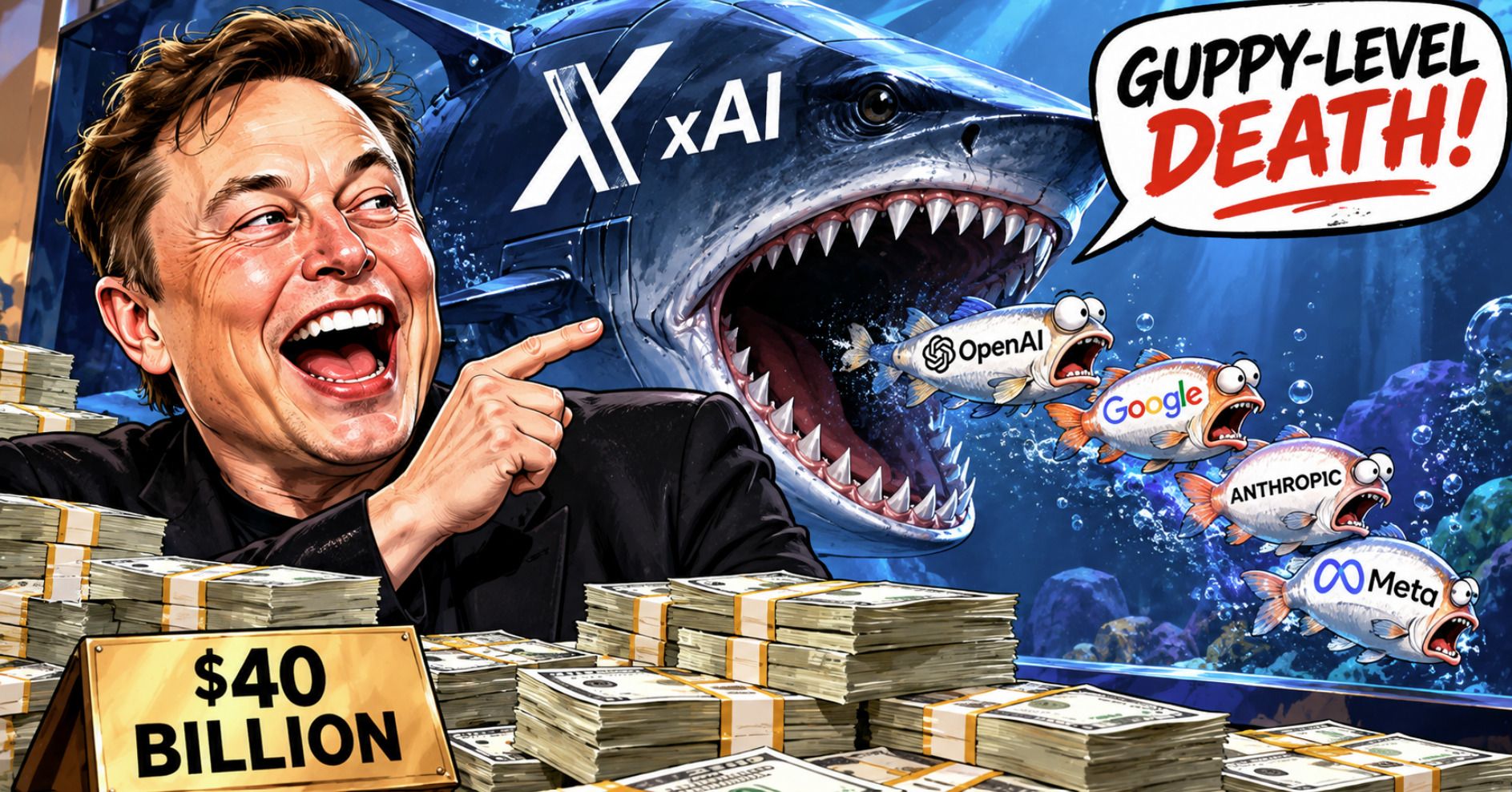
- Elon Musk announced Sunday that SpaceX secured $40 billion in debt financing to purchase powerful AI chips expected to arrive in early 2027.
- Musk warned that more than 200 specialized AI cloud companies face what he called “guppy-level death and consolidation” as lenders pull back.
- SpaceX’s Starlink and rocket-launch revenues helped it secure financing, while Musk is also exploring a possible merger with Tesla.
LAY IT ON ME (I’ve got time).
Elon Musk just borrowed $40 billion to supercharge his artificial intelligence empire. Then he delivered a rather cheerful prediction about the competition: A whole lot of them are going to die.
Not literally, of course. But financially? Musk is expecting carnage.
On Sunday, the billionaire announced that SpaceX had closed a staggering $40 billion debt financing deal to purchase graphics processing units, the high-powered computer chips that fuel the artificial intelligence revolution.
And while celebrating that enormous financial commitment, Musk suggested that many other AI companies won’t be nearly so fortunate when they come knocking on bankers’ doors.
“As of the past few weeks, debt markets have almost entirely shut off access to money for any company that doesn’t have substantial revenue independent of AI data centers,” Musk wrote on X.
Then came the line that should make more than a few Silicon Valley executives consider reaching for the antacids.
“That means the 200+ neoclouds are going to see guppy-level death and consolidation,” Musk declared. “Some will make it through, but not many.”
Guppy-level death. Now there’s a phrase you don’t usually encounter in the quarterly earnings reports.
To understand what Musk is talking about, consider the enormous industry that has sprung up around artificial intelligence.
Companies are racing to build enormous data centers packed with advanced Nvidia chips. Those facilities provide the computing power needed to train AI systems and respond to millions of user requests.
Some companies build the AI models. Others rent out the computing horsepower. The latter group includes specialized providers known as “neoclouds.”
And according to Musk, those businesses have a rather uncomfortable problem.
Many require enormous amounts of borrowed money to build their infrastructure, but their revenue depends heavily on demand from the very AI industry they’re helping to develop.
When lenders become nervous about the potential returns, the money can dry up rather quickly.
That’s where Musk believes SpaceX has a major advantage.
“SpaceX closed $40B of debt for GPUs, but we’re investment grade and have Starlink & launch revenue,” he explained.
In other words, Musk has something the new kids on the AI block may lack: Existing businesses bringing in serious money.
SpaceX earns revenue launching rockets and operating Starlink, its satellite internet service. Those operations give creditors other sources of income to consider when deciding whether to extend financing.
The numbers are enormous. SpaceX’s third-quarter revenue reportedly surged 161% compared with the previous year, reaching $14.58 billion.
And according to Reuters, SpaceX Chief Financial Officer Bret Johnsen said the company expects to spend between $35 billion and $40 billion on capital expenditures in the fourth quarter alone. For perspective, that’s enough money to make even Washington’s most enthusiastic spending committee sit up and take notes.
The $40 billion financing will primarily support chip purchases scheduled for delivery during the first two quarters of 2027, Musk explained. “This is primarily callable debt for GPU purchases that will arrive in Q1 and Q2,” he wrote. “Not a major factor this quarter.”
Earlier this month, Reuters reported that SpaceX was negotiating with banks and asset managers over a financing package to purchase Nvidia chips. Now Musk says the financing has closed, although Fox Business reported that the final pricing terms agreed to by investors were not immediately clear. And the scale of the AI spending spree has Wall Street watching closely.
Technology analyst Dan Ives described the competition for computing power as a “Game of Thrones battle” and suggested that another 800 to 1,000 data centers could be constructed across the United States in the coming years.
That’s an awful lot of concrete, electricity, computer chips and borrowed money riding on the promise that AI demand will keep growing.
But Musk isn’t merely betting on the future of AI infrastructure. He’s also contemplating another enormous corporate combination.
Last week, Musk suggested that merging Tesla and SpaceX could be “a good idea.”
Both companies have reportedly established special committees of independent directors to examine a potential deal, although Musk emphasized that a merger is far from certain.
It’s an intriguing possibility: A business empire spanning electric vehicles, robotics, rockets, satellite internet and artificial intelligence, potentially brought closer together under one corporate roof.
Meanwhile, companies that depend almost entirely on renting AI computing capacity may find themselves competing against an increasingly formidable Musk operation — just as financing becomes harder to obtain.
There are, of course, competing views about the industry’s prospects. Nvidia CEO Jensen Huang has continued to emphasize strong demand for AI infrastructure, and the eventual size of any industry shakeout remains uncertain.
But Musk’s warning is unmistakable.
The first stage of the AI gold rush was about building as quickly as possible and grabbing as much computing power as investors would finance.
The next stage may be about determining who can actually afford to keep the lights on. And Musk, having just lined up another $40 billion, appears determined to make sure his lights stay very, very bright.
DBS WIRE SOURCES (I’ve got all day).
- Fox Business — SpaceX secures $40 billion for AI chips as Musk warns of cloud industry consolidation
- Reuters — Musk says SpaceX raised $40 billion in debt to purchase GPUs
- CoinDesk — Musk warns of a shakeout among AI cloud infrastructure companies
- Business Insider — Musk predicts neocloud failures and addresses possible acquisitions
- Benzinga — Dan Ives predicts a ‘Game of Thrones battle’ for AI computing power