THE DAILY BS: HOW MUCH CAN YOU HANDLE?
SPARE ME THE BS (I’ve got things to do).
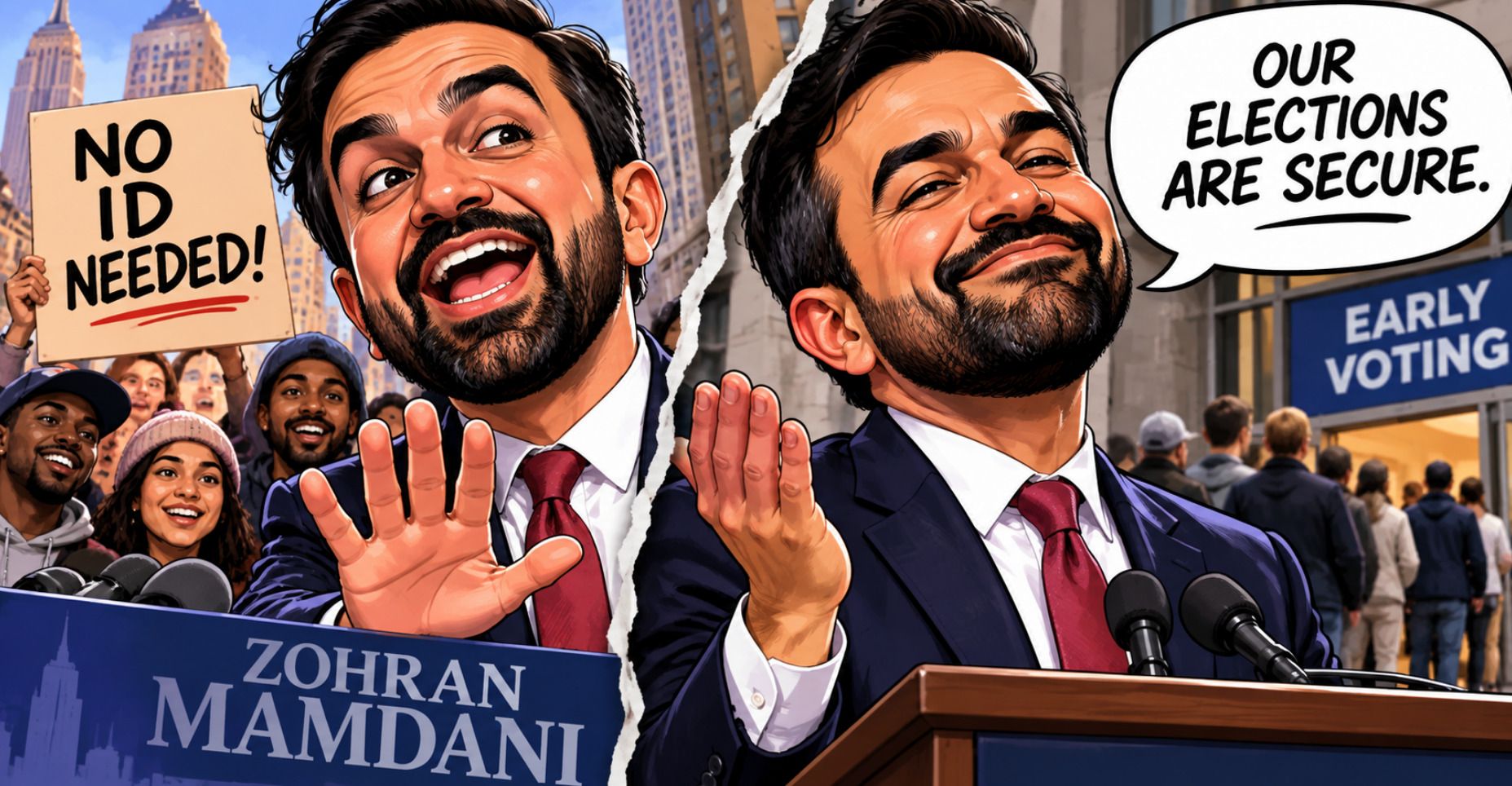
- New York City Mayor Zohran Mamdani appeared in a voting advertisement reminding residents that most registered voters do not need to bring identification to the polls.
- His assurance that “our elections are secure” prompted criticism from Rep. Nancy Mace and X users questioning how polling places verify voters’ identities.
- New York does require voter registration and identification checks in certain first-time voter circumstances, although most returning voters are not required to show ID when casting ballots.
LAY IT ON ME (I’ve got time).
New York City Mayor Zohran Mamdani has a reassuring message for voters heading into the midterm elections.
You generally don’t need to bring identification to vote.
And don’t worry, he says. The elections are secure.
Well, that certainly settles everything.
In a new voting advertisement circulating on X Monday, Mamdani reminds New Yorkers that they don’t need to bring ID to the polls, then assures viewers that the election system is secure.
That combination caught the attention of conservative commentators, who questioned how the mayor could confidently promise election security while emphasizing a system that generally does not require voters to present identification at the polling place.
The End Wokeness account highlighted the juxtaposition in a video posted Monday.
“Mamdani: ‘You do not need to bring [ID] to vote,'” the account wrote, before pointing to the mayor’s subsequent assurance that elections are secure.
And Rep. Nancy Mace had a question.
“How could your elections be secure if you have no idea who’s filling out the ballot?” the South Carolina Republican asked.
It’s a question that goes directly to the debate over voter identification.
And it certainly produced some entertaining responses.
One X commenter suggested New York’s election-security system amounted to the magic of “trust me, bruh.”
Another asked how anyone could have confidence in an election without accurately identifying the person casting a ballot.
Others wondered why Americans regularly have to show identification for ordinary transactions while voting often operates under different rules.
The jokes were flying, but there’s a factual distinction worth examining.
Mamdani was describing a real feature of New York election law.
According to the New York City Board of Elections, registered voters generally do not have to present identification when they arrive to vote.
There are exceptions involving certain first-time voters who did not provide acceptable identification information when they registered.
And that brings us to something missing from much of the online argument.
New York does not simply allow anyone to walk into a polling place, announce a name and automatically receive an ordinary ballot without going through any process.
Voters must register. At the polling place, workers locate their names in the voter rolls and require them to sign the poll book.
Registration procedures also use identifying information, including a driver’s license number or the last four digits of a Social Security number when available.
First-time voters whose identities have not been verified may need to provide additional documentation. Those who cannot do so may cast an affidavit ballot, which is reviewed before it can be counted.
So the mayor’s statement about not bringing ID is broadly correct for established voters.
But it doesn’t answer the question critics are raising about the strength of verification at the moment someone requests a ballot.
And that is a legitimate policy debate.
Supporters of photo-ID requirements argue that presenting identification provides another safeguard against impersonation and increases public confidence in elections.
Opponents argue that New York’s existing registration, signature and ballot-review procedures provide meaningful protections and that additional ID requirements can create obstacles for eligible voters.
Those positions can be debated without pretending the entire election system is either completely unprotected or absolutely incapable of error.
Meanwhile, the Twitchy reaction thread turned Mamdani’s advertisement into a broader discussion of the kinds of identification Americans are expected to produce in daily life.
Some commenters contrasted voting with boarding airplanes, banking and other activities where identity checks are common.
Another drew attention to identification requirements for volunteers in certain New York City programs.
Those comparisons aren’t all legally equivalent, but they help explain why the issue resonates with voters who believe casting a ballot deserves especially careful verification.
The controversy arrives just ahead of the November 3 midterm elections, with national arguments over citizenship verification, voter-roll maintenance and election integrity already intensifying.
Mamdani’s advertisement was intended to make voting requirements clear to New Yorkers.
Instead, its confident assurance about security has reopened a familiar argument about what those safeguards should include.
And that is the question officials ought to be prepared to answer in detail: What specific procedures prevent someone from successfully impersonating a registered voter at the polls?
Because telling people an election is secure is a reassurance.
Explaining how that security actually works is what allows voters to evaluate the claim.
DBS WIRE SOURCES (I’ve got all day).
- Twitchy — Mamdani voting advertisement and X reactions, including Nancy Mace
- New York City Board of Elections — Official voter identification requirements
- NYC311 — November 2026 election check-in and identification procedures
- New York Attorney General — Official voter rights and ID guidance
- NYC Votes — Voting eligibility and poll-site procedures